





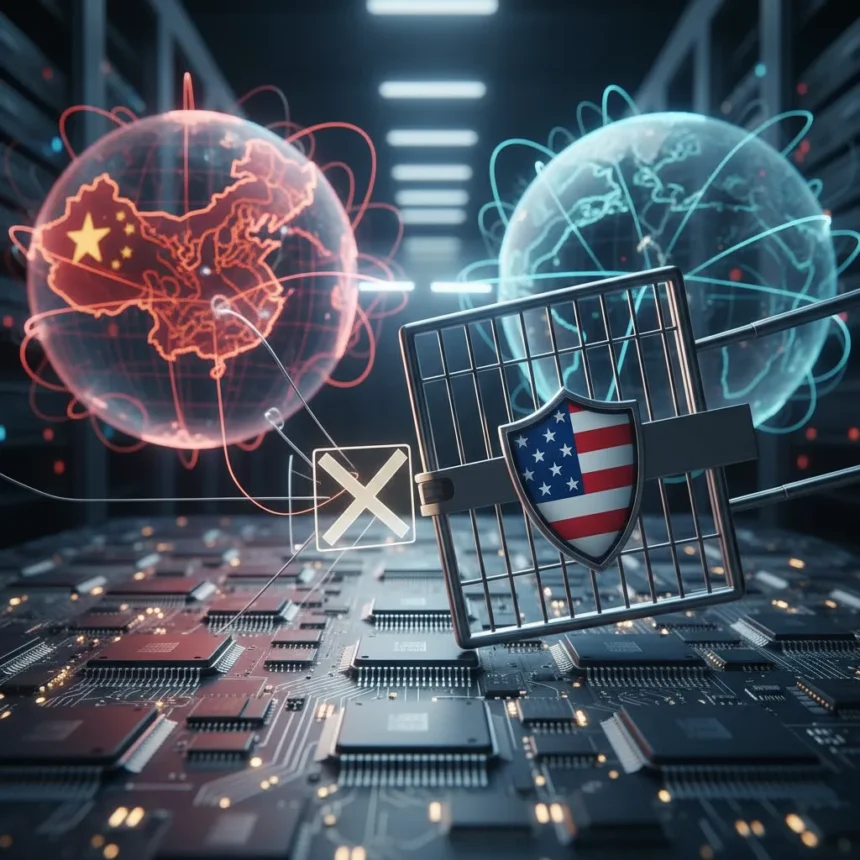
The AI chip export loophole that allowed Chinese-owned subsidiaries located outside China to purchase advanced processors without U.S. export licenses has finally been shut down. The Commerce Department’s Bureau of Industry and Security (BIS) issued new guidance clarifying that export-license requirements now apply to Chinese-headquartered entities regardless of their physical location, closing a regulatory gap that reportedly persisted for roughly a year.
Key Takeaways
- The U.S. closed an AI chip export loophole by shifting compliance focus from delivery destination to buyer ownership
- Hundreds of thousands of advanced AI chips may have been acquired through the gap, according to supply-chain sources
- Chinese subsidiaries in Malaysia, Singapore, and other countries exploited the loophole to buy Nvidia Blackwell and AMD MI350x processors
- The BIS issued the clarification on May 31, after the AI Diffusion rule announced in May 2025 went largely unenforced
- Former State Department official Chris McGuire called the loophole “a huge problem” and warned additional gaps may remain
How the AI Chip Export Loophole Worked
For approximately one year, Chinese companies operating subsidiaries in countries like Malaysia and Singapore found a regulatory blind spot. The U.S. had announced restrictions on advanced AI chip exports in May 2025, but enforcement focused on where chips were being shipped rather than who actually owned the buying entity. This geographic interpretation created an opening: a subsidiary of a Chinese firm, even if headquartered in Beijing, could legally purchase restricted chips if the subsidiary itself was incorporated and operated outside mainland China.
The affected chips included Nvidia’s Blackwell processors and AMD’s MI350x, both critical for large-scale AI training and deployment. Reuters reporting, as cited by supply-chain sources, suggests that the number of advanced chips acquired through this loophole may be in the hundreds of thousands. That scale underscores why the BIS moved to close the gap. “BIS issued guidance clarifying export license requirements that have been in place since 2023,” a BIS spokesperson said, adding that “BIS will continue to enforce export controls rigorously to safeguard critical American technology”.
What Changed: Ownership Now Matters More Than Location
The new guidance fundamentally shifts the compliance framework. Rather than asking “where is the chip being delivered,” regulators now ask “who owns the company buying the chip?” If a Chinese-headquartered entity controls the buyer—even through a subsidiary in Singapore or Malaysia—the transaction now requires an export license. This ownership-based standard is far harder to circumvent than a geography-based one, because shell companies and subsidiary structures are no longer sufficient cover.


Chris McGuire, a former State Department official, confirmed the impact. “Blackwell shipments to China-headquartered companies outside of China are now illegal again,” he told reporting outlets. However, McGuire also sounded a cautionary note: “we have to see how many shipments have already gone to assess how much damage was done,” and he suggested that additional loopholes may exist elsewhere in the regulatory framework. His concern reflects a broader tension in export control enforcement—closing one gap often reveals another.
The Scale of the Problem and What Comes Next
The hundreds of thousands of chips that may have flowed through the loophole represent a significant breach of U.S. strategic technology policy. Advanced AI processors are essential for training large language models and other compute-intensive AI systems, and restricting their flow to China has been a cornerstone of U.S. tech competition strategy. The fact that a regulatory interpretation gap allowed such large-scale circumvention for a full year raises uncomfortable questions about oversight and enforcement.



Going forward, the BIS guidance clarifies the standard, but McGuire’s warning suggests the cat-and-mouse game between regulators and those seeking to circumvent controls continues. Companies and their legal teams will now scrutinize ownership structures more carefully, and the Commerce Department will need to monitor for new workarounds—perhaps involving third-party intermediaries or more complex corporate structures.
Why This Matters for Tech Competition
The AI chip export loophole was never just a regulatory technicality. It directly affected the balance of AI capability between the U.S. and China. Every Blackwell or MI350x processor that left the country through a subsidiary in Southeast Asia was a chip that could train models, power inference servers, or accelerate AI research in China. Multiply that by hundreds of thousands of units, and the strategic impact becomes clear. The closure of this loophole is a partial reassertion of U.S. control over a critical technology, but only partial—the damage from the year-long gap has already been done, and McGuire’s concern about remaining loopholes suggests this will not be the last time regulators play catch-up.
Did the loophole affect only Chinese subsidiaries in specific countries?
The reporting specifically mentions Malaysian and Singapore subsidiaries as targets of the loophole, though the guidance applies to any Chinese-headquartered entity located outside China. The loophole was not limited to those two countries, but they were highlighted as key transit points for the exports.
How long did the AI chip export loophole remain open?
The loophole existed for approximately one year after the U.S. announced the AI Diffusion rule in May 2025 but failed to enforce it against Chinese-owned overseas subsidiaries. The new BIS guidance, issued on May 31, formally closed the gap.



Could other loopholes still exist in AI chip export controls?
Chris McGuire warned that while the ownership-based standard closes this particular loophole, additional gaps may remain in the regulatory framework. Regulators and companies will likely continue to probe the boundaries of what is and is not permitted under the clarified rules.
The closure of the AI chip export loophole marks a significant regulatory correction, but it also exposes a deeper challenge: export controls are only as effective as their enforcement. The fact that a major gap persisted for a year, allowing hundreds of thousands of advanced chips to flow to Chinese-owned entities, suggests that oversight mechanisms need strengthening. Whether the new ownership-based standard holds up depends on how rigorously the BIS enforces it and how quickly new workarounds emerge.
Edited by the All Things Geek team.
Source: Tom's Hardware