


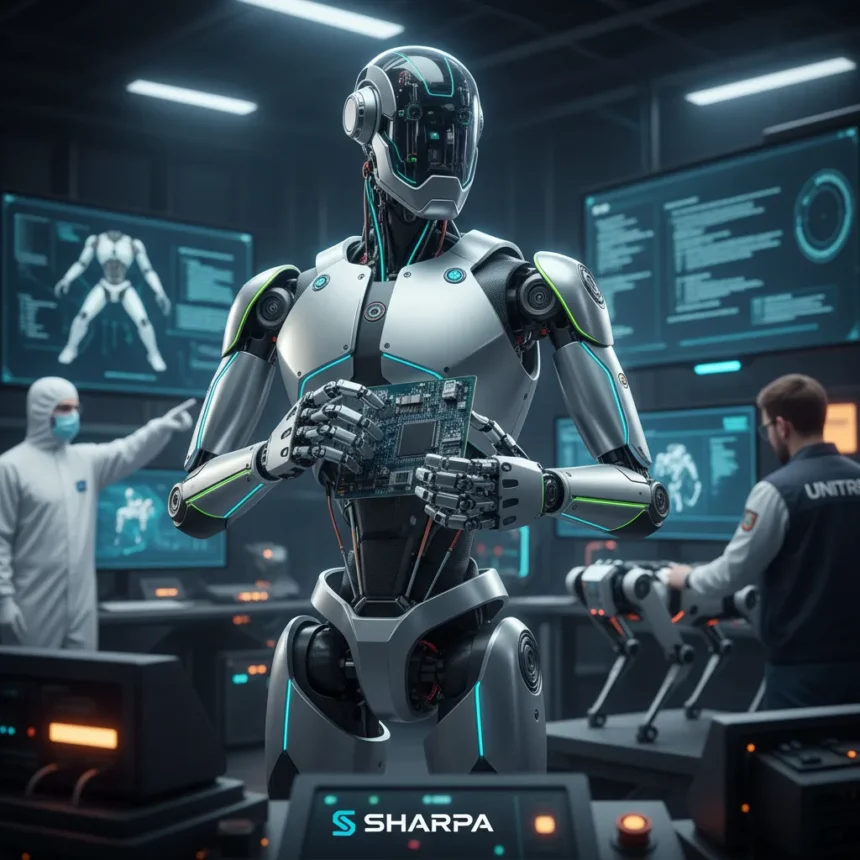
The humanoid robot reference design announced by Nvidia, Unitree Robotics, and Sharpa represents a strategic shift toward accelerating real-world robot deployment. Rather than building a single finished product, the three companies are releasing a blueprint that other robotics firms can adopt, customize, and deploy at scale. CEO Jensen Huang framed the collaboration as a “meaningful step” toward robots capable of performing actual work in practical environments, not just laboratory demonstrations.
Key Takeaways
- The H2+ reference design combines Unitree’s human-sized H2 robot body with Sharpa’s five-fingered Wave hands
- Nvidia’s Isaac GR00T foundational models provide the robot’s advanced reasoning capabilities
- The design streamlines data collection, policy training, and real-world deployment workflows
- Reference designs allow competing manufacturers to accelerate development by adopting a proven blueprint
- Nvidia is positioning itself as an essential software and hardware supplier in the robotics ecosystem
What Makes This Humanoid Robot Reference Design Different
The H2+ humanoid robot reference design is not a finished consumer product or a one-off prototype. It is a complete architectural blueprint that other companies can license, modify, and manufacture. In robotics, reference designs serve as accelerators—they eliminate the need for each startup to reinvent the underlying hardware, allowing teams to focus on specialized applications and software improvements.
The system combines three critical components: Unitree’s H2 humanoid body provides the physical platform with human-scale dimensions, Sharpa’s Wave five-fingered hands deliver the dexterity needed for complex manipulation tasks, and Nvidia’s Isaac GR00T foundational models act as the robot’s reasoning engine. This modular approach means manufacturers can adopt the entire stack or swap components based on their specific use case requirements.
Unlike earlier robotics initiatives that focused on research-only prototypes, this collaboration explicitly targets “real work” in “real settings”—a critical distinction that signals a move away from controlled lab environments toward actual deployment in factories, warehouses, and service industries.



How Nvidia’s Isaac GR00T Powers the Humanoid Robot Reference Design
Isaac GR00T is Nvidia’s foundational model for robotics—essentially an AI system trained to understand and execute complex physical tasks. The model acts as the decision-making layer, enabling the robot to interpret instructions, plan movements, and adapt to unexpected obstacles. Without this reasoning capability, even a perfectly designed robotic body would struggle with real-world variability.
The reference design streamlines three critical workflow stages: data collection (gathering real-world examples of successful task completion), policy training (teaching the AI to replicate those behaviors), and real-world deployment (running the trained model on physical robots). By providing a standardized pipeline, Nvidia reduces the engineering overhead that typically slows down robotics commercialization. Companies no longer need to build their own data infrastructure or train foundational models from scratch—they inherit a proven system and adapt it to their domain.


Nvidia’s Broader Robotics Strategy
This partnership reflects Nvidia’s deliberate strategy to become indispensable across the robotics supply chain. By releasing reference designs rather than finished robots, Nvidia avoids direct competition with manufacturers while deepening its lock-in as a software and hardware platform provider. Every robot built on this blueprint requires Nvidia’s chips, Nvidia’s software frameworks, and ongoing integration with Nvidia’s ecosystem.
The collaboration also signals Nvidia’s geographic expansion in robotics partnerships. While Unitree is China-based, the inclusion of Sharpa—a Singapore-based robotics firm—suggests Nvidia is actively building relationships with developers across Asia, Europe, and beyond. This multi-region approach strengthens Nvidia’s position as a neutral platform provider rather than a geopolitically aligned vendor.
What This Means for Robotics Companies and Investors
For smaller robotics startups, the H2+ reference design removes a major barrier to entry. Previously, building a competitive humanoid robot required solving simultaneous hardware, software, and AI challenges—a capital-intensive gauntlet that only well-funded teams could attempt. A reference design collapses this complexity, allowing teams to focus on application-layer innovation instead.
For investors, the announcement signals that the robotics industry is transitioning from pure research into commercialization. Reference designs are not released for speculative technologies—they are released when underlying capabilities are deemed ready for real-world deployment. Huang’s language about “meaningful steps” toward capable robots reflects this maturation, even if the robots themselves remain in early deployment stages.

Can the H2+ humanoid robot reference design actually perform real work?
The reference design is intended to support robots that perform real work, but the announcement does not present independent testing results or commercial deployment examples. The system is a blueprint and workflow framework—its effectiveness depends on how well manufacturers implement it and how successfully they train the AI models for their specific applications.
How does this humanoid robot reference design compare to other robotics initiatives?
Unlike finished robots sold by individual manufacturers, this reference design is a shared blueprint that competing companies can adopt and customize. This approach accelerates industry-wide development rather than betting on a single company’s proprietary solution, making it a more collaborative model than traditional product competition.
Why did Nvidia partner with Unitree and Sharpa specifically?
Unitree brings proven humanoid robotics hardware with the H2 platform, while Sharpa contributes advanced five-fingered hand technology—two critical components that would otherwise require Nvidia to develop or acquire separately. The partnership allows each company to contribute its core competency while Nvidia provides the AI foundation and ecosystem integration.
The H2+ humanoid robot reference design represents a pragmatic acceleration strategy. Nvidia is not trying to dominate robotics manufacturing—it is positioning itself as the indispensable intelligence and software layer that every serious robotics company will eventually depend on. Whether these robots actually perform useful work at scale depends on execution by manufacturers and application developers, but the reference design removes excuses for delays. The real test begins when these blueprints reach production lines.
Edited by the All Things Geek team.
Source: TechRadar