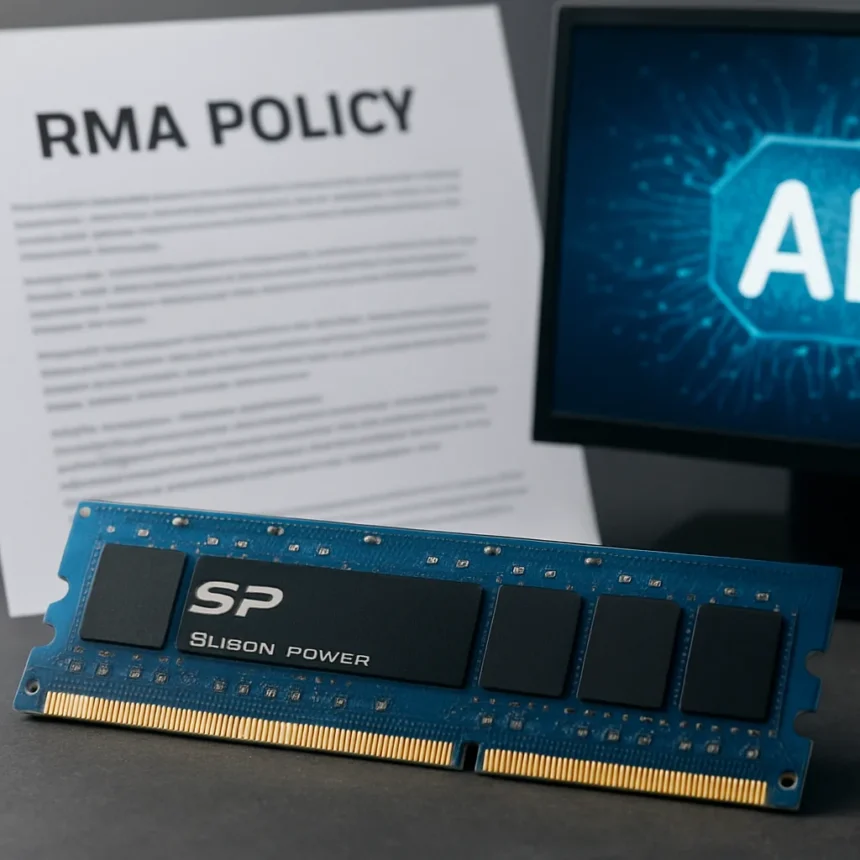
AI-driven RAM shortages are no longer just a supply chain talking point — they are now shaping warranty policy. Silicon Power’s US RMA policy refers to the company’s updated process for handling defective RAM and SSD returns, and in a move that stands apart from the rest of the industry, the Taiwanese storage brand has revised its terms to explicitly account for scenarios where replacement products simply cannot be sourced. If stock runs out, customers get their original purchase price back.
What Silicon Power’s Updated RMA Policy Actually Says
The revised policy introduces three distinct warranty resolution paths: replacement with the same or an equivalent model, a full refund of the original purchase price, or a partial refund. The critical addition is the second option. Silicon Power has explicitly stated it will refund the original purchase price if there is a shortage of replacement products — a direct acknowledgment that AI-driven RAM shortages could leave the company unable to fulfil standard warranty obligations through hardware alone.
The standard RMA process still operates on stock availability, and replacements may arrive as refurbished units, newly manufactured products, repaired items restored to functional equivalence, or comparable models where the original has been discontinued. Any replacement unit carries the remainder of the original warranty period, not a fresh term. Shipping costs are split: customers cover the cost of sending the defective product in, while Silicon Power handles the return leg.
Why AI-Driven RAM Shortages Are Forcing Policy Changes
The storage industry is under genuine pressure from AI infrastructure buildout. Data centres and hyperscalers are consuming DRAM and NAND flash at a pace that compresses the supply available to consumer and prosumer channels. When a warranty claim comes in during a shortage cycle, a manufacturer that only offers like-for-like replacement is in an awkward position — and the customer is left waiting indefinitely. Silicon Power’s policy update is a practical acknowledgment of that reality, even if it stops short of naming specific shortage triggers or timelines.


What makes this notable is that most competing RAM and SSD manufacturers have not made equivalent adjustments. The prevailing industry approach remains in-warranty replacement only, with no formal refund hedge built into policy documents. Silicon Power’s move does not guarantee customers will always receive a refund — the company retains discretion over when a shortage threshold is met — but it does create a documented commitment that rivals currently lack.
How Silicon Power RMA Policy Compares to Industry Norms
To understand why this matters, consider what the standard warranty experience looks like elsewhere. Most storage brands offer a single resolution path: send the defective unit back, receive a replacement when one becomes available. There is no formal fallback if stock is constrained, no refund clause, and no timeline commitment. Customers in shortage periods can find themselves in extended limbo.



Silicon Power’s three-tier resolution structure — replacement, full refund, or partial refund — gives the company flexibility while also giving customers a clearer set of expectations. The partial refund option is worth noting too, as it suggests a tiered response depending on product age, depreciation, or availability, though the policy does not specify the exact criteria for when a partial rather than full refund applies.
What Customers Need to Know Before Filing an RMA
Several conditions apply before any of the three resolution paths become available. Products must carry intact Silicon Power labels, show no physical damage, include proof of purchase through online registration, and — for external storage and SSDs — come with all original accessories. The 30-day satisfaction return window operates separately: items must be unopened, in original packaging, with all included free items present. Shipping fees and the value of any bundled free items are non-refundable under that window.
One point deserves emphasis: Silicon Power explicitly states it provides no guarantee for data completeness during the RMA process and accepts no liability for data loss. Customers must back up their data before shipping any device. This is standard across the industry, but worth stating clearly given that storage failures often happen without warning, leaving users scrambling. Back up first, file the RMA second.
Does Silicon Power’s new RMA policy apply globally?
The updated policy with the AI-driven shortage refund clause applies specifically to Silicon Power’s US operations. The research brief does not confirm equivalent policy changes in other regions. Customers outside the US should check their regional Silicon Power warranty terms directly before assuming the same protections apply.



Will Silicon Power automatically refund me if my RAM or SSD fails?
Not automatically. The refund option activates when Silicon Power determines there is a shortage of replacement products. The company’s first preference remains providing a replacement unit — either the same model, an equivalent, or a refurbished version. A refund is the fallback, not the default resolution.
What happens to my warranty if I receive a refurbished replacement?
Any replacement unit, whether new or refurbished, carries the remainder of your original warranty period rather than starting a fresh term. For lifetime warranty products, coverage runs from the original purchase date until Silicon Power determines the product has reached end of lifecycle.
Silicon Power’s policy update is a small but meaningful signal that AI-driven RAM shortages are being taken seriously enough to appear in warranty documents — not just analyst reports. For consumers, it offers a documented refund path that most storage brands do not currently provide. Whether competitors follow suit will depend on how severe shortage cycles become, but for now, Silicon Power has staked out a more consumer-friendly position than the industry norm.
Edited by the All Things Geek team.
Source: Tom's Hardware