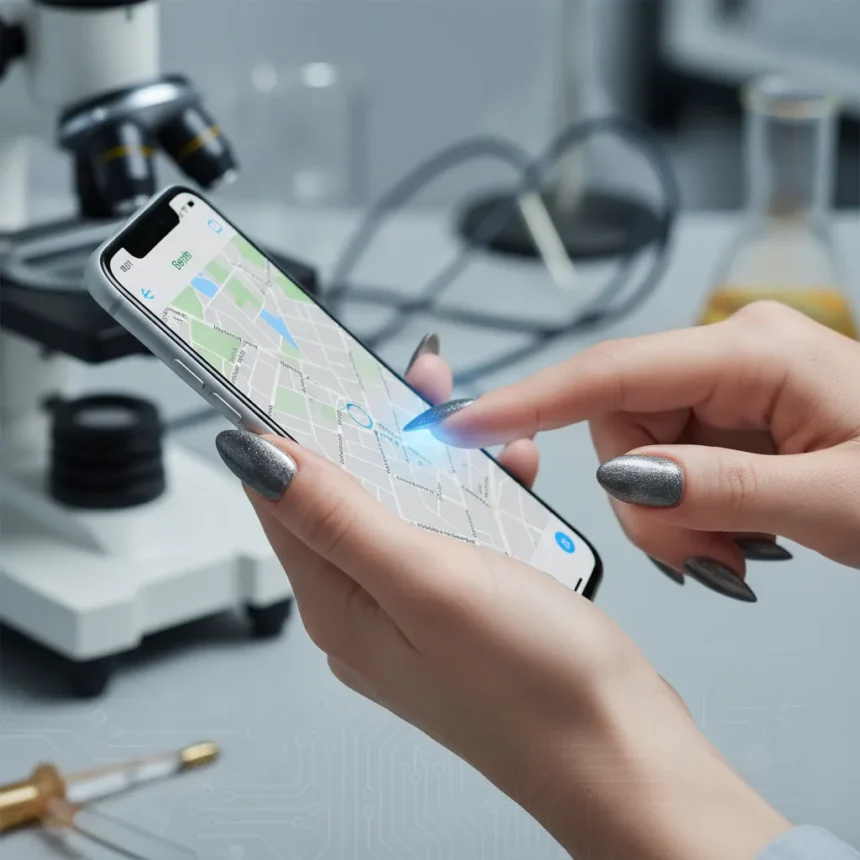
Conductive nail polish is a clear, touch-responsive coating developed by undergraduate Manasi Desai and Professor Joshua Lawrence at Centenary College of Louisiana that transforms fingernails into functional phone styluses. The formula combines two organic compounds—taurine (nontoxic but slightly opaque) and ethanolamine (conductive but toxic and volatile)—to create a transparent polish that registers on capacitive touchscreens. The prototype addresses a genuine problem: people with long nails or hardened fingertips, colloquially called “zombie fingers,” struggle to activate touchscreens because the devices rely on skin conductivity to detect contact.
Key Takeaways
- Conductive nail polish uses acid-base chemistry to register touches on capacitive touchscreens without metallic particles or carbon nanotubes.
- Developed at Centenary College of Louisiana by Desai and Lawrence; provisional patent filed and presented at American Chemical Society spring meeting.
- Current prototype works for only a few hours after application due to ethanolamine evaporation and shows inconsistent performance.
- Prior approaches used conductive nanotubes or metals, which created hazardous manufacturing conditions and limited color options to black or metallic shades.
- Can be applied over existing manicures or bare nails, offering both cosmetic and functional benefits for people with callused fingertips.
How conductive nail polish works differently
The chemistry behind this conductive nail polish differs fundamentally from previous attempts at touchscreen-friendly coatings. Rather than embedding conductive carbon nanotubes or metallic particles—approaches that created inhalation hazards during manufacturing and restricted the polish to black or metallic finishes—the Louisiana team uses acid-base chemistry. When the polish contacts a touchscreen’s electric field, protons jump between molecules in the formula, altering the capacitance at that point just enough for the device to register a touch. This mechanism is elegant because it works with the physics of capacitive screens rather than trying to simulate skin conductivity through foreign materials.
“Chemists are here to solve problems and to try to make your world better,” Professor Lawrence said when discussing the motivation behind the research. The formula’s transparency matters too. Unlike earlier metallic or nanotube-based solutions that forced users into a single aesthetic, conductive nail polish can be applied over any manicure design or worn on bare nails. This dual benefit—functional and cosmetic—expands the appeal beyond solving a technical problem to offering a lifestyle choice.
Why the prototype still needs work
The current version of conductive nail polish remains experimental and inconsistent. The formula registers touches on smartphones but only for a few hours after application, then the conductivity fades. This limitation stems from ethanolamine’s inherent volatility—it evaporates quickly, taking the conductive properties with it. The team also notes the polish performs inconsistently across different tests, suggesting the balance between the two organic compounds needs refinement. Additionally, while taurine is nontoxic, ethanolamine is toxic, meaning the final commercial formula would need to eliminate or replace the ethanolamine component entirely.


The researchers acknowledge this is hard, iterative work. “We’re doing the hard work of finding things that don’t work, and eventually, if you do that long enough, you find something that does,” Lawrence explained. A provisional patent has been filed, and the team presented findings at the American Chemical Society spring meeting in Atlanta, Georgia. Funding came from Centenary College of Louisiana, the Albert Sklar Family, and the Sklar Chair in Chemistry. These are early-stage results, not a finished product ready for market.
Solving the long-nail touchscreen problem
Capacitive touchscreens have dominated smartphones and tablets for over a decade, but they create a genuine accessibility issue for people with long nails or callused fingertips. Standard capacitive technology detects the electrical conductivity of skin, which means gloved hands, thick calluses, or the keratin structure of long nails can all prevent registration. For people with long nails, this means either using a stylus constantly, using the side of the hand, or tapping awkwardly with the pad of the finger—all workarounds that frustrate daily use. Manasi Desai highlighted this in her own words: “Our final, clear polish could be put over any manicure or even bare nails, which could help people with calluses on their fingertips, too. So, it has both a cosmetic and lifestyle benefit”.



The conductive nail polish addresses this by making the nail itself conductive, bypassing the need for skin contact. This is fundamentally different from prior solutions. Elektra Nails, demonstrated at CES 2014, offered glue-on nail extensions designed for touchscreen use, but that required replacing nails entirely. A polish-based approach is less invasive and more accessible—it can be applied during a regular manicure or at home.
What comes next for conductive nail polish
The research is at the prototype stage, and significant development remains before commercial availability. The team must solve the evaporation problem, likely by replacing ethanolamine with a nontoxic alternative that maintains conductivity. They also need to improve consistency so the polish performs reliably across multiple applications and devices. The provisional patent suggests commercial intent, but patents are filed years before products reach consumers.
Centenary College’s chemistry program is funded to continue this work, and the ACS presentation will expose the research to the broader scientific community, potentially attracting collaborators or industry interest. If the team solves the durability and toxicity issues, conductive nail polish could reach the market within a few years. For now, it remains a clever proof of concept that chemistry can solve everyday usability problems.
Is conductive nail polish available now?
No. Conductive nail polish is in prototype stage only and not commercially available. The current formula is inconsistent, works for only a few hours after application, and contains toxic components that must be reformulated before any consumer product launch. Centenary College researchers continue development with funding support.



How does conductive nail polish compare to touchscreen styluses?
A traditional stylus requires carrying a separate tool and works only on devices that support it, whereas conductive nail polish, once perfected, would work on any capacitive touchscreen and require nothing extra—just painted nails. However, styluses offer immediate functionality and indefinite durability, while the current nail polish prototype lasts only hours.
Can conductive nail polish work on all phone types?
Conductive nail polish is designed for capacitive touchscreens, which power the vast majority of smartphones and tablets worldwide. Older resistive screens or specialized industrial touchscreens operate on different principles and would not benefit.
Conductive nail polish represents a clever intersection of chemistry and everyday frustration. The Louisiana team has identified a real problem—people with long nails or callused fingertips struggling with capacitive touchscreens—and sketched a cosmetically appealing solution using acid-base chemistry rather than hazardous materials. The prototype proves the concept works in principle, but the formula needs significant refinement before it becomes a practical consumer product. For now, it remains a reminder that sometimes the best solutions to tech problems come not from engineers, but from chemists willing to experiment.
Edited by the All Things Geek team.
Source: TechRadar