






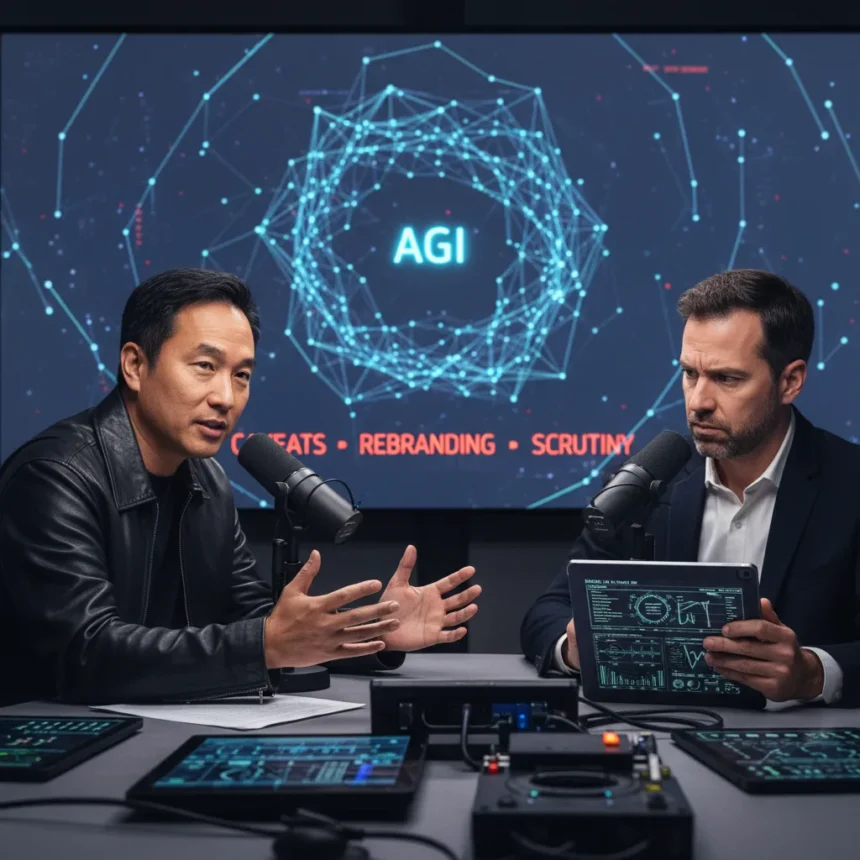
Jensen Huang, CEO of Nvidia, declared on the Lex Fridman podcast that “I think we’ve achieved AGI” — a statement that immediately revived one of tech’s most contentious debates. The episode, published March 23, 2026, caught the industry’s attention precisely because it comes from the leader of a company controlling roughly 80% of the AI chip market. But here’s the problem: Huang’s own caveats undermine the claim, and the rest of the industry is actively running away from the AGI label altogether.
Key Takeaways
- Nvidia CEO Jensen Huang stated “I think we’ve achieved AGI” on the Lex Fridman podcast in March 2026.
- Huang defined AGI as a system capable of doing your job, including building and running a billion-dollar company.
- OpenClaw, an open-source AI agent platform, served as Huang’s primary example of AGI-level capability.
- Tech leaders at OpenAI and Google are deliberately avoiding the “AGI” label to reduce hype and regulatory pressure.
- Huang himself acknowledged AI agents face severe limitations: short-lived success and zero chance of building enduring companies like Nvidia.
What Huang Actually Said About AGI
Huang and Fridman framed AGI as a system capable of “essentially doing your job” — specifically, building and running a billion-dollar company. Huang agreed with this definition and cited OpenClaw, an open-source AI agent platform, as evidence that we’re already there. The platform enables AI agents to create applications, digital influencers, and social tools that can achieve rapid, large-scale success. On the surface, it sounds like a reasonable claim. But Huang immediately hedged it.
“I wouldn’t be surprised if some social thing happened or somebody created a digital influencer… or some social application… and it becomes out of the blue an instant success,” Huang said. That’s not confidence — that’s speculation. And then came the real admission: “A lot of people use it for a couple of months and it kind of dies away”. In other words, the evidence Huang cited for AGI is, by his own account, mostly viral novelties that fade fast. He even stated flatly: “The odds of 100,000 of those agents building Nvidia is zero per cent”. If AI agents cannot build companies, how have we achieved AGI by Huang’s own definition?
Why the Industry Is Backing Away From AGI
Huang’s claim is notable precisely because the rest of the tech industry is doing the opposite. OpenAI, the company that helped popularize the AGI concept, has shifted to language like “levels of AI capability” to describe its systems. Google similarly avoids “AGI” in favor of “advanced AI systems”. This rebranding is deliberate. AGI remains embedded in major contracts like the OpenAI-Microsoft deal, but as a business and regulatory matter, the term has become a liability. It triggers hype cycles, invites regulatory scrutiny, and sets unrealistic expectations.


Huang’s statement, then, feels like a throwback to an earlier era of AI discourse — one where bold claims about superintelligence were common and unchallenged. By 2026, the industry has learned that such claims attract unwanted attention and backlash. Huang, leading the most dominant company in AI infrastructure, arguably has less incentive to avoid the term than executives at OpenAI or Google, who face direct regulatory pressure. But that doesn’t make his claim more credible — it just makes it more isolated.
The AGI Definition Problem
Here’s where Huang’s argument falls apart entirely. AGI, by most serious definitions, should mean artificial general intelligence — a system capable of learning and applying knowledge across any domain, matching or exceeding human-level reasoning in breadth and depth. Huang’s definition was narrower: a system that can do your job. By that measure, ChatGPT might already qualify for many roles. But that’s not AGI in the traditional sense. It’s narrow capability in specific domains, however impressive those domains might be.



The fact that Huang had to invoke OpenClaw — a platform for creating AI agents that mostly generate viral content before fading — as evidence of AGI reveals how weak the underlying claim is. A system that builds short-lived social apps is not the same as a system capable of reasoning about physics, building microchips, conducting scientific research, and navigating novel real-world problems simultaneously. Huang seems to have conflated “AI agents that can create things” with “artificial general intelligence,” a fundamental category error that experts would immediately challenge.
What This Means for AI Discourse
Huang’s claim matters less for its accuracy than for what it reveals about the state of AI hype in 2026. Nvidia’s dominance in AI chips gives Huang outsized influence over how the industry talks about its own capabilities. When the CEO of the most powerful company in AI infrastructure declares AGI achieved, it shapes investor expectations, regulatory perception, and public understanding — regardless of whether the claim holds up to scrutiny.
The industry’s move away from “AGI” as a term reflects a maturing understanding that the concept is more useful as a philosophical thought experiment than as a practical milestone to declare achieved. Experts still debate whether AGI is years or decades away, but few serious researchers claim we’ve already crossed the threshold. Huang’s statement, combined with his own caveats, suggests he knows this too — he just chose to make the bold claim anyway.
Is Huang Claiming AGI or Just Hype?
The most generous interpretation is that Huang misspoke or oversimplified for effect on a podcast. The most critical interpretation is that he made a claim he knows is dubious to drive narrative around Nvidia‘s dominance. Either way, the evidence he provided does not support the conclusion. AI agents creating viral content that fades within months is not artificial general intelligence by any rigorous definition.



Why Does Huang’s AGI Claim Matter If It’s Wrong?
Because Nvidia controls the infrastructure on which all modern AI systems run, Huang’s statements shape how the industry thinks about its own progress. When he declares AGI achieved, some investors, policymakers, and researchers will take it seriously, even if the technical community remains skeptical. This amplification effect — where a powerful CEO’s claim gets repeated and believed despite weak evidence — is how tech hype cycles actually work. The claim itself may be wrong, but its impact on market perception and regulatory thinking is very real.
What Would Real AGI Actually Look Like?
True AGI would need to demonstrate reasoning across domains without task-specific training, adapt to novel problems without human guidance, and operate at or above human capability in most intellectual tasks. OpenClaw agents creating social apps do none of these things. They operate within narrow, predefined domains. They require human setup and oversight. And their success is measured in weeks or months, not sustained problem-solving over years. By any reasonable standard, we are nowhere near AGI — and Huang’s own admission that AI agents cannot build companies like Nvidia proves it.
Closing Thoughts
Jensen Huang’s declaration that we’ve achieved AGI is bold, attention-grabbing, and almost certainly wrong. The irony is that his own caveats — about short-lived success, about zero chance of AI building companies — demolish the very claim he made. The industry’s deliberate shift away from the AGI label reflects a healthier, more honest approach to discussing what AI can and cannot do. Huang’s claim is a reminder that even the most powerful voices in tech can make statements that don’t survive basic scrutiny. The real question isn’t whether we’ve achieved AGI — it’s why Nvidia’s CEO felt the need to claim we had.
This article was written with AI assistance and editorially reviewed.
Source: TechRadar