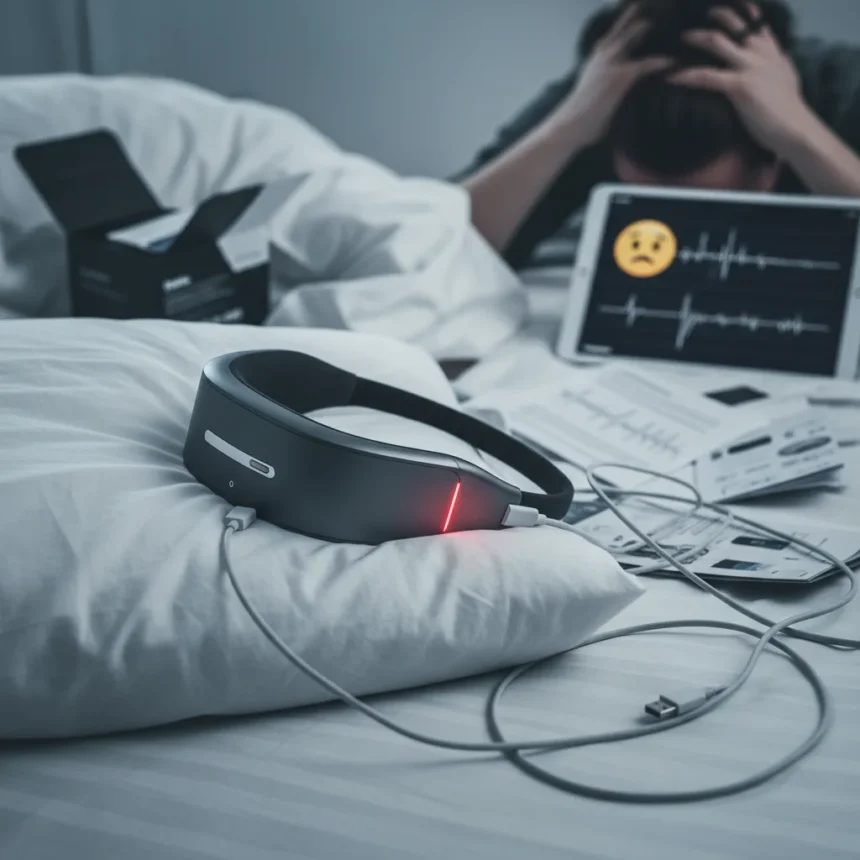
The Elemind sleep headband is a wearable device designed to reduce anxiety and improve sleep quality by reading and responding to brainwave activity, launched to address the growing problem of middle-of-the-night anxiety waking that disrupts millions of sleepers worldwide. The device works by detecting brainwave patterns associated with anxiety and triggering calming stimuli—a concept that sounds promising on paper but reveals significant practical limitations in real-world use.
Key Takeaways
- Elemind uses brainwave monitoring to detect and interrupt anxiety-driven sleep disruption.
- The device successfully reduces some nighttime awakenings caused by stress.
- Two major design flaws limit usability and comfort during extended wear.
- Cognitive shuffling offers a simpler, non-tech alternative to achieve similar results.
- Sleep headbands require consistent fit and electrode contact to function effectively.
How the Elemind Sleep Headband Actually Works
The Elemind sleep headband operates by monitoring brainwave activity throughout the night, detecting patterns that indicate anxiety or stress responses, and delivering targeted stimuli designed to interrupt the anxiety cycle before it fully wakes the user. Unlike traditional sleep aids that rely on medication or white noise, this device attempts to work at the neurological level, directly addressing the brain states that trigger anxiety-driven insomnia.
The appeal is clear: if the device can catch anxiety at its source—before it escalates to full wakefulness—users might avoid the 3 a.m. panic that derails entire nights. For people whose insomnia stems primarily from stress rather than poor sleep hygiene or environmental factors, a neurological intervention could theoretically outperform generic sleep products. However, the Elemind’s execution reveals why most sleep tech still relies on simpler, less ambitious approaches.
The Two Major Flaws That Undermine Performance
The first critical flaw centers on physical comfort and fit consistency. The headband must maintain precise electrode contact with the scalp throughout the night to accurately read brainwave data. Any shifting, loosening, or movement disrupts the signal, rendering the device ineffective. For side sleepers, stomach sleepers, or anyone who moves during sleep—which is most people—maintaining that contact becomes a nightly battle. The device cannot distinguish between a genuine anxiety-related brainwave shift and a signal dropout caused by poor electrode contact, leading to either missed interventions or false triggers.


The second major flaw involves the device’s reliance on consistent, uninterrupted use. The Elemind requires a full charge and setup routine each night, and any deviation—forgetting to charge it, losing the app connection, or simply deciding you want to sleep without a headband—breaks the continuity needed for the device to learn your personal brainwave patterns and optimize its responses. Unlike medications or behavioral techniques, which work independently of daily setup, this device adds friction to the very activity it aims to improve: sleep.
Does the Elemind Sleep Headband Actually Work?
The honest answer is: sometimes, and less reliably than simpler alternatives. For users who experience anxiety-driven awakenings and who are willing to wear a headband every single night, the device does show measurable reductions in middle-of-the-night wake-ups. The brainwave-reading concept is sound, and the stimuli it delivers are genuinely designed to interrupt anxiety spirals rather than mask them with noise or distraction.



However, the device’s success depends entirely on perfect fit, nightly consistency, and the user’s willingness to troubleshoot connectivity and electrode contact issues. For a product positioned as a solution to anxiety-driven insomnia—a condition that often involves stress and low tolerance for additional complications—the Elemind introduces exactly the kind of friction that defeats its purpose. A user experiencing 3 a.m. panic is unlikely to benefit from a device that requires troubleshooting its own connection at that moment.
A Simpler Alternative: Cognitive Shuffling
The research brief references cognitive shuffling as an alternative technique worth considering. This is a mental exercise that interrupts the anxiety-thought loop by deliberately shifting attention between random, unrelated images or concepts—a completely non-technological approach that requires no setup, no charging, and no physical contact. For many people struggling with anxiety-driven insomnia, cognitive shuffling delivers similar results to the Elemind without the hardware complications, though it does require learning the technique and practicing it consistently.
The existence of such a straightforward alternative raises an important question: if a free mental technique can achieve comparable anxiety reduction without the device’s physical and logistical overhead, why choose the Elemind? The answer depends on whether you find mental exercises difficult to execute during high-anxiety moments—some people do, and for them, an automated device might be worth the trade-offs.
Elemind Sleep Headband vs. Other Sleep Tech
Most competing sleep devices—whether white noise machines, smart mattress toppers, or sleep tracking wearables—take a different approach: they optimize the sleep environment or provide passive feedback without attempting real-time anxiety intervention. The Elemind’s ambition to actively detect and interrupt anxiety in real time sets it apart, but that same ambition creates the reliability problems described above.



Traditional sleep aids like weighted blankets or blackout curtains require no setup and work consistently. Smartphone sleep apps offer cognitive behavioral therapy for insomnia without requiring physical contact. The Elemind occupies an awkward middle ground: more complicated than passive solutions, less reliable than behavioral approaches, and dependent on nightly consistency in a way that most successful sleep interventions are not.
Should You Buy the Elemind Sleep Headband?
Buy it if you experience frequent, anxiety-driven awakenings and are genuinely willing to wear a headband every single night, troubleshoot electrode contact issues, and maintain the device’s charge and app connection. This is a narrow use case, but it describes real people with real problems.
Skip it if you move significantly during sleep, if you travel frequently, if you prefer low-friction solutions, or if you want a device that works without nightly setup. For those users, cognitive shuffling, sleep-focused therapy, or even a simple white noise machine will deliver more consistent results with far less hassle.
How does the Elemind sleep headband compare to white noise machines?
White noise machines mask environmental sounds and provide passive comfort, but they do not address anxiety-driven insomnia at its source. The Elemind attempts active intervention by detecting brainwave anxiety patterns, which is theoretically more targeted. However, white noise requires zero setup and works every night, while the Elemind’s effectiveness depends on perfect fit and consistent use.
Can the Elemind sleep headband work for all types of insomnia?
No. The Elemind is specifically designed for anxiety-driven sleep disruption. If your insomnia stems from poor sleep hygiene, an uncomfortable mattress, caffeine consumption, or circadian rhythm disorders, the Elemind will not address those root causes. It is narrowly targeted, which is both its strength and its limitation.
Is cognitive shuffling as effective as the Elemind sleep headband?
For anxiety-driven insomnia, cognitive shuffling can deliver comparable results without requiring any device or nightly setup. The trade-off is that it requires active mental effort during moments of high anxiety, whereas the Elemind attempts to automate the process. Which is more practical depends entirely on whether you can execute a mental technique when panic is highest.
The Elemind sleep headband represents an interesting attempt to solve anxiety-driven insomnia through technology, but it stumbles on the fundamentals: comfort, reliability, and ease of use. For a device aimed at people already struggling with stress and sleep disruption, adding nightly setup friction and fit-dependent performance feels counterintuitive. Before investing in the Elemind, try cognitive shuffling or speak with a sleep specialist about behavioral approaches. If those fail and you remain committed to a device-based solution, the Elemind’s brainwave-reading approach may be worth the trade-offs—but only if you accept its limitations as the price of its ambition.
Where to Buy
Oura Ring 4 | Withings Sleep Analyzer | Garmin Index Sleep Monitor | Apple Watch 11
Edited by the All Things Geek team.
Source: Tom's Guide