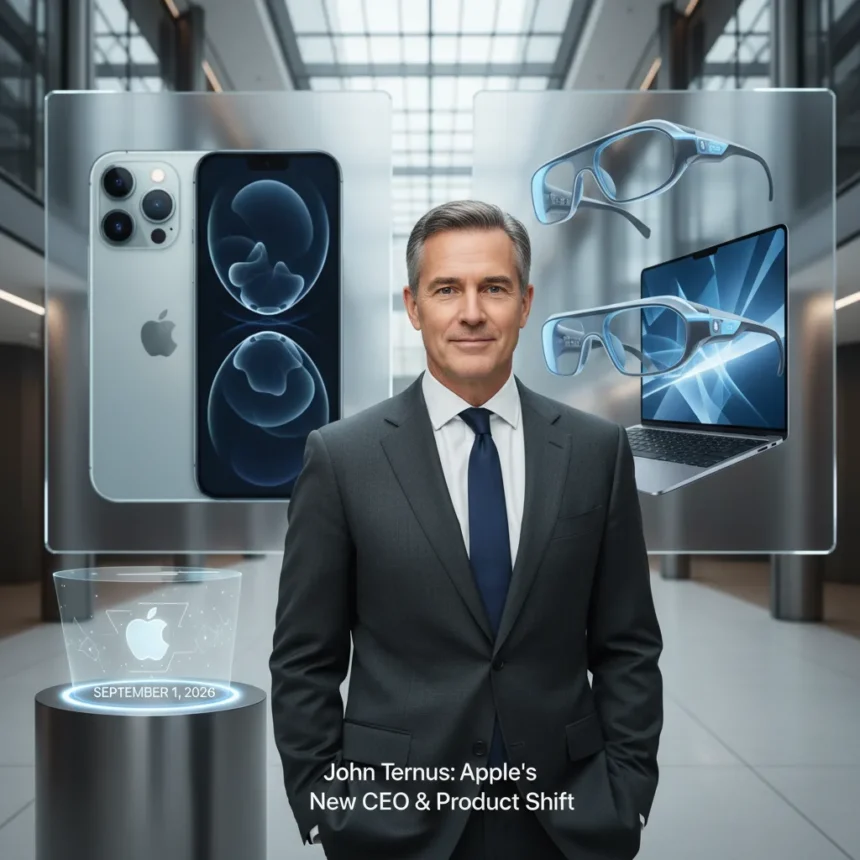
John Ternus became Apple’s chief executive officer on September 1, 2026, marking a significant leadership transition at the world’s most valuable technology company. Previously serving as Senior Vice President of Hardware Engineering since 2021, Ternus brings a distinctly different profile to the role than his predecessor Tim Cook—one rooted in product design rather than operations and supply chain management.
Key Takeaways
- John Ternus assumed the Apple CEO role on September 1, 2026, replacing Tim Cook
- He previously led hardware engineering for iPad, AirPods, iPhone, Mac, and Apple Watch
- His team has shipped iPhone 17 Pro/Pro Max, iPhone Air, and MacBook Neo under his oversight
- Apple is expected to pursue folding iPhone and smart glasses products under his leadership
- His engineering background signals a shift toward hardware innovation as a strategic priority
Who Is John Ternus and His Hardware Engineering Legacy
John Ternus is an engineer-turned-executive whose career at Apple has been defined by hands-on responsibility for the company’s most iconic product categories. As Senior Vice President of Hardware Engineering, he oversaw the design and engineering of iPad, AirPods, iPhone, Mac, and Apple Watch product lines. This portfolio represents the vast majority of Apple’s revenue and brand identity. His team has delivered multiple generations of these devices, including the iPhone 17 Pro and Pro Max, the iPhone Air, and the MacBook Neo—products that showcase both incremental refinement and occasional bold architectural shifts.
Unlike Tim Cook, whose background centered on manufacturing optimization and supply chain excellence, Ternus comes from the design and engineering side of Apple’s business. This distinction matters. Cook’s tenure focused on operational efficiency, margin expansion, and ecosystem lock-in. Ternus’s appointment signals that Apple’s board believes the company’s next growth phase depends on hardware innovation rather than further operational squeezing.
What Product Changes Can We Expect Under Ternus
Apple is expected to release a folding iPhone and smart glasses under Ternus’s leadership, two product categories that represent genuine category creation rather than incremental iteration. These are not minor updates—they are bets-the-company initiatives that require deep hardware engineering expertise to execute at scale. A folding iPhone demands new display technology, hinge engineering, and thermal management solutions. Smart glasses require miniaturization, power efficiency, and spatial computing integration that go far beyond current wearable capabilities.


Ternus’s appointment as CEO is not accidental timing relative to these projects. His team has already been working on both initiatives while he held the hardware engineering role. Promoting him to the top job removes bureaucratic friction and gives him direct authority to allocate resources, set timelines, and make the trade-off decisions that ambitious hardware projects require. The MacBook Neo, shipped under his hardware engineering leadership, demonstrates his willingness to pursue unconventional designs—a quality essential for bringing folding phones and AR glasses to market.
Beyond these flagship bets, expect Ternus to prioritize engineering depth in established categories. His team has shipped multiple generations of iPhone, Mac, and iPad products, meaning he understands the constraints and opportunities in mature product lines. Rather than radical redesigns across the board, look for thoughtful improvements in thermal performance, battery efficiency, and manufacturing precision—the kinds of refinements that distinguish premium products from commodity devices.



How Ternus Differs From Tim Cook’s Strategic Approach
Tim Cook’s Apple prioritized ecosystem integration, services revenue, and supply chain resilience. These are important—they built the moat that makes Apple’s hardware profitable. But they are also defensive strategies. Ternus’s appointment suggests Apple wants to shift toward offensive hardware innovation. The company has spent the last decade perfecting the iPhone formula and expanding services. The folding iPhone and smart glasses represent the next frontier.
Cook’s operational excellence created the conditions for Ternus to succeed. A company with weak supply chains and manufacturing discipline could never execute a folding phone at scale. But operational excellence alone does not generate the breakthrough products that drive upgrades and customer excitement. Ternus’s background suggests he will push the company toward riskier, more ambitious hardware bets—which is what a mature company needs to do when its core products have reached saturation.
Why This Leadership Transition Matters Now
Apple faces a critical moment. iPhone sales have plateaued in mature markets, and the company’s services business, while profitable, cannot sustain the growth expectations of shareholders. The company needs new product categories. Cook built the foundation for this shift, but a hardware engineer leading the company signals that execution of these bets is now the priority. Ternus has the credibility within Apple’s engineering organization to demand resources and make difficult trade-offs. He also has the technical depth to evaluate whether ambitious projects are actually feasible or merely wishful thinking.
The folding iPhone and smart glasses are not guaranteed successes. Samsung‘s Galaxy Z Fold has a loyal following but remains niche. AR glasses have killed more companies than they have created. But under Ternus’s leadership, Apple at least has a CEO who understands the hardware challenges these projects face and can make informed decisions about resource allocation and timeline. That is a meaningful difference from a CEO whose expertise lies elsewhere.



Will John Ternus Change Apple’s Product Philosophy
Ternus is unlikely to abandon the principles that made Apple successful under Cook—premium pricing, vertical integration, ecosystem lock-in, and obsessive attention to detail. What he may change is the company’s willingness to take hardware risks. Cook’s Apple often waited for technologies to mature before integrating them. Ternus’s Apple may be willing to ship products with new technologies earlier, accepting higher failure rates in exchange for faster learning and market leadership.
His track record with the MacBook Neo suggests he is comfortable with unconventional designs that challenge industry assumptions. The iPhone Air, another product his team shipped, shows he understands how to create compelling product tiers without fragmenting the brand. These are the skills that will determine whether the folding iPhone and smart glasses succeed or become expensive footnotes in Apple’s history.
What Does John Ternus’s Appointment Mean for Apple’s Competitors
For Samsung, Google, and other hardware competitors, Ternus’s appointment is a warning. Apple’s hardware engineering talent is already deep. Putting an engineer in the CEO role amplifies that advantage. Samsung has been shipping folding phones longer than Apple, but Apple’s resources and engineering discipline could quickly establish dominance in the category. Google has been pursuing AR glasses for years but has struggled with form factor and power efficiency—exactly the problems Ternus’s team would be equipped to solve.
The competitive threat is not that Ternus is smarter than his competitors. It is that he has authority to move fast, access to Apple’s manufacturing partnerships, and a company culture obsessed with hardware quality. That combination is difficult to match.
Will Apple’s Product Roadmap Change Under John Ternus
Yes, but gradually. Ternus did not become CEO to dismantle everything Cook built. The iPhone, Mac, iPad, and Apple Watch will remain core products. But the company’s strategic focus will shift toward new categories. Expect continued investment in AI features and services, but with greater emphasis on hardware-enabled differentiation. The folding iPhone and smart glasses are not side projects—they are the future of the company under Ternus’s leadership.
His engineering background also suggests Apple may slow down the pace of annual updates in mature categories. Rather than shipping a new iPhone every year with minor improvements, the company might shift to longer product cycles with more substantial hardware changes. This would align with Ternus’s apparent philosophy that engineering resources are better spent on breakthrough innovations than incremental updates.
FAQ
When did John Ternus become Apple CEO?
John Ternus became Apple CEO on September 1, 2026, replacing Tim Cook. He previously served as Senior Vice President of Hardware Engineering, overseeing the design and development of iPad, AirPods, iPhone, Mac, and Apple Watch.
What products has John Ternus’s team engineered at Apple?
Ternus’s hardware engineering team has shipped multiple generations of iPhone, iPad, AirPods, Mac, and Apple Watch products, including the iPhone 17 Pro and Pro Max, iPhone Air, and MacBook Neo. His team has been responsible for some of Apple’s most significant hardware releases over the past several years.
What new products will Apple release under John Ternus?
Apple is expected to release a folding iPhone and smart glasses under Ternus’s leadership. These represent major new product categories that signal a shift toward hardware innovation as a core strategic priority under his CEO tenure.
John Ternus’s appointment as Apple CEO represents a deliberate shift in corporate strategy. After nearly a decade of Tim Cook optimizing operations and building services revenue, Apple is placing hardware engineering expertise at the top. The folding iPhone and smart glasses are not guaranteed to succeed, but they are the kinds of bets a mature technology company must make to sustain growth. Ternus has the credibility, technical depth, and organizational authority to execute these ambitions. Whether he can deliver breakthrough products that rival the iPhone’s impact remains the defining question of his tenure.
Edited by the All Things Geek team.
Source: T3