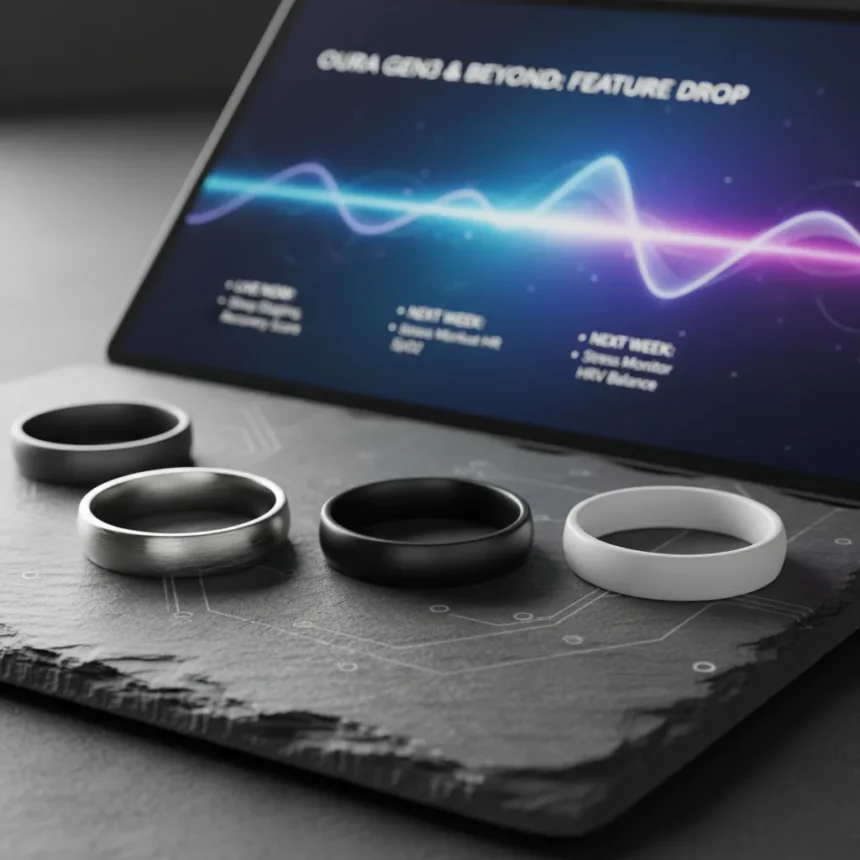
Oura Ring just got a significant update that proves the company is committed to improving existing hardware rather than forcing users to buy new models. The Oura Ring new features are now live for Gen3, Ring 4, and Ring 4 Ceramic owners, with additional capabilities arriving the following week.
Key Takeaways
- Oura Ring new features are rolling out to three existing models, not just new hardware.
- Ring 4 launched in October 2024 with improved battery life and all-circular design.
- Oura continues adding AI features, stress detection, and cycle tracking capabilities.
- Real-world battery performance typically falls short of advertised specs by one to two days.
- Competitors like RingConn Gen 3 are pushing subscription-free models and 13-day battery life.
What Oura Ring New Features Bring to Your Wrist Right Now
The update applies across Oura’s current lineup, ensuring that owners of the Ring Gen3, Ring 4, and Ring 4 Ceramic all benefit from the same improvements. This cross-model approach is smart strategy—it rewards loyal customers and extends the value proposition of older hardware at a time when smart-ring competition is intensifying. Oura Ring new features expand the app’s health-tracking capabilities, building on the platform’s existing strength in sleep analysis, readiness metrics, and activity monitoring.
The company has been steadily enhancing its ecosystem with integrations like Strava, which connects to approximately 100 million active users worldwide. By rolling out features across multiple generations simultaneously, Oura is signaling that software improvements matter as much as hardware upgrades—a lesson the smartwatch industry learned years ago.
Oura Ring New Features Coming Next Week: What to Expect
Additional capabilities are arriving in the week following the initial launch. Tom’s Guide previously reported that Oura has beta-tested a period-tracking feature that can estimate your cycle start, and that relaxing audio sessions are expanding within the app. Real-time fitness tracking in the app is also on Oura’s roadmap, though the exact timing of that rollout remains unclear.


These additions address gaps that competitors are aggressively filling. The Amazfit Helio Smart Ring, for instance, supports female health tracking including period and ovulation predictions, and costs over $200 less than the Ring 4. RingConn Gen 3, expected to arrive later this year, promises 13-day battery life and subscription-free operation—both areas where Oura currently trails. By accelerating its feature roadmap, Oura is trying to stay ahead of rivals who are emphasizing gesture controls, haptic feedback, and subscription-free pricing.
How Oura Ring 4 Stacks Up Against the Competition
The Ring 4, which launched on October 3, 2024, remains Tom’s Guide’s top pick for smart rings. It features a titanium design, all-circular form factor, and sensors for heart rate, respiratory rate, body temperature, and movement detection. The advertised battery life is up to eight days, though real-world testing shows closer to six days. The Ring Gen3 previously claimed seven days of battery, but users typically saw about five days in practice.



At $349, the Ring 4 is premium-priced, which makes the feature updates particularly valuable for owners who want to justify their investment. However, cheaper alternatives are emerging. The Helio Ring costs significantly less and still delivers comprehensive sleep and health tracking without a subscription requirement. For users prioritizing battery endurance, RingConn Gen 3’s promised 13-day performance—up from 10 days in its predecessor—represents a meaningful leap.
Why These Updates Matter Right Now
Smart rings are becoming a genuine category rather than a niche novelty. Oura Ring new features arrive at a moment when Samsung Galaxy Ring, Amazfit, RingConn, and others are all competing aggressively for wrist real estate. The company’s decision to push updates to older models rather than reserve features for new hardware shows confidence in its platform. It also suggests Oura believes its app experience—with detailed sleep scoring, readiness analysis, and growing AI capabilities—is the real differentiator, not the ring itself.
The addition of cycle tracking, stress detection, and fitness logging capabilities addresses use cases that smartwatch competitors like Apple Watch have dominated for years. By bundling these into a ring form factor with superior battery life, Oura is carving out a distinct niche for users who want continuous health monitoring without constant charging.
Is Oura Ring worth buying right now?
The Ring 4 at $349 is expensive, but the steady stream of software improvements and cross-generational support suggests Oura stands behind its ecosystem. If you value detailed sleep analysis, recovery insights, and a minimalist wearable form factor, it remains the best choice in its category. However, if battery life and subscription-free operation are your priorities, cheaper alternatives deserve serious consideration.



When will real-time fitness tracking arrive in the Oura app?
Tom’s Guide has reported that real-time fitness tracking is coming to the Oura app, but no specific launch date has been announced. The feature is on the company’s roadmap, suggesting it is still in development. Check Oura’s official announcements for timing.
Does Oura Ring 4 support cycle and fertility tracking?
Yes. Oura supports cycle and fertility tracking through integration with Natural Cycles. The company is also beta-testing a period-tracking feature that can estimate your cycle start, with expansion expected soon.
Oura Ring new features demonstrate that the company is listening to its user base and evolving its platform to stay competitive. The fact that these improvements are rolling out to existing hardware—not just new models—is a refreshing reminder that great wearables are defined by software as much as sensors. For current owners, the updates are a win. For prospective buyers, they’re a signal that Oura is committed to long-term support, even as smarter, faster competitors close in.
Edited by the All Things Geek team.
Source: Tom's Guide