





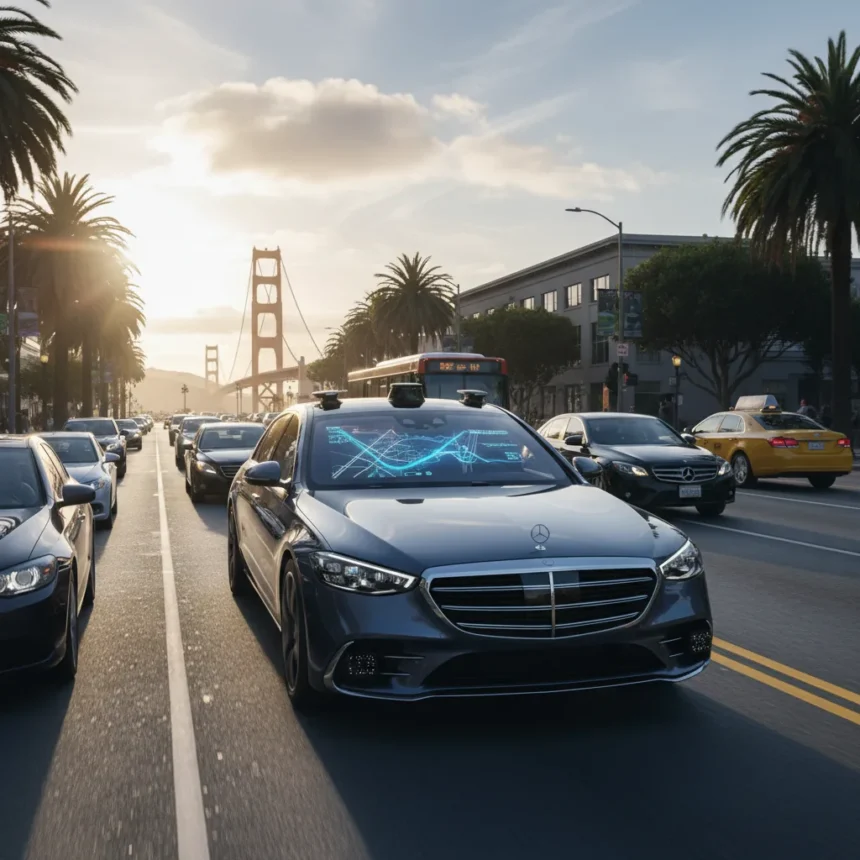
Nvidia autonomous driving has reached a critical inflection point. At GTC 2026 in San Jose on March 16, Nvidia demonstrated a Mercedes-Benz S-Class equipped with NVIDIA DRIVE Hyperion architecture and full-stack NVIDIA DRIVE AV L4 software that navigated live San Francisco traffic with a clarity of decision-making that felt fundamentally different from every autonomous vehicle demo that came before it. This was not a rehearsed route on a closed course. It was a reasoning system thinking out loud.
Key Takeaways
- Mercedes S-Class with NVIDIA DRIVE AV handled real SF traffic using end-to-end AI reasoning validated in Omniverse simulation.
- Alpamayo reasoning model narrates vehicle decisions in real-time, explaining lane changes, obstacle avoidance, and passenger instructions.
- Four new automakers (BYD, Hyundai, Nissan, Geely) join existing partners, scaling Nvidia autonomous driving across 18 million vehicles annually.
- Uber partnership enables robotaxi deployment of L4-ready vehicles, moving from demo to commercial operation.
- Jensen Huang declared “The ChatGPT moment of self-driving cars has arrived” – a watershed claim backed by functional edge-case handling.
How Nvidia Autonomous Driving Handles the Unpredictable
The core innovation behind Nvidia autonomous driving is architectural: DRIVE AV runs end-to-end AI and classical stacks in parallel, with a Halos safety system validating every decision in real time. This redundancy matters. Real traffic is not a dataset—it is pedestrians stepping into crosswalks, debris blocking lanes, and vehicles cutting in without warning. Traditional rule-based systems struggle with novelty. Nvidia’s approach uses AI trained on DGX systems to perceive, reason about, and safely navigate scenarios the system has never encountered before.
During the GTC 2026 demo, the Mercedes S-Class narrated its reasoning aloud via the Alpamayo model, a reasoning AI designed specifically for autonomous vehicle decision-making. When the vehicle changed lanes, it explained why. When it slowed for an obstacle, it described what it detected and how it chose to respond. This transparency is crucial—it converts a black box into a legible system. Passengers see not just that the car is driving itself, but how it is thinking.
The validation process underpins this confidence. Nvidia trains these systems on massive compute infrastructure, then validates them using Omniverse NuRec (a simulation environment) and Cosmos world models before deploying to hardware. The Mercedes platform represents the first production-grade L4-ready system to emerge from this pipeline, not a prototype or a limited deployment.

Nvidia Autonomous Driving Expands to Seven Automakers and Uber
Nvidia autonomous driving is no longer a Mercedes story. At GTC 2026, Nvidia announced that four new manufacturers—BYD, Hyundai, Nissan, and Geely—have joined existing partners Mercedes, Toyota, and General Motors on the DRIVE Hyperion platform. These seven companies produce approximately 18 million vehicles per year, giving Nvidia autonomous driving the scale to reshape mobility at a global level.
The Uber partnership is the commercial turning point. Nvidia’s robo-taxi ready platform will power Uber’s ride-hailing fleet, moving L4-ready vehicles from conference demos into cities where real passengers will depend on them. This is not a future promise. Deployment timelines are already being negotiated. The question is no longer whether autonomous vehicles can work—it is how fast they can be built and certified.

The breadth of partnerships also reveals Nvidia’s ecosystem strategy. Rather than building its own vehicles, Nvidia supplies the DRIVE stack—perception, planning, reasoning, and safety validation—to any manufacturer willing to adopt it. This approach mirrors Nvidia’s dominance in AI chips: become the foundational layer that every competitor must use.
Why the ChatGPT Moment Analogy Holds
Jensen Huang’s declaration—”The ChatGPT moment of self-driving cars has arrived”—invokes the sudden shift from skepticism to inevitability that followed ChatGPT’s release in late 2022. The analogy works because both moments represent a crossing of a competence threshold. Before ChatGPT, large language models were impressive technical artifacts. After ChatGPT, they were tools people actually wanted to use. Before GTC 2026, autonomous vehicles were engineering challenges. After watching the Mercedes navigate San Francisco while explaining its reasoning, they became a solved problem waiting for regulatory approval and fleet integration.
This shift matters psychologically and commercially. When a technology feels impossible, investment hesitates. When it feels inevitable, capital floods in. Nvidia autonomous driving has just crossed that line. The demo was not a proof of concept. It was a proof of inevitability.
What Happens When an Autonomous Vehicle Gets Stuck
One detail from the GTC 2026 demo captures the pragmatism of Nvidia’s approach: if the vehicle encounters a scenario it cannot safely resolve, a human can inject waypoints—specific coordinates—and the vehicle will navigate itself to them. This is not a failure mode. It is a graceful fallback. Rather than requiring a human to take full control, the system accepts guidance and continues operating autonomously. For robotaxi fleets, this capability means fewer tow trucks and faster recovery from edge cases.



How Does Nvidia Autonomous Driving Compare to Traditional Self-Driving Approaches
Nvidia autonomous driving differs fundamentally from earlier rule-based systems. Traditional approaches encoded decision logic as explicit rules: “if pedestrian detected, then brake.” This works until the rules do not cover the scenario. Nvidia’s end-to-end AI approach learns decision patterns from vast amounts of simulated and real data, then generalizes to novel situations. The Halos safety system validates every output, ensuring that reasoning errors do not translate to unsafe actions. This hybrid of learning and safety validation represents a generational leap in robustness.
When Will Nvidia Autonomous Driving Reach Consumers
The Mercedes S-Class platform entered production in January 2026 with MB.OS, Mercedes’ operating system, integrated with NVIDIA DRIVE Hyperion. Deployment timelines for customer vehicles and Uber robotaxi fleets are under way, though specific launch dates for each region and service tier have not been announced. The GTC 2026 demos indicate that the technical barrier has fallen; regulatory approval and fleet logistics are now the limiting factors.
Can Nvidia Autonomous Driving Handle All Weather and Road Conditions
The research brief does not detail specific performance data for rain, snow, or extreme conditions. However, Nvidia’s validation approach using Omniverse simulation and Cosmos physical simulation models suggests that edge cases beyond San Francisco traffic are being tested. The system’s ability to reason about novel scenarios—rather than relying on pre-programmed rules—implies better generalization to varied conditions, but independent validation data is not yet public.
Nvidia autonomous driving has crossed a threshold that felt perpetually distant just months ago. The Mercedes S-Class navigating San Francisco while explaining its reasoning was not a marketing stunt—it was a functional system handling real complexity. With seven automakers now committed to the DRIVE platform and Uber preparing to deploy L4-ready vehicles, the autonomous vehicle era is no longer a prediction. It is a logistics problem. That shift, more than any single technical achievement, is why Huang’s “ChatGPT moment” comparison resonates. The future of mobility just became inevitable.
Edited by the All Things Geek team.
Source: TechRadar