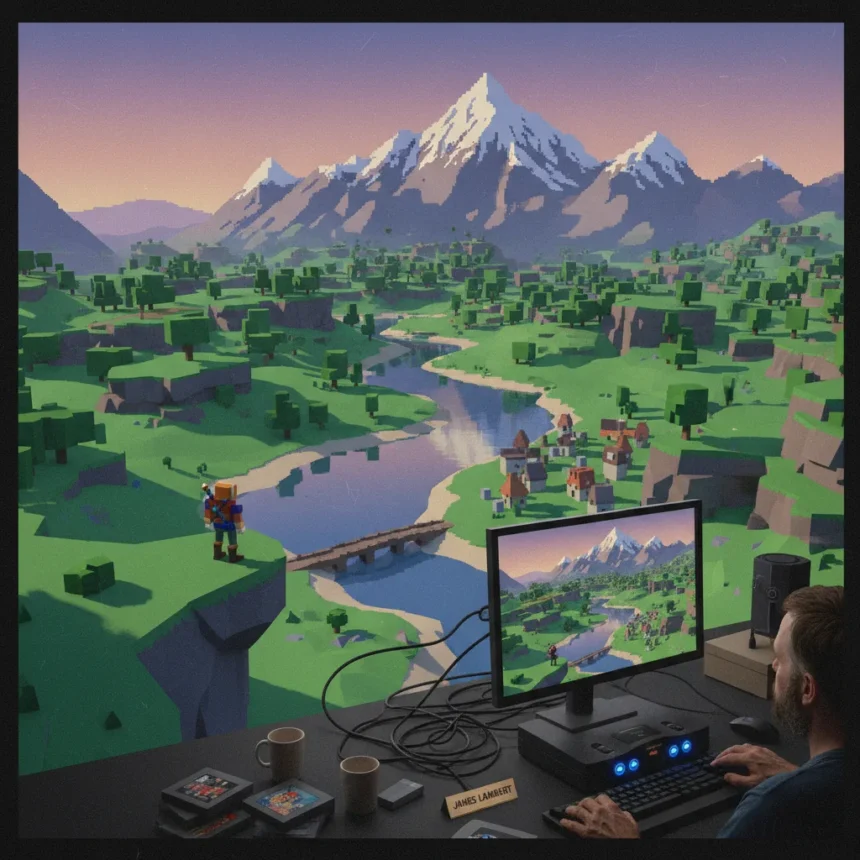
Developer James Lambert has built a custom N64 open-world engine that renders seamless worlds with zero loading screens on the 30-year-old Nintendo console, achieving draw distances on the scale of modern games like Skyrim. What makes this remarkable is not just that it works—it’s that Lambert solved fundamental hardware limitations that should have made it impossible.
Key Takeaways
- N64 open-world engine renders massive seamless worlds with zero loading screens on original hardware
- Draw distance matches Skyrim scale—visible from one corner of the map to the other
- Two-pass rendering technique bypasses N64’s 15-bit Z-buffer limitation at large distances
- Terrain divided into chunks with baked per-chunk textures eliminates redundant material swaps
- Fully functional demo downloadable for free from GitHub
How the N64 Open-world Engine Solves the Z-buffer Problem
The N64’s 15-bit Z-buffer creates a technical wall for distant rendering. At large draw distances, the buffer cannot distinguish depth precision accurately, causing Z-fighting—a visual glitch where overlapping geometry flickers. Lambert solved this with a two-pass rendering system. The first pass renders the distant world at a scale of roughly 1/100th its actual size, with the Z-buffer disabled entirely and geometry drawn back-to-front. The second pass renders the nearby foreground normally with full Z-buffer precision. This architectural separation prevents the precision conflict that would normally cripple long-distance visibility.
The technique is elegant because it exploits a fundamental truth: distant objects don’t need high precision if they’re small enough. By shrinking the distant world mathematically, Lambert forced the N64 to render what it can actually handle. The back-to-front ordering in the distant pass ensures correct occlusion without relying on depth testing. It’s a workaround that feels like cheating until you realize it’s pure technical necessity.
Terrain Chunks and Texture Optimization
Beyond the Z-buffer fix, Lambert divided the terrain into chunks that render individually in back-to-front order relative to each other. This matters because the N64 has severe material-swapping overhead. Every time the GPU switches from one texture to another, it stalls. By baking a unique texture per terrain chunk, Lambert eliminated redundant material changes. Instead of swapping materials dozens of times per frame, the engine swaps once per chunk.


This optimization reflects a broader principle: on constrained hardware, you trade storage for speed. The N64 has limited RAM, but storing pre-baked chunk textures costs less than the GPU stalls from constant material swaps. It’s the kind of decision that separates a technical demo from something that actually runs smoothly on original hardware.
Real-time Rendering and Practical Draw Distance
Lambert’s demo achieves what he describes as Skyrim-scale visibility: standing on one corner of the map, you can see all the way to the opposite corner. This is rendered in real-time on original N64 hardware—no pre-rendered backgrounds, no tricks. The engine is fast enough to support a fully upgraded hover cycle vehicle that reaches around 180 mph when boosting, allowing players to traverse the massive world without hitting loading screens.



For context, the N64 originally shipped with games like The Legend of Zelda: Ocarina of Time, which used fog and draw distance limits to hide the console’s memory constraints. Lambert’s engine doesn’t hide those constraints—it bypasses them through architectural innovation. The comparison isn’t subtle: games from 1998 could barely render a single castle. This engine renders an entire open world.
The Broader Impact on Retro Development
The demo sparked discussion on developer communities like Hacker News and Tildes about what’s actually possible on aging hardware. Other retro developers have noted that manual levels-of-detail (LODs) and billboard imposters—flat poster textures that rotate to face the camera—are standard techniques for distant objects, as famously used in GTA V. Lambert’s work suggests the N64 community hasn’t exhausted these approaches.
A separate N64 engine called Pyrite64 is also in active development by another creator, showing renewed interest in custom tooling for the platform. These aren’t nostalgia projects—they’re genuine technical challenges that push against hardware limits in ways modern development rarely requires. The constraint forces innovation.
Where to Experience It
The demo is freely downloadable from GitHub at https://github.com/lambertjamesd/n64brew2025/releases. It runs on original N64 hardware, not emulation. This is significant because emulation can hide performance problems—original hardware doesn’t lie. If it runs smoothly on a 30-year-old console, the optimization is real.


Can the N64 really render Skyrim-scale worlds?
Not Skyrim’s actual content—the N64 lacks the memory and processing power for that game’s complexity. But the draw distance and terrain visibility are comparable. You can see from one corner of the map to the other without fog walls or loading screens, which was impossible on the original hardware.
Is this the first open-world N64 engine?
Not technically. Road Rash 64 (1998) is sometimes cited as an accidental open-world game with no loading between races. But Lambert’s engine is the first to achieve this scale with zero loading screens and modern draw distances through deliberate architectural design rather than accident.
How much storage does the baked terrain data require?
The research brief does not specify total file size or storage requirements. The demo is available for download, so file size is observable, but exact specifications are not detailed in available sources.
What Lambert has demonstrated is that the N64’s limitations are not absolute—they’re puzzles waiting for the right solution. By understanding the Z-buffer constraint, optimizing texture swaps, and rendering in two passes, he pushed a 30-year-old console into territory that seemed impossible. That’s not nostalgia. That’s engineering.
Edited by the All Things Geek team.
Source: Tom's Hardware