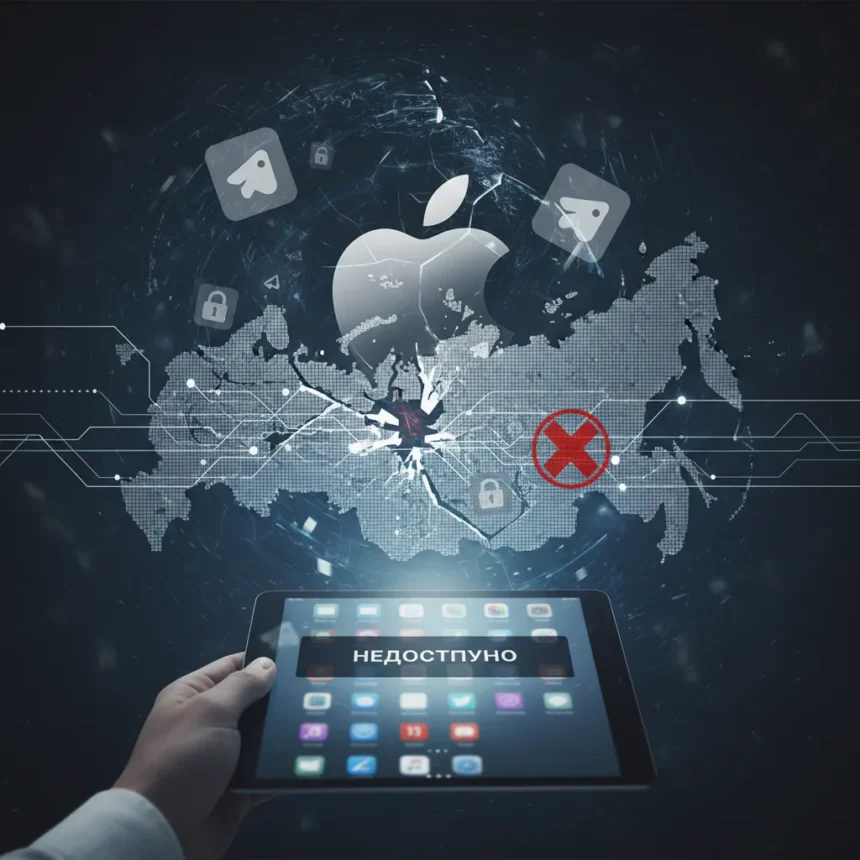
Apple’s Russian App Store VPN removal represents a watershed moment in how tech giants enable state censorship. In March 2026, Apple purged dozens of custom VPN and proxy applications from its Russian storefront at the explicit request of Roskomnadzor, the country’s communications regulator. This latest escalation builds on a pattern: close to 60 VPN apps have disappeared since summer 2024, with over 100 now unavailable to Russian iOS users.
Key Takeaways
- Apple removed dozens of VPN apps from the Russian App Store in March 2026 following Roskomnadzor orders
- Over 100 VPN applications are now unavailable to Russian iOS users since mid-2024
- Affected apps include NordVPN, Proton VPN, Amnezia VPN, and DVPN, blocked via geo-restriction tied to Russian Apple IDs
- Google Play retains similar apps, blocking only by court order rather than preemptively
- VPN use itself remains legal in Russia; removals target circumvention tools amid Telegram crackdown
How Apple’s Russian App Store VPN removal works
Apple removed the apps by citing content illegal in Russia, referencing Roskomnadzor’s prohibited information register. The removals are geo-blocked, affecting only users with Russian App Store accounts tied to Russian payment methods or regional settings. This means a Russian citizen cannot download NordVPN, Proton VPN, Red Shield VPN, or dozens of other tools—but an international user accessing the Russian storefront can still find them. The mechanism is surgical: Apple’s letter to developers stated the apps would be removed because they include content that violates Russian law and breaches App Store guidelines requiring compliance with local regulations. VPN use itself is not prohibited in Russia; the law targets circumvention tools, particularly those enabling access to blocked sites like Telegram, Western social networks, and opposition media.
The affected applications span both full-service VPN providers and custom proxy clients. NordVPN, Proton VPN, and AdGuard VPN are household names in the privacy space. But the bulk of removals target lighter-weight tools—applications that route traffic through user-configured proxies rather than proprietary VPN servers. DVPN by NORSE Labs, which ranked as the third most popular free app in its category before removal in April 2025, exemplifies this category. Amnezia VPN, removed on October 30-31, 2024, operates similarly. These apps require users to supply their own routing configurations, making them harder to block at scale—yet Apple’s regional removal achieves what Russian authorities could not accomplish alone.
Why Apple’s Russian App Store VPN removal matters for digital freedom
This is not about Apple enforcing law neutrally. Google Play hosts the same applications in Russia, blocking only when presented with a court order. Apple chose to act preemptively, without judicial process, at an agency’s administrative request. The distinction matters. Benjamin Ismail, director of GreatFire, an organization tracking internet censorship, called the removals alarming: Apple’s silent deletion of close to 60 VPN apps represents a direct threat to digital freedom and privacy, enabling government censorship without transparency or due process. Red Shield VPN’s developers were blunter, calling Apple’s action not just hypocrisy and cowardice but a crime against freedom of information. Aleksandr Litreev, CEO of NORSE Labs, emphasized that Apple removed DVPN without any valid court order, purely at Roskomnadzor’s request.


The timing is significant. Russia blocked Telegram in 2016 and has systematically restricted Western social networks, news outlets, and opposition media. VPNs became the primary tool for Russians seeking uncensored information. By removing VPN applications, Apple doesn’t merely comply with Russian law—it actively prevents Russian citizens from accessing tools that bypass state censorship. Roskomsvoboda, a Russian digital rights group, described Apple’s speed in fulfilling censors’ demands as lightning-fast, noting that the company removes apps faster than Russian authorities can block individual nodes.
How Apple Russian App Store VPN removal compares to other platforms
Google’s approach differs materially. Google Play retains many of the same VPN applications that Apple removed, blocking only when presented with a court order rather than acting on administrative requests. This is not a defense of Google—it simply illustrates that the tech industry has choices. Apple chose compliance; Google chose a higher bar. Neither choice is ideal, but the gap between them reveals how much discretion Apple exercised. The company could have required a court order, set a transparency threshold, or published removal notices. Instead, it removed apps silently and at an agency’s request, creating a chilling effect: developers now know that Apple will remove their applications from the Russian store without warning or judicial process.


The practical impact is immediate. Russian users cannot download VPN applications through the official App Store. They can sideload apps via alternative methods or switch to Android, but the barrier is higher. For non-technical users, Apple’s removal is effectively a ban. This is precisely what Roskomnadzor sought: not a legal prohibition on VPN use, but a technical barrier that prevents ordinary Russians from accessing circumvention tools.
What comes next for Apple and digital freedom in Russia
The removals will likely continue. Roskomnadzor has demonstrated that Apple responds to administrative requests without judicial oversight. Other authoritarian regimes are watching. If Apple’s model spreads—where governments request app removals and Apple complies without court orders—the App Store becomes a tool of state censorship rather than a neutral marketplace. Apple has justified its actions by citing App Store rules requiring compliance with local law. That logic is sound in principle but dangerous in practice, because it subordinates digital freedom to the legal frameworks of authoritarian states.
Developers have limited recourse. They cannot appeal Roskomnadzor’s determination; they can only comply or abandon the Russian market. NORSE Labs and Red Shield VPN have protested publicly, but public pressure has not reversed removals. For Russian users, the options are narrowing: use a VPN before Apple removes it, sideload older versions, switch to Android, or accept the digital restrictions the state imposes.
Has Apple removed VPN apps from other country App Stores?
The research brief does not provide information about VPN removals in other countries’ App Stores. Apple’s actions in Russia are documented, but comparable removals in other nations are not addressed in available sources.



Can Russian users still access VPN services through other methods?
Yes. Russian users can sideload VPN applications onto iOS devices through alternative methods, or switch to Android devices where Google Play retains many VPN apps. However, these workarounds require technical knowledge and are not accessible to most casual users. The App Store removal is effective precisely because it blocks the easiest path.
Why did Apple remove these apps instead of blocking them at the network level?
Apple removed the apps at Roskomnadzor’s explicit request, citing content illegal in Russia. The removals are geo-blocked, affecting only the Russian App Store. This approach allows Apple to comply with Russian law while maintaining availability elsewhere, but it does nothing to protect Russian users seeking digital freedom.
Apple’s Russian App Store VPN removal is a clear case of a technology company choosing compliance over principle. The company had alternatives—requiring court orders, publishing transparency reports, or simply refusing to remove applications—but chose the path of least resistance. In doing so, Apple has become an instrument of state censorship, silencing the tools Russians use to access information their government wants hidden. That choice will define how the tech industry responds to authoritarian pressure for years to come.
Edited by the All Things Geek team.
Source: TechRadar