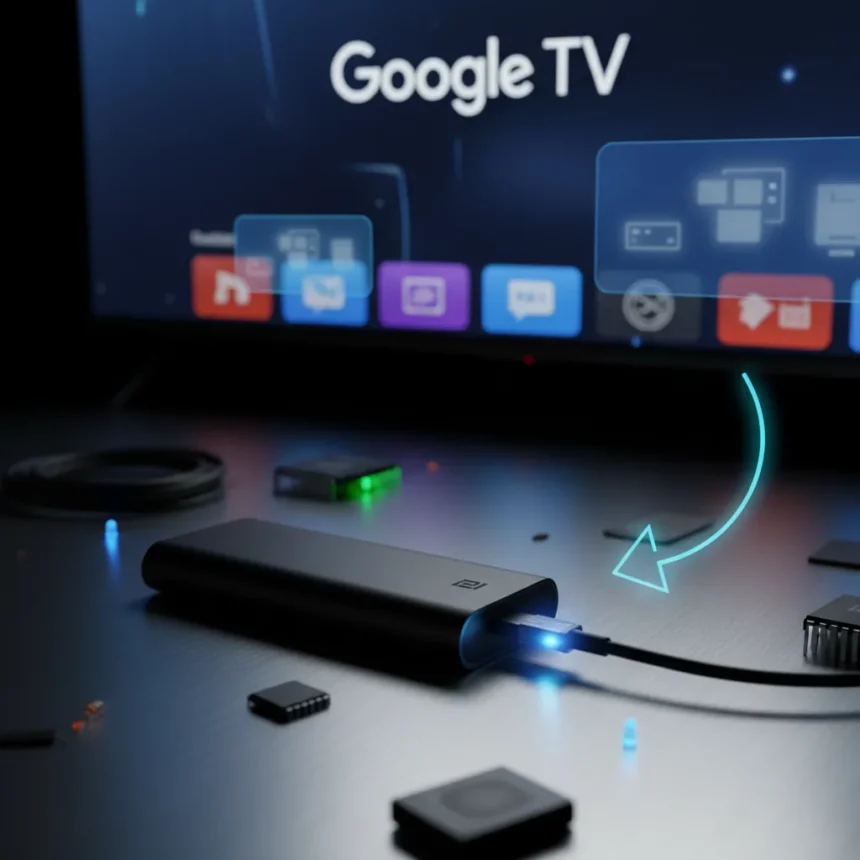
The Xiaomi TV Stick HD is a compact Google TV streaming dongle designed to add smart streaming capabilities to older HD televisions, but it arrives with specs that feel borrowed from 2020. Xiaomi’s first major refresh of its HD streaming stick line switches to Google TV with HDR10+ support and a faster processor, yet clings to 1GB of RAM and a microUSB power port—choices that undermine an otherwise sensible update for budget-conscious viewers upgrading aging TVs.
Key Takeaways
- Xiaomi TV Stick HD runs Google TV with HDR10+ support, a step up from older Android TV models
- Hardware includes just 1GB RAM and microUSB charging, criticized as outdated for 2026
- No 4K support; positioned as an alternative to Xiaomi’s separate TV Stick 4K 2nd Gen line
- Global launch began around March 30, 2026, targeting budget HD TV owners
- Faster CPU performance than previous generations, though specific benchmarks remain unspecified
What the Xiaomi TV Stick HD Actually Offers
The Xiaomi TV Stick HD delivers a genuine upgrade path for owners of older televisions who want streaming without replacing their entire display. Google TV replaces the aging Android TV platform, bringing a cleaner interface, faster app loading, and preloaded access to Netflix, Amazon Prime Video, and YouTube. The addition of HDR10+ support means content on compatible services will display with better color and contrast than the previous generation, even if you’re watching on a 1080p screen.
The processor gets a meaningful bump in CPU performance compared to earlier Xiaomi streaming sticks, though Xiaomi has declined to publish detailed specifications or benchmark comparisons. For everyday streaming—Netflix, YouTube, casual gaming—this should handle the workload. The remote includes dedicated buttons for major streaming services, mirroring the design approach of Xiaomi’s 4K model.
Connectivity covers the essentials: dual-band WiFi (likely WiFi 6 based on the 4K variant’s specs), Bluetooth 5.2 for wireless accessories, and Google Cast for screen mirroring. None of this is groundbreaking, but it’s solid for the price tier this device targets.



Why Xiaomi TV Stick HD Feels Like a Missed Opportunity
Here’s the frustration: in 2026, the Xiaomi TV Stick HD still ships with 1GB of RAM and microUSB charging. The 4K variant, by contrast, doubles the RAM to 2GB and maintains USB-C—a standard that became mainstream years ago. For a device launching in 2026, 1GB RAM feels like a compromise that shouldn’t exist. Apps will launch slower, multitasking will stutter, and the device will feel sluggish compared to even mid-range competitors.
The microUSB port is the real head-scratcher. USB-C offers faster power delivery, better durability, and universal compatibility with modern cables. Sticking with microUSB signals either cost-cutting or indifference to user experience. If you’re upgrading from an older Xiaomi stick, you might keep the old power cable—but new users will need to hunt for a microUSB charger in a world that has largely moved on.



Xiaomi’s decision to skip 4K entirely creates an awkward product gap. The TV Stick 4K 2nd Gen delivers true 4K resolution, Dolby Vision, DTS:X audio, and Dolby Atmos for roughly 49 dollars, making the HD-only stick a harder sell unless your TV genuinely cannot display 4K. Even budget 1080p TV owners upgrading in 2026 might prefer spending the extra dollars for future-proofing.
Xiaomi TV Stick HD vs. The 4K Alternative
The Xiaomi TV Stick 4K 2nd Gen is the obvious comparison point. It supports actual 4K resolution, Dolby Vision, HDR10+, DTS:X, and Dolby Atmos audio. It includes 2GB RAM instead of 1GB, and ships with USB-C. The CPU performance is substantially faster—the 4K model uses a 6nm 2.5GHz quad-core Cortex-A55 processor with an ARM G310 V2 GPU, delivering 80 percent better CPU performance and 150 percent better GPU performance than the first-generation 4K stick.
Pricing tells the story. The TV Stick 4K 2nd Gen costs around 49 dollars on AliExpress and 56.99 dollars for the first-gen 4K model. Xiaomi hasn’t announced pricing for the HD stick, but if it undercuts the 4K version by only 10-15 dollars, the math favors buyers choosing the 4K stick instead. The only scenario where the HD stick makes sense is if your television genuinely lacks a 4K panel and you want the cheapest possible entry to Google TV streaming.
Who Should Buy the Xiaomi TV Stick HD?
The Xiaomi TV Stick HD has a narrow but real audience. If you own a 1080p TV from 2015 or earlier and want to avoid replacing the entire set, this stick adds streaming capability without forcing an upgrade. It’s cheaper than a new TV and simpler than rigging a Chromecast or Fire TV Stick to an older display. The Google TV interface is cleaner and faster than Android TV, and HDR10+ support ensures you’re not completely left behind on modern content.



For everyone else, the value proposition crumbles. If your TV supports 4K—or if you plan to upgrade your TV in the next few years—the TV Stick 4K 2nd Gen is the smarter buy. The price gap is likely small enough that the extra features justify the spend. And if you’re buying new in 2026, the 1GB RAM and microUSB limitations feel like buying yesterday’s technology today.
Does the Xiaomi TV Stick HD support 4K?
No. The Xiaomi TV Stick HD maxes out at HD resolution (1080p). Xiaomi offers 4K support through its separate TV Stick 4K 2nd Gen line, which includes Dolby Vision, DTS:X, and Dolby Atmos audio. If you need 4K streaming, you’ll need to choose that model instead.
What’s the difference between 1GB RAM and 2GB RAM on a streaming stick?
1GB RAM means slower app launches, stuttering when switching between apps, and potential freezes during heavy use. The TV Stick 4K 2nd Gen’s 2GB RAM handles multitasking and modern apps more smoothly. For casual streaming, 1GB works, but 2GB is noticeably snappier—and the cost difference is minimal.
Should I buy the Xiaomi TV Stick HD or wait for something better?
If you own a 1080p TV and want the cheapest way to add Google TV streaming, the Xiaomi TV Stick HD makes sense. If your TV supports 4K or you plan to upgrade soon, the TV Stick 4K 2nd Gen is a better long-term investment for only slightly more money. The HD stick’s 1GB RAM and microUSB port are genuine drawbacks that will feel dated within a year or two.
The Xiaomi TV Stick HD is a competent streaming stick for a specific use case, but it arrives with compromises that feel unnecessary in 2026. Google TV is a genuine upgrade, and HDR10+ support is welcome. But 1GB RAM and microUSB charging are cost-cuts that shouldn’t exist at any price point. If Xiaomi had matched the 4K stick’s RAM and USB-C standard, this would be an easy recommendation for budget HD TV owners. Instead, it’s a device that asks you to accept yesterday’s limitations for today’s price—a trade-off that rarely makes sense.
Edited by the All Things Geek team.
Source: Android Central