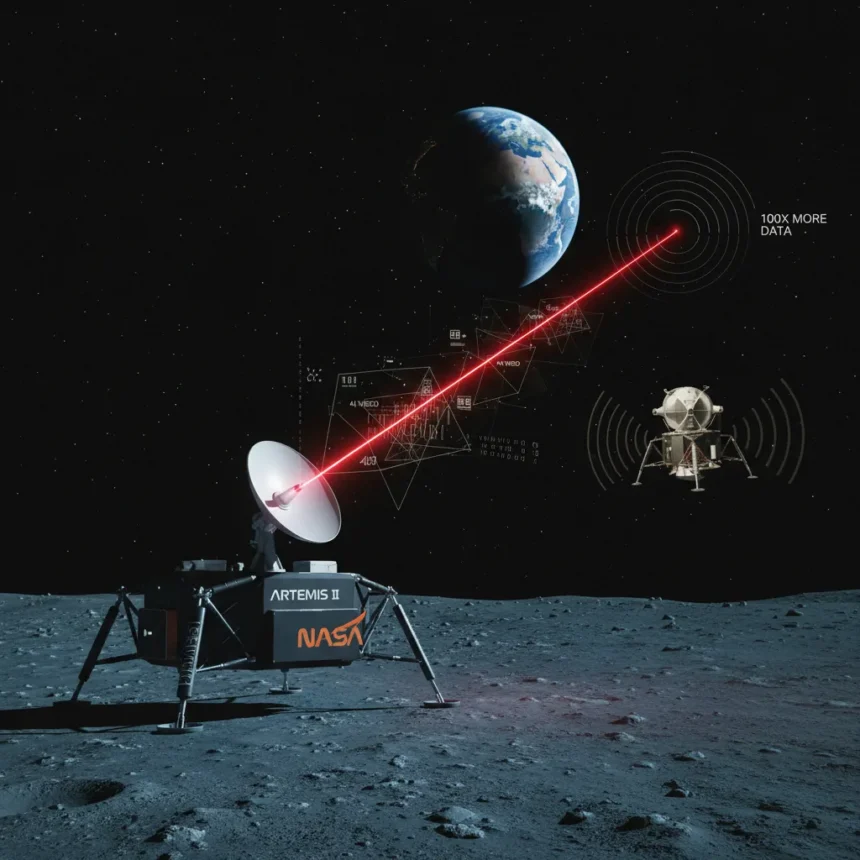
Artemis II laser communications system represents a fundamental shift in how NASA talks to spacecraft beyond Earth orbit. The Orion Artemis II Optical Communications System (O2O), developed by MIT Lincoln Laboratory in collaboration with NASA Goddard Space Flight Center, will transmit 4K high-definition video from the Moon during the 10-day crewed mission launching around April 1, 2026. This is not just an incremental upgrade—it is a wholesale replacement of the radio-frequency systems that Apollo astronauts relied on fifty years ago.
Key Takeaways
- Artemis II laser communications delivers up to 260 Mbps downlink, enabling live 4K video from the Moon
- O2O system provides 100 times more data capacity than traditional radio networks used in Apollo era
- MAScOT terminal, about the size of a house cat, uses a 4-inch telescope to transmit infrared laser beams
- Ground stations in Las Cruces, New Mexico and Table Mountain, California receive the laser signals
- First operational laser communications on a human-rated mission beyond low Earth orbit
How Artemis II Laser Communications Works
The Artemis II laser communications system operates on a deceptively simple principle: infrared light carries far more data than radio waves because it has a higher frequency. The core hardware is the Modular, Agile, Scalable Optical Terminal (MAScOT), a compact device roughly the size of a house cat that houses a 4-inch telescope mounted on two-axis gimbals. This telescope points precisely at ground stations in New Mexico or California, allowing the spacecraft to transmit and receive laser signals with minimal power consumption. The system includes three major components: the optical module with its telescope and gimbals, a modem that converts data and commands into laser signals, and a controller that interfaces with Orion’s avionics.
Why does this matter for astronauts? Farzana Khatri, lead systems engineer at MIT Lincoln Laboratory’s Optical and Quantum Communications Group, noted that space-based communications has always presented enormous challenges. The Artemis II laser communications system solves this by using less power and requiring smaller hardware than radio systems. As Jade Wang, Assistant Group Leader at the same lab, explained: with laser communications, NASA can deliver far more data with far less power and much smaller terminals. For a mission sending humans back to the Moon, this efficiency is critical.
Artemis II Laser Communications vs. Apollo Radio Systems
The contrast between Artemis II laser communications and Apollo-era S-band radio is stark. Apollo astronauts transmitted at rates measured in kilobits per second. NASA’s traditional Deep Space Network and Tracking and Data Relay Satellite System (TDRSS) still rely on radio frequencies that, while reliable, are bandwidth-limited. Artemis II laser communications will operate at 260 Mbps downlink for science data, procedures, flight plans, and crew communications—roughly 100 times the capacity of radio networks. In testing, the system demonstrated even higher rates: 1.2 Gbps downlink and 155 Mbps uplink.

This bandwidth explosion means NASA can do things Apollo could never attempt. Steve Horowitz, O2O project manager, stated clearly: at 260 megabits per second, Artemis II laser communications is capable of sending down 4K high-definition video from the Moon, plus video, pictures, procedures, flight plans, and real-time links between Orion and mission control. For astronaut safety, this is transformative. Steve Gillmer, Assistant Group Leader of Structural and Thermo-Fluids Engineering at MIT Lincoln Laboratory, emphasized that in-flight instrumentation generates critical data about spacecraft health and astronaut safety—data that would be difficult to transmit reliably without laser communications.
Why Artemis II Laser Communications Matters Now
Artemis II laser communications is not merely a technology demonstration. It is the operational foundation for NASA’s deeper lunar return. The mission launches as a crewed orbital flight around the Moon, using NASA’s Near Space Network and Deep Space Network as primary communications systems, with O2O as a demonstration payload. Success here paves the way for more ambitious missions. The MAScOT architecture won the 2025 R&D 100 Award, signaling recognition from the broader technology community. The LEMNOS Pipeline project enabled operational laser communications on Artemis II, marking the first time human spaceflight beyond low Earth orbit will rely on this technology.



Ground stations in Las Cruces, New Mexico and Table Mountain, California were selected specifically for their minimal cloud coverage, ensuring reliable signal reception. This geographic choice underscores NASA’s pragmatism: laser beams cannot penetrate clouds, so ground infrastructure matters as much as spacecraft hardware. The system will operate during the full 10-day mission, transmitting everything from high-resolution imagery to telemetry that mission controllers on Earth need to monitor crew safety.
What Comes After Artemis II Laser Communications?
Artemis II laser communications is not the endpoint. Recent demonstrations show the trajectory. The ILLUMA-T-to-LCRD system achieved 1.2 Gbps downlink and 155 Mbps uplink. NASA’s Deep Space Optical Communications project proved that laser systems can deliver 100 times more data millions of miles away. An Airbus system achieved 1.8 Gbps with a capacity of 40 terabytes daily. These advances are not isolated lab experiments—they are operational systems proving that laser communications scales.
For Artemis III and beyond, laser communications will likely become standard rather than experimental. The technology removes a genuine bottleneck in deep space exploration: the inability to transmit large volumes of critical data from far away. Without this capability, future lunar bases, Mars missions, and deep space science would face severe constraints on what data astronauts and rovers could send home.
Can Artemis II Laser Communications Handle Real-World Conditions?
The system has been tested extensively on the ground, demonstrating the bandwidth rates mentioned above. However, the Artemis II mission will be the first true operational test in the actual environment—orbiting the Moon, transmitting through the vacuum of space to distant ground stations. Weather at the ground stations could interrupt signals, though the selected locations in New Mexico and California minimize this risk. The two-axis gimbal system must track precisely as Orion orbits, a challenge that ground testing has addressed but flight will validate.



Is Artemis II laser communications the first time humans have used this technology in space?
No. Uncrewed missions and demonstrations have used laser communications before. However, Artemis II laser communications represents the first operational deployment on a human-rated mission beyond low Earth orbit. Earlier laser communications systems operated in Earth orbit or on robotic deep space probes. Artemis II will be different: astronauts aboard Orion will depend on this system to communicate with Earth during a crewed lunar mission.
Why does Artemis II laser communications use infrared instead of visible light?
Infrared light has a higher frequency than radio waves, allowing it to carry more data in the same timeframe. It is also less affected by atmospheric scattering and can be focused more precisely with smaller optics. The 4-inch telescope in MAScOT is far smaller than the massive radio dishes required for comparable data rates, reducing weight and power consumption—critical constraints for spacecraft.
Artemis II laser communications is not revolutionary in the way that the first Moon landing was. It is a quiet, essential upgrade that removes a fundamental constraint on deep space exploration. When astronauts transmit 4K video of the lunar surface back to Earth in real time, they will be using technology that Apollo never had and that radio systems cannot match. That capability, multiplied across future missions, will reshape what humans can accomplish beyond Earth orbit.
Edited by the All Things Geek team.
Source: Tom's Hardware