





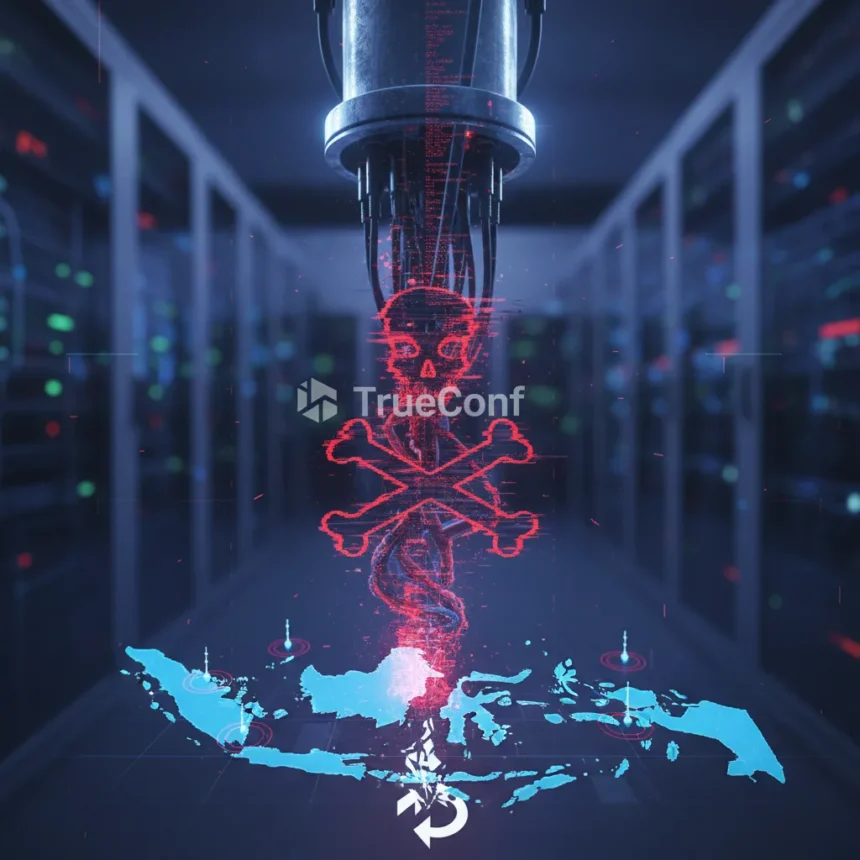
A TrueConf zero-day vulnerability tracked as CVE-2026-3502 has been actively exploited since early 2026 to distribute malware across government and military networks in Southeast Asia, transforming the platform’s trusted update mechanism into a weaponized delivery channel. The flaw, which carries a CVSS severity score of 7.8, allows attackers who control on-premises TrueConf servers to replace legitimate software updates with malicious executables that clients download and execute without validation.
Key Takeaways
- CVE-2026-3502 exploited in Operation TrueChaos campaign targeting Southeast Asian governments since early 2026
- Vulnerability affects TrueConf versions 8.1.0 through 8.5.2; patched in version 8.5.3 released March 2026
- Missing integrity checks allow attackers to replace updates with arbitrary code executed on client machines
- Over 100,000 organizations including military, governments, and air traffic control systems use TrueConf
- Attack requires server compromise only; clients are compromised through normal update process without phishing or endpoint targeting
How the TrueConf Zero-Day Attack Works
The exploitation chain is brutally simple because it leverages the implicit trust between clients and their on-premises server. When a TrueConf client launches—often triggered by an attacker-sent link presenting an update prompt—it checks for newer versions on the compromised server. The attacker has already replaced the legitimate update package with a weaponized version containing malicious payloads. The client retrieves and executes this file without any integrity validation, allowing arbitrary code execution under the guise of a routine software update.
According to Check Point researchers who disclosed the vulnerability, the attack’s elegance lies in its simplicity: “An attacker who gains control of the on-premises TrueConf server can replace the expected update package with an arbitrary executable, presented as the current application version, and distribute it to all connected clients.” Because clients trust server-provided updates without proper cryptographic validation, a single compromised server can distribute malware to dozens or hundreds of connected government entities simultaneously.
The malicious payloads deployed in Operation TrueChaos deliver the Havoc open-source post-exploitation framework, enabling attackers to conduct reconnaissance, establish persistence, and maintain command-and-control communication across compromised networks. This transforms what should be a routine maintenance operation into a beachhead for long-term espionage.


Why This Vulnerability Matters for Governments
TrueConf is specifically designed for closed, offline, or LAN-isolated environments where organizations cannot rely on cloud-based conferencing platforms like Zoom. Governments, militaries, oil and gas operators, and air traffic control systems adopted TrueConf precisely because it keeps sensitive communications on-premises and offline. The platform’s popularity surged post-COVID as organizations sought secure alternatives to cloud conferencing for classified communications.
The vulnerability’s impact is magnified because it does not require attackers to compromise individual endpoints. Instead, as Check Point noted, “The exploitation of CVE-2026-3502 did not require the attacker to compromise each endpoint individually. Instead, the attacker abused the trusted relationship between a central on-premises TrueConf server and its clients.” This means a single server breach can cascade into network-wide compromise affecting hundreds of users simultaneously—a nightmare scenario for military and government IT security teams.



Suspected China-nexus threat actors linked to the Amaranth-Dragon group have been actively exploiting this flaw since early 2026, targeting Southeast Asian government entities. The campaign demonstrates how even air-gapped networks designed for security can become vulnerable when trust mechanisms lack proper validation.
Patch Status and Remediation
TrueConf released version 8.5.3 in March 2026 to patch CVE-2026-3502, addressing the missing integrity check in the client’s update mechanism. Organizations running versions 8.1.0 through 8.5.2 are exposed and should upgrade immediately. However, the patch’s release came after weeks of active exploitation, meaning many government and military networks likely remain compromised with persistent backdoors established before the fix was available.
The window between exploitation and patching underscores a critical security lesson: self-hosted platforms require robust update validation mechanisms as a baseline, not an afterthought. TrueConf’s architects assumed on-premises deployment meant inherent security, but they failed to account for scenarios where attackers gain server access through supply chain compromise, insider threats, or network lateral movement.
What This Means for Closed Network Security
The TrueConf zero-day vulnerability exposes a fundamental assumption in air-gapped network design: that isolation alone provides security. It does not. When software running in isolated environments lacks cryptographic integrity validation, attackers who breach the perimeter can weaponize trusted internal mechanisms—updates, patches, configuration files—as malware distribution channels. This applies to any self-hosted conferencing, VPN, or communication platform deployed in sensitive environments.



Organizations defending classified networks should audit all software update mechanisms for cryptographic signature validation, implement strict code signing requirements, and monitor update channels for anomalies. A compromised update is exponentially more dangerous than a compromised endpoint because it bypasses user skepticism and security awareness entirely.
Is the TrueConf zero-day actively being exploited?
Yes. Operation TrueChaos has been actively exploiting CVE-2026-3502 since early 2026, targeting Southeast Asian government networks. The campaign continued through March 2026 when the patch was released, meaning attackers had a multi-month window to establish persistent access.
Which TrueConf versions are vulnerable?
Versions 8.1.0 through 8.5.2 are affected by the vulnerability. Version 8.5.3, released in March 2026, contains the fix.
Can TrueConf users detect if their server was compromised?
Detection is difficult because the attack leaves minimal forensic traces—it exploits normal update processes without requiring unusual network traffic or system behavior. Organizations should review server access logs, update package hashes, and client telemetry for signs of unauthorized modification. Threat hunting for Havoc framework artifacts may reveal post-compromise activity.
The TrueConf zero-day demonstrates that self-hosted security is only as strong as the trust mechanisms underlying it. For government and military networks, the lesson is clear: assume every update channel, every configuration file, and every internal communication can be weaponized if an attacker reaches the server. Cryptographic validation is not optional—it is foundational. Organizations still running vulnerable versions should prioritize patching immediately, then conduct forensic analysis to determine if compromise occurred before the fix was deployed.
Edited by the All Things Geek team.
Source: TechRadar




