




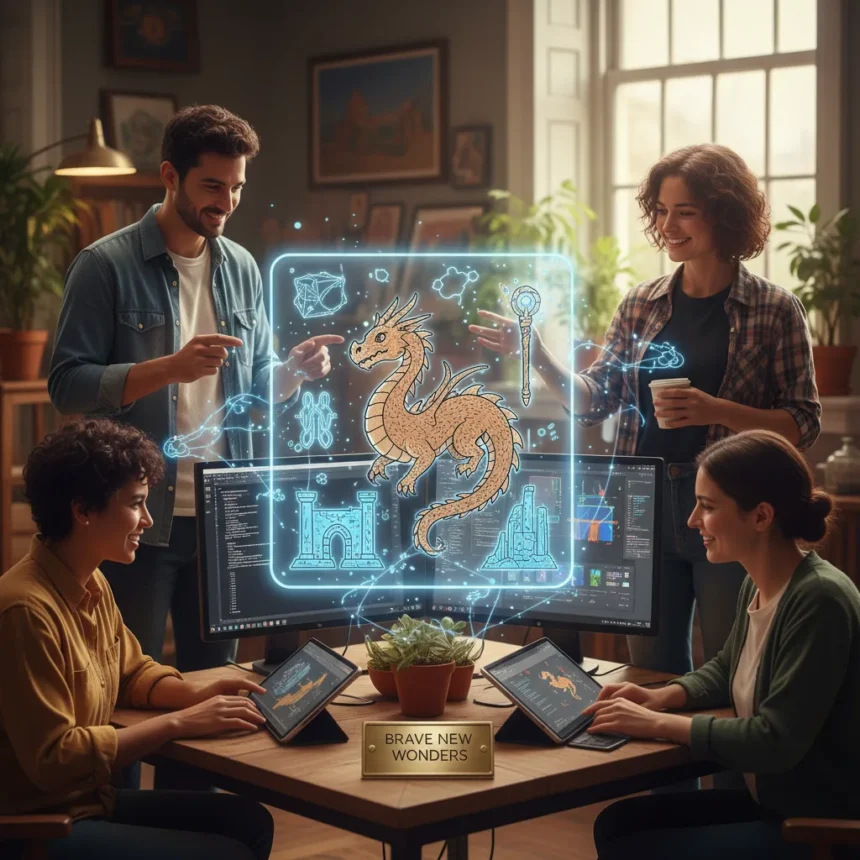
Brave New Wonders, a factory automation strategy game by City From Naught, is forcing a reckoning: AI in indie games doesn’t have to mean displacing artists. The game uses natural language AI to power its core mechanic—commanding automatons with plain text instructions—while explicitly rejecting generative AI for art, animation, sound, and story. This distinction matters more than the hype around AI-generated everything suggests.
Key Takeaways
- Brave New Wonders uses AI to interpret text commands for automatons, not to generate game assets.
- City From Naught refuses generative AI for illustrations, models, textures, animations, sound, and music.
- The game targets players who want automation mechanics without conveyor belts or rigid interfaces.
- AI as gameplay mechanic differs fundamentally from AI as content pipeline replacement.
- Competing approaches like Bobium Brawlers use on-device AI for creature generation, enhancing rather than replacing artists.
How Brave New Wonders Actually Uses AI
The game’s AI system does one thing well: it translates player intent into action. Write “deliver fusion fuel from factory to warehouse” in any language, and the AI parses the instruction, generates an execution template, and commands an automaton to carry it out. This is middleware, not magic. It’s closer to how a physics engine works than how Midjourney works.
Players can preset automaton behaviors or write fully custom instructions using an in-game behavior editor. The AI then enables factories, automatons, and wonders to signal and collaborate across a global network. What makes this interesting isn’t that the AI is intelligent—it’s that the game outsources tedious UI design to natural language. A player who hates menus suddenly has agency. That’s a genuine design win, not AI theater.
The Red Line: What City From Naught Refuses to Do
Here’s where Brave New Wonders separates itself from the AI-hype crowd. The studio explicitly states: “We believe in the place human artists have had and will have in the world. We do not condone the use of generative AI that exploits human artists by denying them fair compensation or that reduces the meaning of their work”. No AI-generated illustrations. No AI-generated 3D models, textures, animations, sound effects, music, or voice work.

This isn’t virtue signaling dressed up as design philosophy. City From Naught co-founder Shala Chen has discussed drawing clear boundaries and leaving room for creativity within those constraints. The studio recognizes that AI in game development exists on a spectrum. Using it to parse text commands is not the same as replacing a concept artist. One enhances gameplay; the other cannibalizes a paycheck.
AI in indie games: A Comparison That Matters
Not every indie studio using AI is taking City From Naught’s approach. Bobium Brawlers, a mobile PvP game by Studio Atelico, uses on-device AI for creature generation and NPC simulation—handling memory and actions without sending data to the cloud. The key difference: Studio Atelico frames AI as middleware, like Havok physics engines, that enables unlimited randomization while artists maintain control over the visual style guide. Mollie Boorman, the game’s art director, was explicit: “It’s not about replacing parts of our pipeline or getting rid of creatives. There’s more to making assets than just content”.



Both approaches treat AI as a tool within defined constraints, not a replacement for human judgment. Neither studio is using generative AI to strip-mine human artwork for training data. The contrast with major publishers experimenting with AI asset generation is stark. Indie developers, perhaps because they lack the legal buffers of larger companies, are being more honest about where AI belongs and where it doesn’t.
Why This Matters Right Now
The conversation around AI in games has been poisoned by extremes. One side claims AI will replace all creative work. The other dismisses AI as hype. Brave New Wonders and Bobium Brawlers suggest a third path exists: AI as a tool that solves specific design problems without erasing the humans who actually make games playable and beautiful.
City From Naught is currently running playtests for Brave New Wonders, with sign-ups available on Steam, and has showcased the game at events including Taipei meetups and the XP Game Summit. The game is coming to PC via Steam, though no release date has been announced. These playtests matter because they let players judge whether AI-powered text commands actually improve the automation game experience or just create a novelty that wears thin.
Does AI in indie games require ethical guardrails?
Yes. The difference between City From Naught’s approach and exploitative generative AI is the difference between a tool and a weapon. Brave New Wonders uses AI to solve a user interface problem. It doesn’t use AI to generate art and claim it’s original. That distinction should be the baseline, not the exception.



Can indie studios afford to reject generative AI for assets?
Brave New Wonders proves the answer is yes, at least when a studio is willing to hire artists and pay them fairly. The game’s visual identity comes from human designers, not diffusion models. Smaller budgets mean making harder choices about where to spend resources. City From Naught chose to spend on people, not shortcuts.
Is Brave New Wonders the future of AI in games?
Not necessarily. It’s one possible future. The game proves that AI can enhance indie game design without exploiting the people who make games. Whether other studios follow suit depends on whether the industry values integrity over speed. Brave New Wonders is coming to PC Steam soon, and its reception will likely influence how other indie developers think about drawing their own red lines around AI. If players reward thoughtful AI integration and punish exploitative shortcuts, the market will follow. If not, we’ll see a race to the bottom instead.
This article was written with AI assistance and editorially reviewed.
Source: Creativebloq