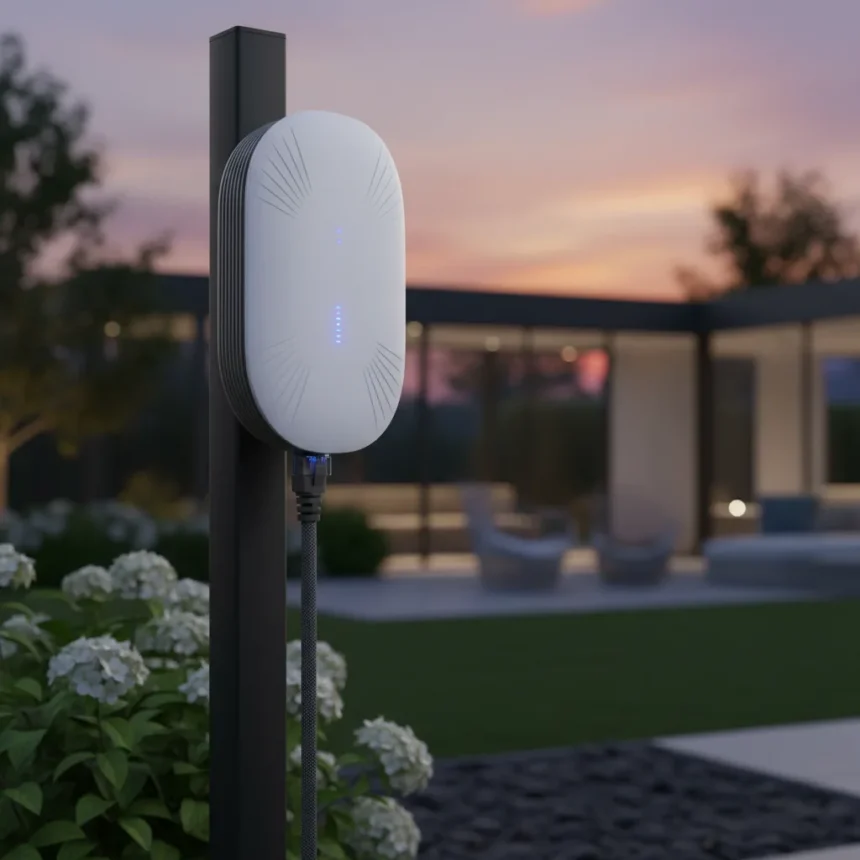
The Asus ZenWiFi BD5 Outdoor is a dual-band Wi-Fi 7 mesh extender designed for backyards and large outdoor spaces, delivering speeds up to 5000 Mbps (BE5000) with MLO and 4K-QAM technology that offers up to 20% more throughput compared to Wi-Fi 6 and 6E standards. What sets it apart from typical mesh nodes is its IP65 water-resistant and dust-tight rating, dual 2.5Gbps PoE auto-sensing ports, and AiMesh compatibility with existing ASUS routers like the AX86U, GT-BE98 Pro, and RT-BE96U. But there is a critical catch: this unit shines only when you run an Ethernet backhaul. Wireless backhaul performance is hit-or-miss, making it essential to understand the trade-offs before investing.
Key Takeaways
- Delivers up to 5000 Mbps Wi-Fi 7 speeds with MLO and 4K-QAM, offering 20% faster transfers than Wi-Fi 6/6E.
- IP65 rating and dual 2.5Gbps PoE ports enable outdoor installation without separate electrical outlets.
- AiMesh compatible with ASUS routers; covers up to 2500 ft² per unit as a standalone node.
- Ethernet backhaul performance is excellent; wireless backhaul is unreliable and inconsistent.
- Functions as standalone router, AiMesh node, or PoE access point—no Repeater mode available.
Asus ZenWiFi BD5 Outdoor Specifications and Design
The Asus ZenWiFi BD5 Outdoor delivers dual-band Wi-Fi 7 performance with a 2.4GHz band supporting up to 688 Mbps and a 5GHz band reaching 4324 Mbps. The unit weighs just 2.29 lbs and ships in white, making it compact enough for flexible outdoor mounting. The real innovation lies in its connectivity: dual 2.5Gbps PoE auto-sensing ports eliminate the need to run a separate electrical cord to your outdoor installation, a genuine convenience factor for anyone extending coverage to a patio, shed, or detached garage.
The IP65 rating means the device can withstand rain, dust, and harsh weather without degradation. For ASUS ecosystem users, the Asus ZenWiFi BD5 Outdoor integrates smoothly with AiMesh, allowing it to function as a satellite node extending coverage up to 2500 ft² per unit. It also works standalone as a router or as a business-class PoE access point, though ASUS omitted Repeater mode—a limitation worth noting if you are upgrading from a traditional mesh repeater.
Performance: Ethernet Backhaul Versus Wireless
Here is where the Asus ZenWiFi BD5 Outdoor reveals its true nature. With an Ethernet backhaul—whether Cat6 or better—the unit performs reliably and delivers the speeds ASUS advertises. The 2×2 MIMO configuration on both bands handles outdoor throughput competently, and the MLO (Multi-Link Operation) and 4K-QAM enhancements provide meaningful performance gains over Wi-Fi 6 and 6E alternatives.


Wireless backhaul is another story entirely. Performance becomes inconsistent and unreliable, making it unsuitable as a primary connection method for users without access to Ethernet runs. This is a significant limitation for anyone with a garage or outbuilding far from the main router. If you cannot run a cable, the Asus ZenWiFi BD5 Outdoor may disappoint. This constraint narrows its appeal to users with existing outdoor Ethernet infrastructure or those willing to install Cat6 runs specifically for this unit.
Compared to the TP-Link Deco BE25, a more affordable dual-band Wi-Fi 7 alternative, the Asus ZenWiFi BD5 Outdoor offers superior port options and outdoor durability, but the Deco BE25 avoids the wireless backhaul penalty by design. ASUS essentially forces you to choose: either invest in Ethernet infrastructure or accept spotty wireless performance.



Features and Software
The Asus ZenWiFi BD5 Outdoor runs ASUSWRT 5.0, which includes free lifetime VPN, Parental Controls, Online Protection, and Smart Home Master SSIDs. These are solid management features for families managing multiple devices. AiMesh compatibility means you can mix and match with other ASUS routers—a real advantage if you already own an ASUS mesh system and want to expand outdoors without replacing your entire setup.
The device can function as a standalone router, an AiMesh node, or a standard PoE access point, offering flexibility for different deployment scenarios. However, the absence of Repeater mode is worth noting, as some users may prefer simple repeater functionality over full mesh integration.
Coverage and Real-World Use Cases
A single Asus ZenWiFi BD5 Outdoor unit covers up to 2500 ft², which handles most residential backyards and medium-sized outdoor spaces. For larger properties, ASUS offers a 3-pack indoor variant covering 6800 sq ft, though the outdoor model is designed as a single-unit or multi-unit expansion rather than a complete replacement mesh system.
The ideal use case is straightforward: you have gigabit or faster broadband, an existing ASUS mesh system indoors, and the ability to run Ethernet to your backyard or patio. Run a Cat6 cable outdoors, plug it into the PoE port, and the Asus ZenWiFi BD5 Outdoor handles the rest. If you lack Ethernet access, wireless backhaul will frustrate you—it is not a workaround, it is a compromise.



Should You Buy the Asus ZenWiFi BD5 Outdoor?
The Asus ZenWiFi BD5 Outdoor is a strong choice if you meet three conditions: you own an ASUS mesh router already, you can run Ethernet to your outdoor location, and you want Wi-Fi 7 performance without replacing your entire system. The PoE ports are genuinely useful, the IP65 rating is robust, and AiMesh integration is seamless.
If wireless backhaul is your only option, look elsewhere. The performance inconsistency makes it unsuitable as a primary connection method. The theoretical 5000 Mbps speeds are marketing numbers; real-world throughput depends entirely on wired connectivity.
Is the Asus ZenWiFi BD5 Outdoor worth upgrading from Wi-Fi 6?
If you have existing Wi-Fi 6 outdoor coverage, upgrading to the Asus ZenWiFi BD5 Outdoor makes sense only if you need additional coverage area or plan to expand to gigabit broadband speeds. The 20% throughput improvement over Wi-Fi 6 is meaningful for high-bandwidth tasks, but it only materializes with Ethernet backhaul. Without wired connectivity, the upgrade is not worth the investment.
Can you use the Asus ZenWiFi BD5 Outdoor without an ASUS mesh system?
Yes, it can function as a standalone router or PoE access point, but AiMesh integration is where its strengths lie. Using it as a standalone outdoor router without an existing ASUS ecosystem means losing the seamless management and unified coverage benefits that justify its premium positioning.
The Asus ZenWiFi BD5 Outdoor is a specialized tool designed for ASUS ecosystem users with Ethernet access to outdoor locations. It excels in that narrow but real use case. For everyone else, the wireless backhaul limitation is a dealbreaker. Choose it only if you can run a cable—otherwise, you are paying for a feature set you cannot fully use.
Where to Buy
Check Amazon | TP-Link Deco BE65-Outdoor | TP-Link Deco BE25-Outdoor
Edited by the All Things Geek team.
Source: Tom's Hardware