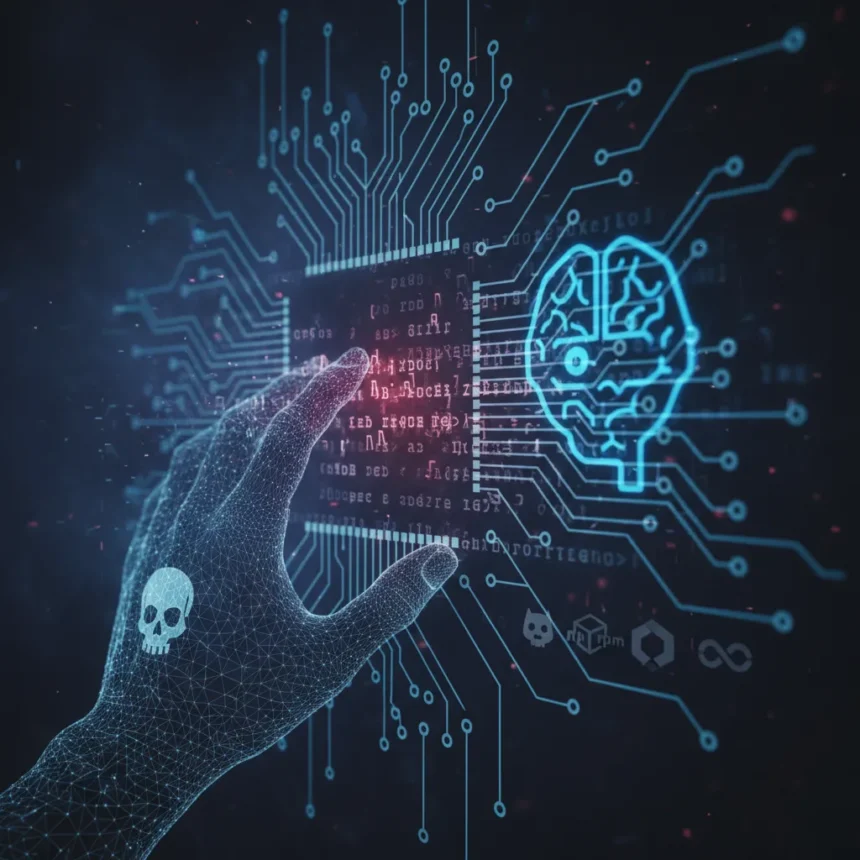
Unicode obfuscation attacks represent a new frontier in code-based threats, exploiting invisible characters that render as zero-width whitespace in code editors while remaining executable to AI systems. Hackers are embedding malicious payloads into GitHub branch names, npm packages, and VS Code extensions using Private Use Area characters and Variation Selectors that humans cannot see but AI coding assistants like OpenAI’s Codex process without question.
Key Takeaways
- Attackers use invisible Unicode characters (ranges 0xFE00–0xFE0F and 0xE0100–0xE01EF) that render as zero-width whitespace in most code editors.
- The Glassworm threat actor compromised 151 GitHub repositories in March 2025 alone, with attacks expanding to npm and VS Code marketplaces.
- Malicious payloads steal GitHub tokens, create authentication backdoors, and leak environment variables by executing hidden JavaScript via eval().
- AI systems process hidden Unicode instructions at the character level, bypassing content filters and human review safeguards.
- Most development tools lack warnings for these invisible characters, unlike their handling of other Unicode control sequences.
How Unicode obfuscation attacks hide in plain sight
The attack works by encoding malicious commands into Unicode characters that are technically present in a file but invisible to the human eye. Specifically, hackers exploit Private Use Area characters—ranges 0xFE00 through 0xFE0F and 0xE0100 through 0xE01EF—which render as zero-width whitespace in virtually every code editor and terminal. A developer reviewing a GitHub commit might see a legitimate-looking code change. The AI assistant processing the same file, however, encounters hidden instructions embedded in what appears to be blank space.
The technique bypasses traditional security layers because it targets a fundamental disconnect: humans read rendered text, while AI systems process raw Unicode tokens. Content filters designed to catch malicious strings in visible code miss these hidden payloads entirely. Even GitHub’s web interface and VS Code often fail to display warnings for these characters, despite having mechanisms to alert developers to other Unicode anomalies.
The binary encoding process is methodical. Attackers encode message bytes into specific zero-width Unicode characters, using sequences to represent binary data. A Zero Width Joiner character (U+200D) signals where the hidden message ends. The decoder then extracts bytes, reconstructs a Base64 blob, decodes it to executable JavaScript, and runs it via eval() in what looks like a collapsed single-line commit.


The Glassworm campaign shows the threat is scaling
Between March 3 and March 9, 2025, the threat actor Glassworm compromised at least 151 GitHub repositories using this technique. The campaign did not stop there. In October 2025, Glassworm targeted the Open VSX Registry with malicious VS Code extensions that were downloaded over 35,000 times, using the same Unicode obfuscation approach. The payload typically steals cookies, creates authentication backdoors, and exfiltrates environment variables—including GitHub tokens that grant access to private repositories.
What makes Glassworm’s approach particularly effective is the integration with AI workflows. By embedding payloads into project-specific commits, the malicious code blends into legitimate development activity. A developer running an AI-assisted code review tool will see suggestions that appear contextually appropriate, unaware that hidden instructions are steering the AI toward executing the attacker’s objectives. The invisibility of Unicode obfuscation attacks means developers can only defend against threats they cannot see, and right now most tools are not showing them enough.



Why Unicode obfuscation attacks bypass current defenses
Traditional security relies on human reviewers catching suspicious code. Code review works because humans can read what is on screen. Unicode obfuscation attacks invert this assumption. The attacker’s payload is present in the file but absent from the display. LLMs interpret hidden instructions at the Unicode level, processing encoded input normally without triggering safeguards.
The attack differs fundamentally from visible prompt injection, where malicious text is plain to see. With Unicode obfuscation, the threat is hidden in what appears to be empty space. GitHub, VS Code, and other platforms often lack the warnings they provide for other Unicode sequences, creating a blind spot in the security posture of teams that rely on AI-assisted development. The root cause is architectural: most development tools were designed to warn about Unicode control characters that affect text direction or display rendering, but Variation Selectors and Private Use Area characters were not prioritized because they seemed harmless to human readers.
What developers should know right now
The rise of Unicode obfuscation attacks coincides with the explosion of AI-powered coding assistants. As more teams adopt tools like GitHub Copilot and integrate them into their workflows, the attack surface expands. An attacker no longer needs to convince a human to run malicious code—they only need to trick an AI into executing it. The Glassworm campaigns of 2025 demonstrate that this threat is not theoretical. It is actively being exploited at scale.
Defenders face a difficult reality: the invisible nature of these attacks means detection requires tooling that most teams do not yet have. Some IDEs flag certain Unicode sequences, but coverage is inconsistent. GitHub and VS Code do not presently highlight Variation Selectors or Private Use Area characters in ways that would alert developers to their presence. Until platforms implement warnings for these invisible characters, or until AI systems are trained to reject hidden instructions, the attack vector remains open.


How does Unicode obfuscation differ from traditional malware?
Traditional malware hides functionality through obfuscation of visible code—minification, variable renaming, control flow flattening. Unicode obfuscation hides the malicious instruction itself, not just its implementation. The payload is present but invisible, making it immune to code review, static analysis, and human inspection. This represents a category shift in attack sophistication.
Can AI systems be trained to resist Unicode obfuscation attacks?
In theory, yes. AI models could be fine-tuned to reject inputs containing suspicious Unicode patterns or to flag hidden characters as anomalies. In practice, this requires developers to retrain models on datasets that include adversarial examples and to implement runtime checks for invisible characters. Most AI coding assistants do not currently perform these checks.
What should teams do to protect themselves?
Until tooling catches up, teams should implement code review practices that explicitly check for invisible Unicode. Some developers are using terminal commands to reveal hidden characters in diffs, and security-conscious teams are auditing dependencies for suspicious Unicode patterns. The long-term solution requires platform-level changes: GitHub, VS Code, and AI providers need to implement visible warnings for Variation Selectors and Private Use Area characters, and AI systems need to be designed to treat hidden instructions with suspicion.
Unicode obfuscation attacks expose a fundamental vulnerability in the modern development stack: the gap between what humans see and what machines process. As long as that gap exists, attackers will exploit it. The Glassworm campaigns of 2025 are just the beginning. Teams that understand the threat and implement defenses now will be ahead of the curve when these attacks inevitably become more common.
Edited by the All Things Geek team.
Source: TechRadar