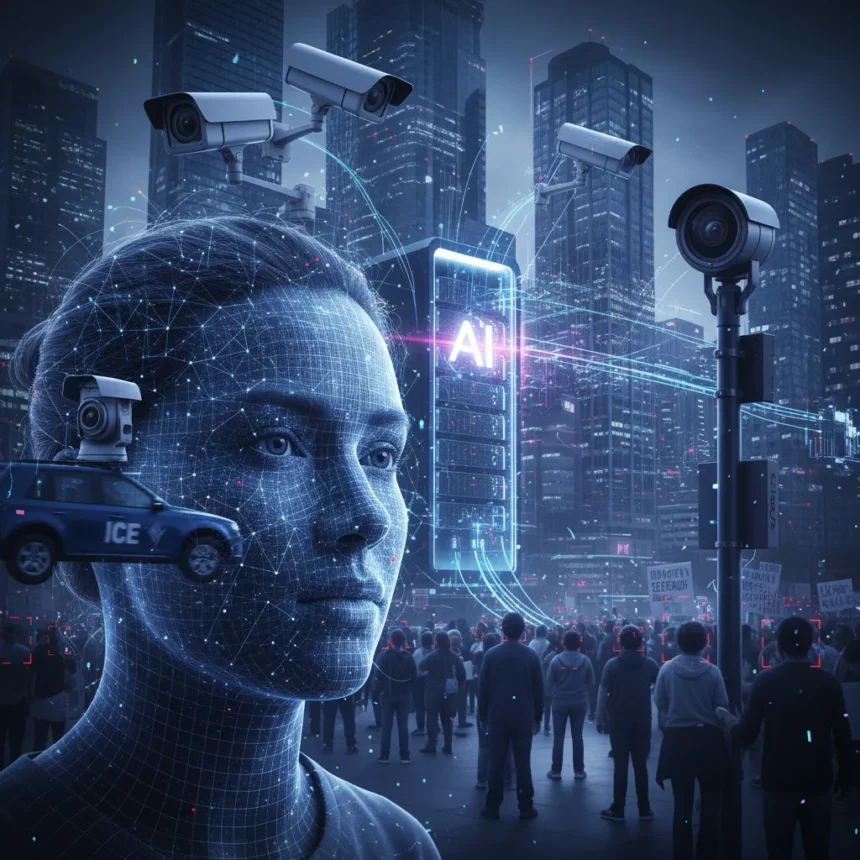
AI-driven mass surveillance is not a theoretical threat lurking in some distant future—it is already operating at scale across American cities and federal agencies, according to security experts and civil liberties advocates. The standoff between Anthropic and the Pentagon over AI’s military applications has exposed what many technologists have long argued: the surveillance infrastructure is live, functional, and expanding faster than policy can contain it.
Key Takeaways
- AI-driven mass surveillance already operates through facial recognition, license plate readers, and Flock cameras across thousands of US cities.
- ICE uses AI to combine license plate data, Ring doorbell footage, traffic cameras, and social media for immigration enforcement.
- Anthropic CEO warned that AI-driven mass surveillance poses “serious, novel risks to our fundamental liberties”.
- Signal boss Meredith Whittaker argues modern AI systems are fundamentally dependent on mass surveillance business models.
- Pentagon pressured Anthropic to remove restrictions on AI use for mass surveillance and autonomous weapons.
The Surveillance Infrastructure Is Already Built
Thousands of cameras equipped with artificial intelligence now scan American streets, parking lots, and public spaces. Over 80,000 Flock cameras—specialized license plate readers—have been deployed across the country and are directly accessed by Customs and Border Protection for surveilling immigrants and monitoring protests. These are not theoretical deployments or pilot programs. They are operational infrastructure processing real data on real people right now.
The shift from pre-AI surveillance to AI-powered systems fundamentally changes what is possible. Before artificial intelligence, matching a license plate to facial recognition data to social media profiles to shopping app records required hours of manual work—what one expert described as a Sisyphean task. AI collapses that workflow into seconds. What was once impractical due to human labor constraints is now trivial due to algorithmic speed. Privacy through obscurity—the old defense of being lost in the crowd—no longer exists.
Immigration and Customs Enforcement has weaponized this capability. ICE combines license plate readers, Ring doorbell data, traffic cameras, social media monitoring, and shopping app data through AI systems to identify and track people. The agency does not need a warrant for each data source. It simply aggregates what already exists in corporate databases and runs it through machine learning models. The result is a surveillance apparatus that would have required an army of agents to maintain two decades ago.



Why AI-Driven Mass Surveillance Depends on Data Extraction
The core problem, according to Signal’s Meredith Whittaker, is structural. Modern AI systems are not incidentally reliant on mass surveillance—they are fundamentally dependent on it. Whittaker, a former Google employee who organized a 2018 staff walkout and founded the AI Now Institute at NYU, argues that “The AI technologies we’re talking about today are reliant on mass surveillance” and require “huge amounts of data that are the derivatives of this mass surveillance business model”.
This business model emerged in the 1990s and has become the economic engine of the tech industry. Companies extract data from billions of users, monetize it through advertising and surveillance contracts, and use that same data to train AI systems. The cycle is self-reinforcing: more data enables better AI, which enables more efficient surveillance, which generates more data. Breaking this cycle would require fundamentally restructuring how tech companies operate—something unlikely to happen voluntarily.



Whittaker’s framing also challenges a common misconception: that AI surveillance is something governments impose on unwilling citizens. In reality, “Most of us are not the users of AI,” she notes. “Most of us are subjected to its use by our employers, by law enforcement, by governments”. The asymmetry is total. Individuals have no control over how AI systems classify, monitor, or judge them.
The Pentagon Wants Fewer Restrictions on Military AI
The dispute between Anthropic and the Pentagon reveals how governments view AI-driven mass surveillance not as a concern but as an asset to be maximized. Anthropic CEO Dario Amodei warned that “AI-driven mass surveillance presents serious, novel risks to our fundamental liberties”. The company initially negotiated terms that restricted AI use for mass surveillance of Americans and autonomous weapons deployment.
The Pentagon renegotiated those terms, threatening to label Anthropic a supply-chain risk if the company did not comply. This is not debate over hypothetical harms. This is a government agency actively pressuring a private AI company to remove safeguards against mass surveillance and autonomous weapons. And Anthropic, despite its stated commitment to responsible AI, faced the choice of capitulating or losing military contracts.
The standoff is instructive because it shows the real constraint on AI surveillance is not technical capability—that already exists—but contractual and political will. Governments have the leverage to demand fewer restrictions. Companies have financial incentives to comply. The public has almost no mechanism to intervene.


Historical Surveillance and the Role of AI
This is not the first time the United States has built mass surveillance infrastructure. A 2013 ACLU report titled “You are Being Tracked” documented license plate readers as a form of street-level surveillance, long before AI integration. Edward Snowden’s 2013 leaks revealed that the NSA and Pentagon had been conducting mass surveillance through telecommunications companies like AT&T and Google. What is new is not surveillance itself but the speed, scale, and opacity with which AI enables it.
The Electronic Frontier Foundation has long called license plate readers a form of “street-level surveillance” that threatens privacy. AI integration does not create surveillance—it turbocharts existing infrastructure. A license plate reader without AI is still a surveillance tool, but it requires human review of footage and manual database searches. A license plate reader with AI automatically matches plates to facial recognition databases, social media profiles, and law enforcement records in real time. The legal framework has not caught up because the technology moved faster than policy.
Who Controls AI Surveillance?
A handful of surveillance giants now control the AI systems that determine who gets monitored, who gets flagged, and who gets investigated. These companies operate largely outside public accountability. Whittaker argues that even when AI outputs are incorrect, they still enable classification and control. A misidentification by a facial recognition system can lead to arrest, detention, and legal consequences, regardless of accuracy.
The problem is compounded by the fact that most people are not even aware they are subjects of AI surveillance. Police departments, immigration agencies, and corporate security teams deploy these systems without public input, without transparency, and without meaningful oversight. By the time surveillance becomes visible—through leaks, lawsuits, or investigative journalism—it is already deeply embedded in operational systems.
Is AI-driven mass surveillance already happening?
Yes. Flock cameras operated by over 80,000 units across US cities, ICE facial recognition systems, and license plate readers integrated with AI are all operational today. The infrastructure is not planned or proposed—it is deployed and functioning.
Can AI-driven mass surveillance be stopped?
Stopping it would require either legislative action to ban or heavily restrict surveillance technology, or a fundamental shift in how companies and governments view data collection. Neither seems imminent. The Pentagon is actively pushing to remove restrictions, not add them.
What makes AI-driven mass surveillance different from traditional surveillance?
AI collapses what once required hours of manual work into seconds. A license plate, a face, social media data, and shopping records can now be cross-referenced instantly, creating a comprehensive profile of an individual’s movements and behavior. Traditional surveillance was labor-intensive and therefore limited in scope. AI surveillance is scalable to entire populations.
The threat is not coming. It is here. The question now is whether democracies can develop legal and technical safeguards faster than governments and corporations can deploy surveillance systems. So far, the answer is no.
Where to Buy
Edited by the All Things Geek team.
Source: TechRadar