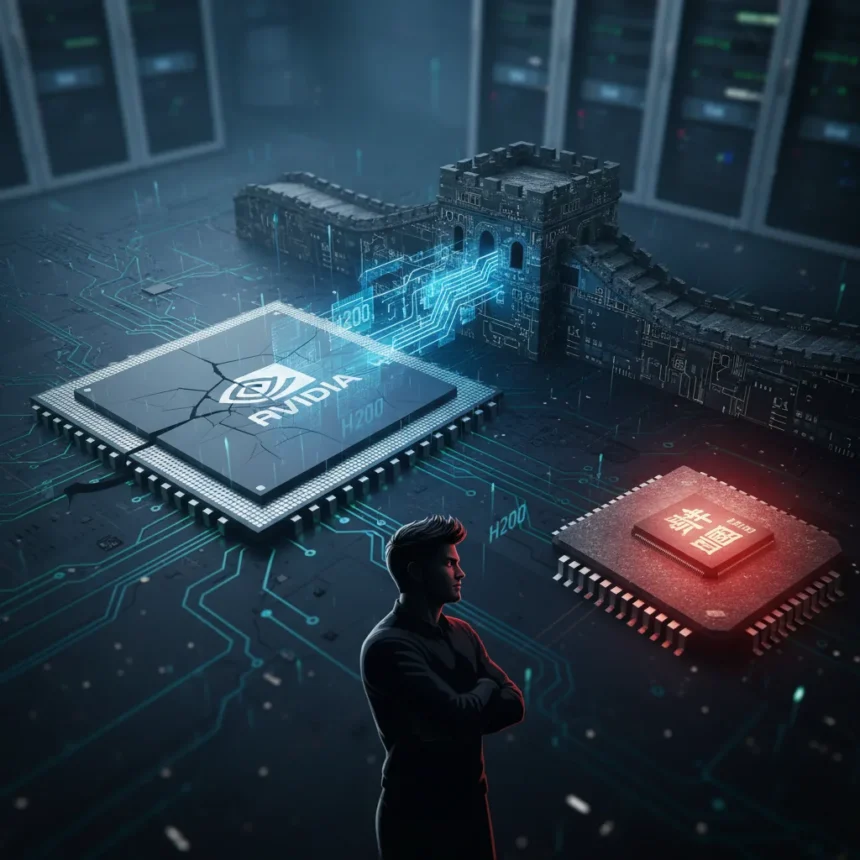
Nvidia H200 purchases are being blocked by China despite receiving approval from the US government, according to a statement from President Trump on Friday. The revelation exposes a critical gap between American export policy and actual market access—even when Washington permits sales, Beijing can independently prevent them from occurring.
Key Takeaways
- Trump stated China has “chose not to” allow Nvidia H200 purchases despite US approval to sell the chips
- The H200 is a powerful AI chip critical to the artificial intelligence race between superpowers
- China is prioritizing homegrown chip development instead of importing advanced US technology
- This contradicts Trump’s December 8, 2025 announcement permitting H200 sales to approved customers with a 25% surcharge
- Beijing previously blocked imports of the less powerful H20 variant, citing security concerns
The Policy Reversal Nobody Expected
In December 2025, Trump announced that Nvidia could sell H200 chips to “approved customers” in China, subject to a 25% surcharge. The decision signaled a shift from the Biden Administration’s strict export restrictions, which had aimed to prevent China from advancing in AI capabilities. That announcement appeared to open a narrow window for American semiconductor sales into the Chinese market. The Friday statement reveals that window was never actually open at all.
China’s decision to block Nvidia H200 purchases is not a formal US policy restriction—it is a Chinese government choice. This distinction matters enormously. It means that Washington’s export permission is only half the equation. Beijing holds the other half, and it has decided to reject the chips regardless of American approval. Trump characterized the situation as China having “chose not to” sanction purchases, framing it as an active decision rather than a passive restriction.
Why China Is Choosing Domestic Chips Over US Technology
The strategic calculus behind China’s block is clear: develop homegrown alternatives rather than depend on American semiconductor imports, even when those imports are technically permitted. This reflects a longer-term commitment to technological self-sufficiency in AI infrastructure. The H200 is described as a powerful and advanced chip critical to the artificial intelligence race, which makes it a strategic asset both sides want to control.



China has form on this. The country previously blocked imports of the H20, a less powerful variant of the H200, citing security concerns. That rejection opened space for Chinese competitors like Huawei to develop domestic alternatives without direct competition from US technology. The pattern suggests Beijing is willing to sacrifice near-term access to latest chips in exchange for long-term independence from American supply chains.
What This Means for the US-China Tech Competition
Trump’s statement signals that despite his earlier dovish approach to chip exports, the underlying geopolitical reality has not changed. China is doubling down on domestic chip development and rejecting US technology even when permitted to buy it. This is not a failure of Trump’s December policy—it is evidence that US export controls alone cannot determine market outcomes when the other side chooses to opt out entirely.



The Biden Administration had enacted strict export restrictions on advanced AI chips to prevent China from advancing in AI capabilities. Trump’s decision to permit H200 sales suggested a softer approach. But China’s independent block shows that Beijing’s strategy transcends any single US administration’s policy. Whether chips are restricted or permitted, China is committed to building its own ecosystem rather than relying on American suppliers.
Does This Change the AI Race?
The practical impact depends on how quickly China can develop competitive domestic alternatives. If homegrown chips reach parity with the H200 within 12 to 24 months, the block becomes a minor inconvenience. If the gap widens, China falls further behind in AI infrastructure. What is certain is that China’s refusal to buy American chips, even when allowed, accelerates its investment in domestic solutions. That acceleration could eventually produce competitors that challenge Nvidia’s dominance globally.
Can the US force China to buy Nvidia chips?
No. The US can permit or restrict exports, but it cannot compel foreign governments to purchase American products. China’s block is a sovereign decision. The only leverage the US has is whether to permit sales in the first place—a choice Trump already made in December 2025. Beyond that, market access is determined by Beijing.
What is the difference between the H200 and H20?
The H20 is a less powerful variant that China previously rejected citing security concerns. The H200 is described as a more advanced and powerful AI chip. Both face the same barrier now: China’s decision to prioritize domestic development over US imports.


Will China’s homegrown chips compete with Nvidia?
That remains uncertain. China is investing heavily in domestic chip development to reduce dependence on American technology. Whether those chips will reach performance parity with the H200 depends on China’s engineering capabilities and timeline. The block suggests Beijing is confident enough in its domestic path to reject US alternatives entirely, but confidence and capability are not the same thing.
Trump’s Friday statement reveals a hard truth: export permission is not the same as market access. Even when Washington opens the door, Beijing can choose not to walk through it. China’s block of Nvidia H200 purchases signals a long-term commitment to technological independence that transcends any single trade policy or administration. The real competition is not over whether China can buy American chips—it is over whether China can build chips good enough that it does not need to.
Edited by the All Things Geek team.
Source: Tom's Hardware