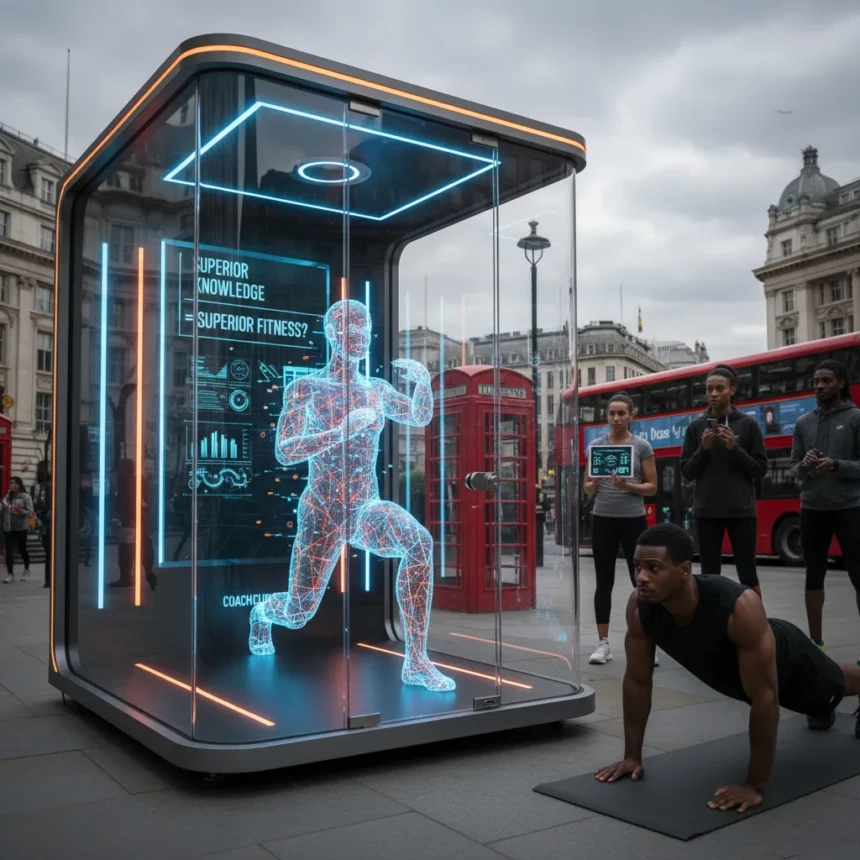
CoachCube is an AI personal trainer housed inside a futuristic Tron-style booth located in central London, offering interactive gym classes in a controlled environment. The system has drawn attention for its immersive setup and the claim that it possesses knowledge beyond what human trainers can offer. But does a sleek physical space and algorithmic superiority actually translate into better workouts?
Key Takeaways
- CoachCube is an AI personal trainer operating from a Tron-style booth in central London.
- The system delivers interactive, personalized gym classes in an immersive controlled environment.
- Users report the AI demonstrates superior knowledge compared to traditional human trainers.
- The experience emphasizes technological novelty and data-driven coaching feedback.
- Availability is currently limited to the central London location.
What Makes CoachCube Different From Traditional Personal Trainers
The core promise of CoachCube centers on computational advantage. Unlike a human trainer bound by personal experience and certification, an AI personal trainer can theoretically process vast datasets about exercise science, biomechanics, and performance optimization simultaneously. Users who have tried the system report that it delivers coaching insights that feel more comprehensive than what they would receive from a standard gym professional. The quote capturing this sentiment—”This just knows so much more than a human ever could”—reflects the appeal of algorithmic depth over human intuition.
However, this claim warrants scrutiny. Superior knowledge does not automatically equal superior results. A human trainer provides real-time form correction, motivation, and adaptability to sudden pain or discomfort that requires judgment calls, not just data. An AI personal trainer excels at pattern recognition and personalized rep schemes but cannot physically adjust your spine or sense when you are mentally fatigued. The comparison is not as simple as “machine beats human.”
The Immersive Booth Experience and Its Limitations
The Tron-style booth design is undeniably striking. A controlled environment booth eliminates gym distractions—no mirrors creating vanity obsession, no strangers staring, no music competition from adjacent equipment. This setup appeals to users who find traditional gyms overwhelming or those seeking a sci-fi aesthetic alongside their fitness routine. The immersive interactive session format suggests real-time feedback, visual cues, and perhaps gamification elements that could boost engagement.



Yet immersion is not the same as effectiveness. A polished environment and slick technology can feel premium without delivering measurable fitness gains. Without access to comparative data—how CoachCube users progress versus traditional gym members or other AI coaching platforms—the appeal remains largely experiential. The technology looks futuristic. Whether it produces results faster or more sustainably than conventional training remains unproven in the available information.
AI Personal Trainer Knowledge: What It Can and Cannot Do
An AI personal trainer excels at several tasks. It can prescribe exercise selection based on your goals, adjust volume and intensity across sessions, and provide form cues via visual feedback. It can track micro-progressions that humans might miss and suggest variations when plateaus occur. These are real advantages, particularly for users who cannot afford or access quality coaching.



Where AI personal trainers struggle is contextual judgment. If your knee feels unstable mid-set, a human trainer watches your movement and makes a call: modify the range of motion, switch exercises, or stop. An AI can offer a decision tree, but it cannot feel the instability itself. CoachCube’s superiority in raw knowledge does not eliminate this gap. For beginners or those returning from injury, this limitation is significant. A safety note for users considering AI-coached training: if you are new to exercise, recovering from injury, or pregnant or postpartum, consult a qualified physical therapist or certified trainer before relying solely on algorithmic guidance.
Is CoachCube Worth the Novelty Factor?
CoachCube occupies an interesting position: it is neither a cheap app subscription nor a traditional personal trainer. It is a physical location in central London offering an experience that blends technology and fitness. That positioning matters. If you value immersion, prefer algorithm-driven coaching, and live near or can travel to the booth location, the appeal is clear. If you are seeking the absolute best fitness results or live outside London, the novelty wears thin quickly.
The real question is whether CoachCube delivers sustained behavior change and measurable progress. An AI personal trainer that keeps you consistent, adjusts your program intelligently, and removes friction from decision-making has genuine value. But none of these benefits require a Tron-style booth. A well-designed app could deliver the same coaching logic. CoachCube’s premium positioning seems to rest on experience and aesthetics as much as on algorithmic superiority.
How Does CoachCube Compare to Other Fitness Solutions?
CoachCube operates in a space where few direct competitors exist. Traditional personal trainers offer human judgment and real-time adjustment but lack algorithmic precision. Fitness apps provide convenience and data tracking but cannot monitor form or provide immediate corrections. CoachCube attempts to bridge both by combining AI coaching with an immersive physical environment. The booth itself is the differentiator—a physical anchor that app-based AI trainers cannot replicate. Whether that anchor justifies the commitment depends entirely on your location and preferences.


Should You Try CoachCube?
If you live in or near central London, value technological novelty, and are curious about AI-guided fitness, CoachCube is worth a trial session. The immersive environment and algorithmic coaching offer a genuinely different experience from standard gyms. If you are seeking the fastest path to fitness results, however, consistency with any training method—human, algorithmic, or hybrid—matters far more than the method itself. CoachCube’s real strength is engagement, not magic.
What kind of exercises does CoachCube provide?
The research available does not specify the exact exercise library or workout types offered by CoachCube. The system delivers interactive gym classes in its booth environment, but detailed information about exercise selection, programming styles, or workout categories is not disclosed. Users should contact the London location directly for specifics about class structure and exercise variety.
Can I use CoachCube remotely or only in the London booth?
CoachCube is currently available as a physical experience in its central London booth location. There is no information about remote access, app-based versions, or expansion to other cities. If you are interested in using the service, you would need to visit the London booth in person for the interactive session.
How much does CoachCube cost?
Pricing information for CoachCube is not publicly available in current sources. To learn about session costs, membership options, or trial rates, you would need to contact the service directly through its London location or official channels.
CoachCube represents an intriguing fusion of AI coaching and immersive design, but it is ultimately a location-specific novelty rather than a fitness revolution. The real test of any AI personal trainer—whether housed in a futuristic booth or delivered through an app—is whether it keeps you consistent and progressing. Technology can facilitate that. It cannot replace discipline.
Edited by the All Things Geek team.
Source: TechRadar