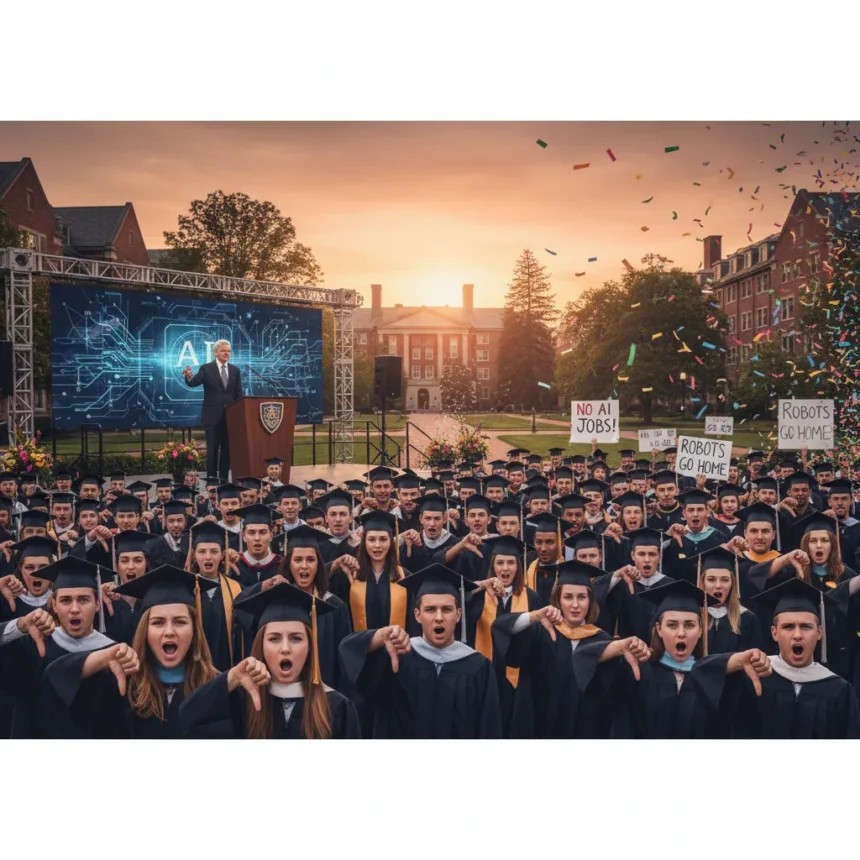
College students AI anxiety reached a breaking point during commencement season when graduates openly booed speakers celebrating artificial intelligence’s potential. The University of Arizona’s ceremony became the flashpoint for a broader generational clash: optimistic tech leaders painting AI as transformative, while students entering a precarious job market heard only existential threat.
Key Takeaways
- Eric Schmidt, former Google CEO, faced sustained booing when praising AI’s role in shaping the future at University of Arizona commencement
- Multiple commencement speakers received similar heckling for positive AI remarks, signaling coordinated student concern
- One speaker responded to boos with “deal with it,” dismissing student anxiety rather than engaging with it
- College students AI anxiety centers on automation’s threat to entry-level positions, the traditional gateway for new graduates
- The backlash reveals a generational divide: tech executives see AI as inevitable progress; graduates see it as a job killer
Why College Grads Are Rejecting AI Hype
College students AI anxiety is not abstract worry—it is rooted in immediate economic reality. Graduates entering the workforce face a job market already squeezed by automation, and now they are being told by the very executives who built AI systems that this disruption is necessary and good. Schmidt’s statement that AI will “shape the world” landed as tone-deaf optimism to an audience worried about whether they will have jobs to shape their own futures.
The booing at University of Arizona was not a spontaneous outburst. It reflected months of campus discourse about AI’s labor displacement, coverage of mass tech layoffs, and growing skepticism toward Silicon Valley’s framing of disruption as progress. For students facing unpaid internships, contract work, and gig economy positions as their realistic entry-level options, hearing a billionaire tech founder celebrate AI feels less like inspiration and more like dismissal of their legitimate fears.
The “deal with it” response from one unnamed speaker crystallized the generational contempt. Rather than acknowledging student concerns about automation, job scarcity, or the concentration of AI wealth, the speaker essentially told graduates to accept whatever future tech leaders have already decided for them. That callousness likely made the booing louder.



The Commencement Speech as Battleground
Commencement addresses have become flashpoints for culture war debates, but the college students AI anxiety backlash is different. This is not ideological posturing—it is economic self-interest. Graduates understand that entry-level roles in content creation, customer service, data analysis, and software testing are precisely the jobs AI systems are designed to automate. When a former Google CEO tells them AI will reshape the world, they hear: your first job might not exist in two years.
Multiple speakers faced similar heckling across commencement season, suggesting this is not isolated student activism but a widespread generational sentiment. The pattern indicates that college students AI anxiety has reached critical mass on campuses. It is no longer fringe concern—it is mainstream graduate opinion.



The contrast between speaker optimism and student skepticism exposes a fundamental communication failure. Tech executives have spent years selling AI as a tool that will free humans from drudgery and enable more creative work. Graduates, facing actual labor market conditions, are not buying that pitch. They want concrete reassurance about employment, not philosophical arguments about technological inevitability.
What This Means for AI’s Cultural Acceptance
The booing at University of Arizona and beyond signals that college students AI anxiety could become a serious obstacle to AI adoption and public trust. If the generation entering the workforce views AI primarily as a threat rather than an opportunity, they will be far less likely to build careers around it, invest in AI skills, or support policies favorable to rapid AI deployment.
Tech leaders have long assumed that younger generations would be more accepting of AI because they grew up with technology. That assumption is proving dangerously wrong. College students AI anxiety is not technophobia—it is rational assessment of their own economic vulnerability. They have watched their older siblings and parents displaced by previous waves of automation. They know that “retraining programs” and “new opportunities” are corporate talking points, not guarantees.
The dismissive “deal with it” response will likely backfire. Graduates who feel unheard and disrespected by tech leadership are more likely to support regulatory constraints on AI, push for stricter labor protections, or simply refuse to participate in AI-driven industries. That could reshape the entire AI ecosystem far more than any technical breakthrough.



Is college students AI anxiety justified?
College graduates face genuinely uncertain job prospects as AI systems automate entry-level roles. Their anxiety is not irrational fear—it reflects observable labor market trends and the explicit capabilities of current AI systems. Whether AI ultimately creates more jobs than it destroys remains an open question that tech leaders cannot credibly answer.
Why did speakers keep praising AI despite knowing students would react negatively?
Commencement speakers, particularly from tech companies, are often selected precisely because they represent innovation and future-thinking. Praising AI aligns with that brand positioning. Many speakers likely underestimated how deeply college students AI anxiety had penetrated campuses, or they believed their optimistic framing would persuade skeptical audiences rather than inflame them.
What happens next for AI adoption among new graduates?
College students AI anxiety could drive a generational shift in how AI is developed and deployed. If the workforce most directly affected by AI automation views the technology with suspicion, demand for AI-centric careers may decline, and political pressure for stronger labor protections may increase. Tech companies will need to move beyond dismissive rhetoric and address real economic concerns if they want the next generation to embrace their vision.
The booing at University of Arizona was not just noise—it was a warning. Tech leaders spent decades assuming they could shape the future without meaningful consent from those most affected by it. College students AI anxiety suggests that era may be ending. If executives want graduates to build the AI future with them rather than against them, they will need to start listening instead of telling students to “deal with it.”
Edited by the All Things Geek team.
Source: Tom's Hardware