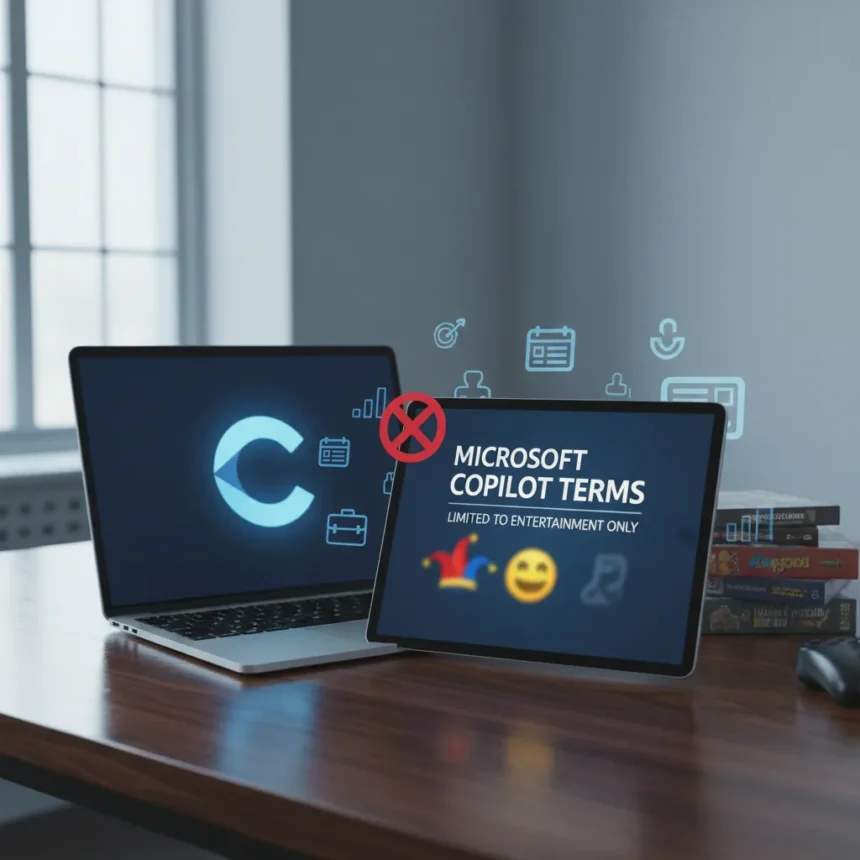
Microsoft Copilot terms of service explicitly state that the service is “for entertainment purposes only” and users should not rely on it for important advice, despite Microsoft’s aggressive push to position Copilot as a serious productivity tool for consumers and enterprises.
Key Takeaways
- Microsoft Copilot terms explicitly label the service as entertainment-only, contradicting its consumer marketing positioning.
- Users assume all liability for Copilot’s mistakes and consequences of actions it takes on their behalf.
- The terms apply to standalone apps, copilot.microsoft.com, copilot.com, copilot.ai, and third-party integrations.
- Non-commercial use only; the Pro plan prohibits professional or business purposes.
- Competitors like Claude and ChatGPT do not label their services as entertainment-only despite similar accuracy disclaimers.
What Microsoft Copilot Terms Actually Say
The entertainment-only restriction appears directly in Microsoft’s official terms of use: “Copilot is for entertainment purposes only. It can make mistakes, and it may not work as intended. Don’t rely on Copilot for important advice. Use Copilot at your own risk”. This language is unusually restrictive compared to how Microsoft markets the product to mainstream users and businesses.
The terms apply broadly across multiple platforms and services. They cover the standalone Copilot apps on computers and mobile devices, the web interfaces at copilot.microsoft.com, copilot.com, and copilot.ai, conversations embedded in other Microsoft applications and websites, and any third-party apps or platforms that link to these terms. The only major exclusion is Microsoft 365 Copilot enterprise services, which operate under separate licensing.
Microsoft explicitly states that users are solely responsible for any actions Copilot takes on their behalf and for all consequences that result. The company also reserves the right to limit the service’s speed or performance at any time without notice. This shifts all liability away from Microsoft and onto the user, even when the AI system produces incorrect or harmful output.



The Liability Shield vs. Consumer Marketing
The entertainment-only framing serves as a liability shield. Microsoft aggressively integrates Copilot into Word, Excel, Outlook, and other consumer productivity tools, marketing it as a transformer for how people work and create. Yet the terms explicitly disclaim responsibility for any loss of profit, business interruption, or business opportunity that results from using the service.
This creates a legal contradiction: Microsoft positions Copilot as a serious workplace tool while the fine print restricts it to entertainment and disclaims liability for business harm. If a user relies on Copilot to draft an important email, analyze financial data, or generate code for a professional project, they are technically violating the terms and cannot seek damages if the AI produces a mistake that costs them money or reputation.



The Pro plan explicitly prohibits professional and commercial use, adding another layer of restriction. Free users operating under the standard terms face the same entertainment-only restriction. This means neither free nor paid consumers can legitimately use Copilot for work-related tasks according to the legal language, even though Microsoft’s marketing materials and product placement suggest otherwise.
How This Compares to Other AI Services
Competitors like Claude, ChatGPT, and Google Gemini include standard disclaimers about accuracy and potential errors in their terms, but none explicitly label their services as “for entertainment purposes only”. They acknowledge that AI systems can hallucinate or produce incorrect output, but they do not restrict users to entertainment use only. This distinction matters legally and practically—it allows users of competing services to rely on them for serious tasks while assuming the risks, whereas Microsoft’s terms appear to forbid serious use entirely.
The gap between how Microsoft markets Copilot and what the terms permit reveals a company hedging its bets. Copilot is embedded in productivity software, promoted as an AI assistant for work, and positioned as a competitive response to ChatGPT and other generative AI tools. Yet the terms read like a disclaimer for a novelty toy. This mismatch creates confusion for users who reasonably expect a tool integrated into Word or Outlook to be suitable for work purposes.
Content Restrictions and User Responsibility
Beyond the entertainment-only restriction, the terms prohibit a broad range of content: adult material, violence or gore, hateful content, terrorism or violent extremism, glorification of violence or suicide, child sexual exploitation or abuse, disturbing or offensive content, and deepfakes without permission. These prohibitions are standard across consumer AI services, but they add another layer of potential liability for users who might unknowingly trigger them.


Microsoft reserves the right to limit service performance or speed as necessary, giving the company flexibility to throttle or restrict access without providing specific notice or explanation. Users have no recourse if Copilot becomes unavailable or degrades during a task they are attempting.
Why This Matters Now
The entertainment-only restriction has surfaced as a point of contradiction at a critical moment. Microsoft is spending billions integrating Copilot into Windows, Office, and other core products. The company is betting that AI assistants will become as essential as search engines. Yet the legal fine print suggests Microsoft does not trust Copilot enough to stand behind it for serious use. This is a red flag for consumers and businesses considering whether to rely on the service for important decisions or work.
What Should Users Actually Do?
If you use Copilot, treat it as a brainstorming tool or starting point, not a source of truth. Verify any factual claims independently. Do not rely on it for medical, legal, financial, or safety-critical advice. If you use it for work, understand that you are technically violating the terms and accept full liability for any mistakes. For serious productivity tasks, consider whether competing services with less restrictive terms better match your needs.
Does Microsoft Copilot have different terms for business users?
Yes. Microsoft 365 Copilot, the enterprise version embedded in Microsoft’s business applications, operates under separate licensing and terms that differ from the consumer entertainment-only restriction. However, the free and Pro versions of standalone Copilot are subject to the entertainment-only limitation regardless of how users actually employ them.
Can I use Copilot Pro for work or professional tasks?
According to the terms, no. The Pro plan explicitly prohibits professional and commercial use. Users who purchase a subscription to Copilot Pro and then use it for work-related tasks are technically breaching the terms of service, even if Microsoft does not actively enforce this restriction.
Why does Microsoft label Copilot as entertainment-only when it’s integrated into work software?
The entertainment-only label appears to be a liability mitigation strategy. By explicitly restricting the service to entertainment, Microsoft limits its legal exposure if users rely on Copilot for serious tasks and the AI produces harmful, incorrect, or incomplete output. This protects the company from lawsuits while still allowing it to market Copilot aggressively as a productivity tool. The contradiction between marketing and terms reflects the tension between Microsoft’s ambitions for Copilot and its legal caution about AI reliability.
The gap between how Microsoft markets Copilot and what the terms actually permit reveals a company that wants to lead the AI revolution without fully committing to the reliability that serious users demand. Until Microsoft updates these terms to reflect the actual use cases it is promoting, consumers and businesses should approach Copilot with skepticism and verify any output independently before relying on it for decisions that matter.
Edited by the All Things Geek team.
Source: Tom's Hardware