





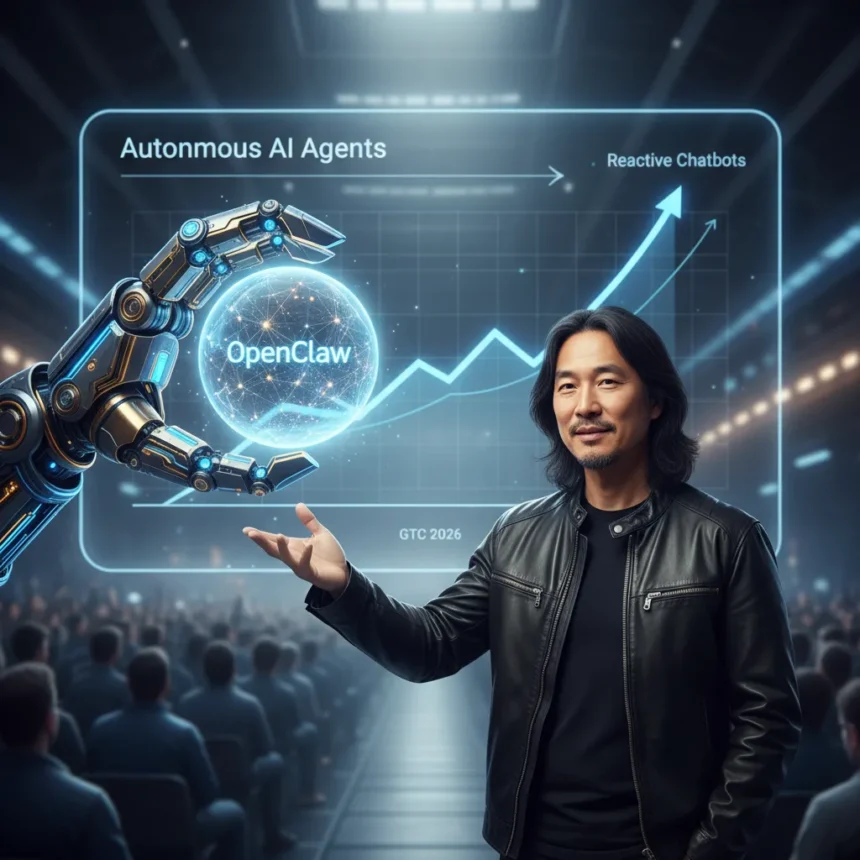
OpenClaw agentic AI represents the next major inflection point in artificial intelligence, according to Nvidia CEO Jensen Huang, who called it “definitely the next ChatGPT” in recent comments to CNBC. But OpenClaw is not a chatbot refinement—it is a fundamentally different category of AI tool designed to act autonomously rather than respond to prompts. Huang’s endorsement carries particular weight because Nvidia dominates the infrastructure powering nearly every major AI model, from OpenAI’s systems to Meta’s platforms.
Key Takeaways
- Nvidia CEO Jensen Huang called OpenClaw “definitely the next ChatGPT,” signaling a major industry shift toward autonomous AI agents
- OpenClaw agentic AI runs locally on user hardware with continuous memory, custom tool integration, and full control—unlike ChatGPT’s cloud-based, session-based design
- Huang compared OpenClaw’s importance to foundational technologies like Linux, Kubernetes, and HTML at GTC 2026
- Nvidia launched NemoClaw and OpenShell at GTC 2026 to position itself in the emerging agentic AI market
- Setup requires 30-60 minutes and moderate-to-high technical skills, compared to ChatGPT’s zero-setup convenience
What OpenClaw Agentic AI Actually Does
OpenClaw agentic AI is an open-source, self-hosted agent that operates independently on local machines or servers, executing tasks without waiting for user input. Unlike ChatGPT, which reacts to messages in a single conversation session, OpenClaw maintains continuous memory across sessions, integrates custom tools, and can monitor conditions or run long-duration tasks autonomously. This architectural difference matters enormously. A chatbot answers questions. An agent takes action.
The technology enables companies to deploy AI systems that operate with full local data privacy, execute complex workflows, and integrate directly with proprietary tools and systems. Think of ChatGPT as a highly capable assistant you must explicitly ask for help. Think of OpenClaw agentic AI as a system that runs in the background, learning your needs and acting on them without constant supervision. Huang stated that OpenClaw has “opened the next frontier of AI to everyone” and that “every company now needs to have an OpenClaw strategy”.
OpenClaw Agentic AI vs ChatGPT: The Core Divide
The comparison reveals why Huang sees OpenClaw agentic AI as transformative rather than incremental. ChatGPT operates as a cloud service with zero setup, session-based memory that resets between conversations, pre-built tools only, and a flat $20-per-month subscription. It excels at one-off tasks: writing, summarizing, quick code generation, supervised research. The trade-off is that your data flows through OpenAI’s servers.



OpenClaw agentic AI flips the model entirely. Setup takes 30-60 minutes and requires moderate-to-high technical skills. Data stays local. Memory persists continuously. You integrate whatever tools you need. Costs depend on which underlying AI model you choose—OpenAI’s API, Anthropic’s Claude, open-source models, or services like OpenRouter. For automation, long-running tasks, and systems requiring real access to your infrastructure, OpenClaw wins decisively. For casual users wanting a polished, zero-friction experience, ChatGPT remains superior.
Nvidia’s Bet on Agentic AI Infrastructure
Huang’s endorsement is not abstract cheerleading. At GTC 2026 in San Jose, Nvidia announced two tools to dominate the emerging agentic AI market: NemoClaw and OpenShell. NemoClaw is an open tool compatible with any coding agents and open models like Nemotron, running locally or in the cloud via Nvidia’s privacy router, and compatible with GeForce RTX PCs, laptops, RTX PRO workstations, and DGX systems. OpenShell is a new capability in Nvidia’s Agent Toolkit (formerly NeMo Agent Toolkit) that includes Nemotron models and AI-Q architecture for custom enterprise agents.



Huang framed OpenClaw agentic AI as foundational infrastructure equivalent to Linux, Kubernetes, and HTML—technologies that shaped entire eras of computing. He argued that “Claude Code and OpenClaw have sparked the agent inflection point, extending AI beyond generation and reasoning into action”. This positioning matters. ChatGPT launched in late 2022 and ignited the generative AI boom. If Huang is right, OpenClaw agentic AI represents the next phase: AI that does things, not just generates text.
Why This Matters Now
The timing reflects genuine industry momentum. Companies have spent two years learning what ChatGPT can do—and hitting its limitations. A chatbot cannot monitor your servers, automate your workflows, or maintain context across weeks of independent operation. OpenClaw agentic AI addresses that gap. The endorsement from Nvidia’s CEO signals that major infrastructure vendors are betting heavily on agentic systems as the next battleground.
However, OpenClaw agentic AI’s reliance on self-hosting and technical expertise creates a ceiling for adoption. ChatGPT’s simplicity is part of its genius. Most users will never set up OpenClaw, just as most users never deployed their own Linux servers. But for organizations with technical teams and complex automation needs, OpenClaw represents a genuine leap forward in capability and control.
Is OpenClaw agentic AI ready for production use?
OpenClaw is available now as an open-source project, with Nvidia’s supporting tools announced at GTC 2026. Setup requires 30-60 minutes and moderate-to-high technical skills, so it is not for casual users. For developers and enterprises with the bandwidth to configure it, production readiness depends on the underlying models and your specific use case.



How does OpenClaw agentic AI differ from other AI agents?
OpenClaw agentic AI emphasizes local hosting, continuous memory, custom tool integration, and full user control. Most competing agents either run in the cloud with limited customization or require significant infrastructure expertise. OpenClaw splits the difference: more control than cloud services, but still accessible to teams with moderate technical skills.
Should companies build an OpenClaw strategy?
Huang believes they should, stating that “every company now needs to have an OpenClaw strategy”. For organizations with automation needs, data privacy concerns, or complex tool ecosystems, exploring OpenClaw agentic AI makes sense. For teams without technical depth or simple use cases, ChatGPT remains the pragmatic choice. The real opportunity is not choosing one or the other, but understanding when each tool fits.
OpenClaw agentic AI represents a genuine inflection point, not hype. Whether it becomes as foundational as Linux or remains a specialized tool for technical teams will depend on how quickly the ecosystem matures and whether simpler deployment options emerge. For now, Huang’s bet signals that the next era of AI competition is not about better chatbots—it is about autonomous systems that act on your behalf.
Edited by the All Things Geek team.
Source: Tom's Guide




