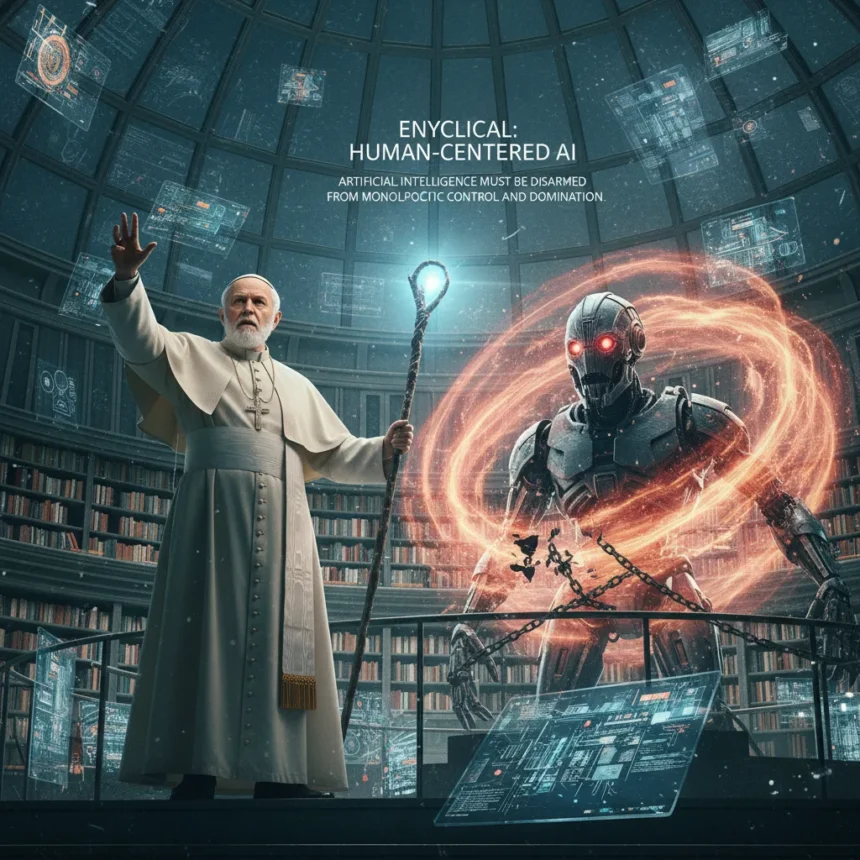
Pope Leo XIV’s first encyclical, titled Magnifica Humanitas, warns that AI must be disarmed from the forces turning it into an instrument of domination. Released in May 2026, the document represents one of the Vatican’s strongest modern statements on artificial intelligence governance, framing the technology as a defining challenge of the modern age.
Key Takeaways
- Pope Leo XIV’s encyclical Magnifica Humanitas argues AI must be disarmed from monopolistic control and domination logics.
- Disarming technology means preventing it from dominating humanity while preserving its beneficial uses.
- The pope calls for responsibility to be clearly defined at every stage: designers, developers, users, and decision-makers.
- The encyclical explicitly forbids entrusting irreversible, lethal decisions to AI systems in military operations.
- The Vatican warns that unchecked AI threatens ethics, global stability, and human dignity across society.
What Does AI Must Be Disarmed Actually Mean?
AI must be disarmed does not mean rejecting technology outright. Rather, Pope Leo XIV argues it means preventing artificial intelligence from dominating humanity and freeing it from the logics that turn it into an instrument of domination, exclusion, and death. The pope distinguishes between the technology itself and the power structures that control it. Disarming, in his framing, requires opening technology to public discussion and debate, making it human-friendly, and restoring it to the plurality of human cultures and ways of life. This is a call for governance, not abandonment.
The encyclical emphasizes that responsibility must be clearly defined at every stage of AI development and deployment—from those who design and develop these systems to those who use them and rely on them for concrete decisions. The Vatican’s position mirrors historical Church support for nuclear disarmament, extending that moral logic to artificial intelligence as a technology capable of reshaping society beyond human control.
The Gandalf Reference and Small Acts of Fidelity
Pope Leo XIV reinforces his argument with a passage associated with Gandalf from The Lord of the Rings: It is not our part to master all the tides of the world, but to do what is in us for the succour of those years wherein we are set, uprooting the evil in the fields that we know, so that those who live after may have clean earth to till. The literary reference is not accidental. The pope uses it to argue that humanity’s defense against dehumanization will come not from grand technological solutions but from small and steadfast acts of fidelity rooted in compassion and human connection. This frames the AI governance struggle as fundamentally moral rather than merely technical.



The choice of Tolkien’s language gives the Vatican’s warning unusual cultural reach. By invoking a beloved fictional wizard rather than purely theological language, the pope speaks to a global audience wrestling with AI’s rapid expansion into education, art, music, employment, and daily life.
The Broader Warnings: Military, Labor, and Monopoly
The encyclical goes beyond abstract principles to condemn specific harms. It explicitly states that it is not permissible to entrust irreversible, lethal decisions to AI systems. This directly addresses the use of artificial intelligence in military operations and autonomous weapons development. The Vatican warns against a race for more powerful algorithms driven by geopolitical and commercial competition, a competition that prioritizes power over ethics.



Pope Leo XIV also identifies what he calls a culture of power driving the development of increasingly sophisticated systems. The document warns about job losses, opaque algorithms that users cannot understand or challenge, and new forms of slavery linked to AI expansion. These concerns reflect real anxieties across societies where AI adoption has accelerated without robust worker protections or transparency requirements. The pope calls for strong global regulation, independent oversight, and ethical safeguards to ensure AI serves humanity rather than profit or war.
Historical Framing: Why This Moment Matters
The pope contextualizes the AI challenge by referencing historical turning points: the Industrial Revolution, World War II, and the fall of the Berlin Wall. Each represents a moment when technology or geopolitics reshaped human civilization. The Vatican’s argument is that we stand at a similar inflection point with artificial intelligence. Unlike those previous moments, however, we have the opportunity to choose a different path—one where AI remains under human control and serves the common good rather than domination.
This historical framing rejects the inevitability narrative that often surrounds AI development. The Vatican is not arguing that powerful AI systems are an unstoppable force to which humanity must adapt. Instead, it insists that humans retain agency and moral responsibility to shape how the technology develops and deploys.
What Does the Vatican Want?
The encyclical’s practical demands include legal oversight, worker protections, safeguards for children, and transparency in algorithmic decision-making. These are not abstract theological positions but concrete governance measures. The pope calls on world leaders and tech companies to ensure AI remains under human control and warns that monopolistic control by governments or corporations could threaten humanity, ethics, and global stability. The document positions the Church as a moral voice demanding accountability from both state and corporate actors in the AI race.


Is Pope Leo XIV rejecting all AI development?
No. The encyclical explicitly states that disarming technology does not mean rejecting it. Pope Leo XIV distinguishes between the technology itself and the systems of power and profit that control it. The goal is to prevent domination while preserving beneficial uses.
What does the Gandalf quote have to do with AI governance?
The pope uses the passage to argue that meaningful resistance to AI domination comes through small, faithful acts of compassion and human connection rather than grand technological solutions. It frames the challenge as fundamentally moral and human-centered rather than technical.
Does the Vatican call for banning AI in military use?
Yes, the encyclical explicitly forbids entrusting irreversible, lethal decisions to AI systems in military operations. The pope argues this crosses a moral line that cannot be crossed, regardless of strategic advantage or efficiency claims.
Pope Leo XIV’s encyclical arrives at a moment when AI’s rapid expansion has triggered backlash across art, music, education, and employment. The Vatican’s intervention carries moral weight precisely because it refuses to treat AI as a purely technical matter. By invoking Gandalf, demanding disarmament, and calling for human-centered governance, the pope reframes the conversation: this is not about whether AI is powerful or inevitable, but about whether humanity will retain control over its own future.
Where to Buy
Apple MacBook Neo | Apple MacBook Neo | Apple MacBook Neo
Edited by the All Things Geek team.
Source: Tom's Guide