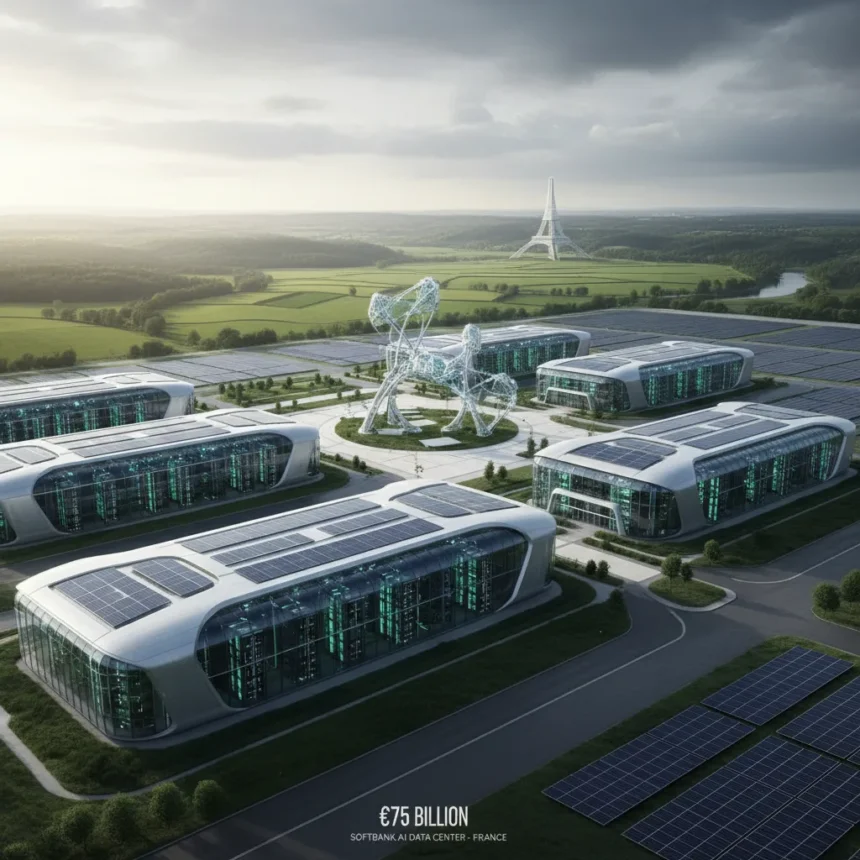
AI data center investment in Europe just hit a new high-water mark. SoftBank Group plans to pour up to €75 billion (roughly $87 billion) into French AI data centers, targeting 5 gigawatts of total capacity in a buildout that the company describes as its biggest AI infrastructure commitment on the continent. The scale is staggering, the timeline stretches to 2031, and the logic behind choosing France over the United States says something important about where the global AI infrastructure race is heading.
Key Takeaways
- SoftBank plans to invest up to €75 billion in French AI data centers, its largest European AI infrastructure commitment.
- The first phase covers €45 billion and targets 3.1 GW of capacity, with delivery planned by 2031.
- First-phase sites are located in the Hauts-de-France region, including Dunkirk, Bosquel, and Bouchain.
- Total planned capacity across all phases reaches 5 gigawatts.
- France’s nuclear-powered grid is cited as a key reason for choosing the country over U.S. locations.
Why France Won SoftBank’s Biggest AI Data Center Investment
France’s nuclear energy grid is the central argument. AI data centers are extraordinarily power-hungry, and the availability of stable, low-carbon electricity at scale is becoming a genuine competitive advantage for host nations. France, which generates the majority of its electricity from nuclear power, offers exactly the kind of reliable grid capacity that U.S. sites — constrained by a patchwork of energy sources and grid bottlenecks — frequently cannot match.
That energy logic is reinforced by political will. The investment reflects direct diplomacy between French President Emmanuel Macron and SoftBank founder Masayoshi Son, a dynamic that has become increasingly common as European governments compete aggressively for AI infrastructure dollars. When a head of state is personally involved in landing a deal of this size, the permitting, land access, and utility coordination that typically slow data center projects tend to move faster.
SoftBank says France is positioned to become a top European hub for AI infrastructure, and a €75 billion commitment makes that claim hard to dismiss. This is not a pilot project or a letter of intent — it is a phased, site-specific buildout with named locations already identified for the first phase.



How the SoftBank France Buildout Is Structured
The first phase of SoftBank’s AI data center investment in France totals €45 billion and is designed to deliver 3.1 gigawatts of capacity. That phase is centred on the Hauts-de-France region, with facilities planned in Dunkirk, Bosquel, and Bouchain. SoftBank has targeted 2031 for first-phase capacity delivery, a timeline that reflects the genuine complexity of building gigawatt-scale infrastructure from the ground up.
The second phase brings total planned capacity to 5 gigawatts, with SoftBank indicating that additional sites across France will be added as demand grows. The incremental structure is sensible — AI compute demand is expanding fast, but committing every euro upfront before the first facilities are operational would be a significant financial risk. Phasing the buildout lets SoftBank adjust to how the AI infrastructure market evolves between now and the end of the decade.



What SoftBank’s Move Means for Europe’s AI Infrastructure Race
Europe has been playing catch-up in AI infrastructure for years. The continent’s data center capacity has historically lagged behind the United States and, increasingly, Asia. A single €75 billion commitment from one investor changes that picture materially. If the full buildout is completed, France alone would host more dedicated AI compute capacity than most European countries have managed to attract across their entire data center sectors.
The comparison with U.S. sites is worth examining honestly. American data center operators face real constraints: grid congestion in major markets, long interconnection queues, and growing political friction around water and land use. France’s nuclear grid sidesteps several of those problems simultaneously. The energy is abundant, relatively stable in price, and carries a lower carbon footprint than gas-heavy grids — a factor that matters to hyperscalers with public sustainability commitments.
Other European nations will be watching this closely. Germany, the UK, and the Netherlands have all competed for AI infrastructure investment, and a project of this scale in France will sharpen that competition. The Hauts-de-France region, in particular, benefits from proximity to major subsea cable landing points and established industrial infrastructure — practical advantages that complement the energy story.
Is SoftBank’s €75 billion France commitment realistic?
The €45 billion first phase, targeting 3.1 GW by 2031, is the more immediately credible figure — it has named sites and a defined timeline. The full €75 billion envelope is a ceiling, not a guarantee. Large infrastructure commitments of this kind are typically structured to scale with demand, so the final figure will depend heavily on how AI compute requirements develop over the next several years.


Why are AI companies choosing France for data centers?
France’s nuclear-powered electricity grid offers the kind of reliable, large-scale power supply that AI data centers require, and which is harder to secure in markets with more fragmented energy infrastructure. Political support at the highest levels — including direct engagement from President Macron — also accelerates the approvals and partnerships that make projects of this scale viable.
When will SoftBank’s French AI data centers be operational?
SoftBank has targeted 2031 for the delivery of first-phase capacity, which covers 3.1 gigawatts across sites in the Hauts-de-France region. Additional phases bringing total capacity to 5 gigawatts do not yet have a confirmed delivery date, with SoftBank indicating expansion will follow demand.
SoftBank’s bet on France is ultimately a bet on energy. The AI infrastructure race is no longer just about who can build the most servers — it’s about who can power them reliably and at scale. France’s nuclear grid gives it a structural advantage that money alone cannot replicate in markets where the electricity simply isn’t there. Whether SoftBank’s full €75 billion vision materialises by the end of the decade depends on execution, demand, and politics. But the direction of travel is clear: Europe’s AI infrastructure future is being built right now, and France just moved to the front of the queue.
Edited by the All Things Geek team.
Source: Tom's Hardware