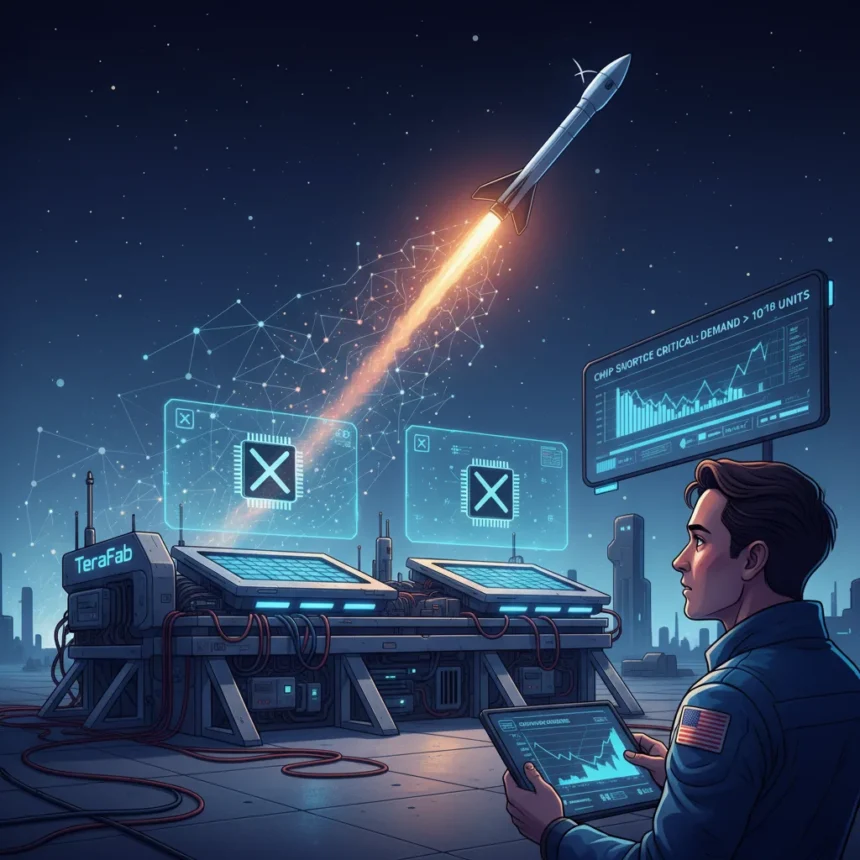
SpaceX’s orbital AI chip shortage represents one of the company’s most fundamental obstacles to scaling space-based artificial intelligence infrastructure, and the company is openly acknowledging the problem in its IPO filings. In regulatory paperwork, SpaceX stated that “our ability to achieve orbital AI at scale depends on our ability to access a sufficient number of AI chips, significantly more than are currently available to us”. This is not speculation about future demand—it is a risk factor SpaceX is warning investors about right now.
Key Takeaways
- SpaceX needs far more AI chips than currently exist to scale orbital AI infrastructure
- The company buys GPUs on a purchase-order basis with no long-term supplier contracts
- SpaceX, Tesla, and xAI are planning TeraFab, a dedicated chip factory, but it may fail
- Key partners Tesla and Intel are not obligated to stay in the TeraFab project
- Current supply chain exposes SpaceX to fab capacity limits, geopolitical risks, and natural disasters
Why orbital AI chip shortage threatens SpaceX’s space ambitions
The core problem is stark: SpaceX cannot access enough artificial intelligence chips to build the orbital data centers it envisions. The company’s reliance on purchase-order GPU buying—rather than long-term contracts with suppliers—leaves it vulnerable to the same supply constraints that have plagued the broader AI industry. SpaceX explicitly states it has “no long-term or other material contractual arrangements with our direct chip suppliers”. This means every GPU purchase is negotiated individually, with no guarantee of allocation or priority when demand spikes.
The orbital AI chip shortage is compounded by SpaceX’s exposure to semiconductor manufacturing risks beyond its control. The company identifies fab capacity shortages, raw material constraints, geopolitical disruptions, and natural disasters affecting semiconductor regions as threats to its supply chain. When TSMC, Samsung Foundry, or other foundries face bottlenecks, SpaceX has no contractual leverage to secure chips. This is not a temporary inconvenience—it is a structural weakness in the company’s ability to execute its vision.
TeraFab as a mitigation strategy—with major caveats
To address the orbital AI chip shortage, SpaceX, Tesla, and xAI are planning TeraFab, a dedicated semiconductor production facility intended to produce chips exclusively for those three companies. Elon Musk reportedly intends to invest tens of billions in the project. On the surface, this looks like a solution: vertical integration that removes dependency on external suppliers. But SpaceX’s own filing undermines confidence in the plan.


The company warns that TeraFab “may not be successful”. More critically, neither Tesla nor Intel are obligated to remain part of the project, and SpaceX “may not enter into any such definitive agreements” with them. This means the orbital AI chip shortage mitigation strategy lacks binding commitments from its key partners. If Tesla pivots to other chip suppliers or xAI’s funding dries up, TeraFab could collapse before producing a single chip. SpaceX is essentially betting on a future factory run by partners who have no contractual obligation to stay.
How the orbital AI chip shortage compares to industry-wide constraints
SpaceX’s problem is not unique, but its scale and stakes are. The broader AI industry faces GPU allocation constraints from Nvidia, AMD, and other suppliers. However, most companies can negotiate multi-year contracts or work with cloud providers to access capacity. SpaceX cannot—it needs chips for space-based infrastructure, a market segment that does not yet exist at scale, making it a lower priority for suppliers than data-center giants like Meta or Microsoft.



The orbital AI chip shortage also reveals a structural mismatch: SpaceX wants to build orbital compute capacity, but the foundries and chip designers that could supply it are already committed to terrestrial AI infrastructure. TSMC, Samsung Foundry, AMD, and Nvidia are all focused on meeting demand from cloud providers and AI labs on Earth. Securing chips for space-based systems is a secondary concern, and SpaceX’s lack of long-term contracts means it is last in line when supply tightens.
What SpaceX’s admission means for its timeline
By explicitly warning investors about the orbital AI chip shortage in its IPO filing, SpaceX is signaling that its space data-center ambitions will not materialize on the timeline the company may have previously suggested. The phrase “significantly more than are currently available to us” is not vague—it means SpaceX’s current chip access is a fraction of what it needs. Without TeraFab, or if TeraFab fails, SpaceX faces a multi-year wait to scale orbital AI infrastructure.
This admission also suggests SpaceX is managing investor expectations. Space-based AI infrastructure is a compelling narrative, but the orbital AI chip shortage is a hard constraint that money alone cannot overcome. You cannot build what you cannot source, and SpaceX’s transparency about this risk is both realistic and cautious.
Can TeraFab realistically solve the orbital AI chip shortage?
TeraFab is SpaceX’s answer to the orbital AI chip shortage, but the project faces multiple failure modes. Building a new semiconductor fab is a capital-intensive, technically complex undertaking that typically takes years and billions of dollars. Even if funded, it requires expertise in advanced chip design and manufacturing that SpaceX does not currently possess. The company would need to hire semiconductor veterans, design chips for space-based workloads, and ramp production—all while competing for foundry capacity and raw materials.



The fact that Tesla and Intel are not obligated to stay in the project makes it even riskier. If either partner exits, TeraFab loses funding or technical expertise. If both leave, the project may become unviable. SpaceX’s IPO filing essentially admits that the orbital AI chip shortage solution depends on partners who can walk away at any time.
What happens if the orbital AI chip shortage is not solved?
If SpaceX cannot access enough chips and TeraFab fails, the company’s orbital AI ambitions will stall. SpaceX may still launch satellites and provide internet service, but space-based artificial intelligence infrastructure—the vision of compute-in-orbit—remains a distant goal. This does not kill SpaceX’s business, but it does delay a major growth narrative that investors are pricing into the company’s valuation.
For the broader space industry, SpaceX’s candor about the orbital AI chip shortage is a reality check. Orbital AI is not inevitable. It is contingent on solving a supply-chain problem that SpaceX itself cannot fully control.
Is SpaceX’s orbital AI project still viable?
Yes, but on a delayed timeline. SpaceX’s admission about the orbital AI chip shortage does not mean the project is dead—it means SpaceX is being honest about the constraints. If TeraFab succeeds or if chip supply improves, SpaceX can scale orbital AI infrastructure. If neither happens, the company will have to wait longer or scale more slowly than originally planned.
What is TeraFab and why does it matter for the orbital AI chip shortage?
TeraFab is a proposed dedicated semiconductor factory intended to produce chips exclusively for SpaceX, Tesla, and xAI. It matters because it is SpaceX’s primary mitigation strategy for the orbital AI chip shortage. If TeraFab succeeds, it could reduce SpaceX’s dependence on external suppliers and solve the access problem. If it fails, SpaceX remains exposed to the broader chip shortage and supplier constraints.
Will Tesla and Intel stay committed to TeraFab?
SpaceX’s IPO filing says they are not obligated to. Tesla and Intel have no contractual requirement to remain part of the project, which means either company could exit if the economics or strategy change. This uncertainty weakens TeraFab’s credibility as a solution to the orbital AI chip shortage and adds risk to SpaceX’s long-term plans.
SpaceX’s public acknowledgment of the orbital AI chip shortage is refreshingly honest, but it also underscores a hard truth: ambitious space-based AI infrastructure cannot be built faster than the semiconductor industry can supply chips. TeraFab is a bet that SpaceX, Tesla, and xAI can build their own foundry. If that bet fails, the orbital AI dream will have to wait.
Edited by the All Things Geek team.
Source: TechRadar