




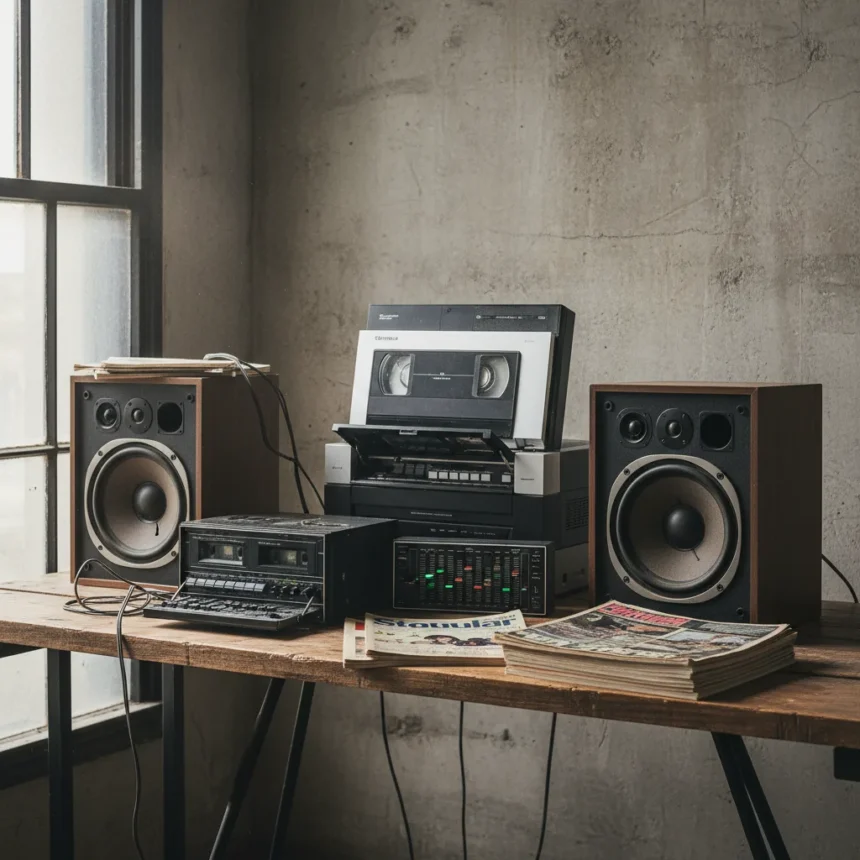
The 1980s hi-fi archives tell a story that modern audio enthusiasts rarely hear—one of mechanical ingenuity, bold design choices, and technologies that seemed revolutionary before digital streaming erased them from memory. What Hi-Fi’s retrospective of equipment from 45 years ago reveals not just products, but a snapshot of how consumers approached sound quality when vinyl ruled and cassettes promised portable music.
Key Takeaways
- 1980s loudspeakers prioritized step-up designs that bridged budget and premium segments.
- Car stereo systems represented a major innovation category in early 1980s audio retail.
- VCR technology competed alongside audio equipment as a home entertainment investment.
- Archive reviews from What Hi-Fi provide historical context for modern audio design choices.
- Vintage equipment specifications reveal how performance priorities have shifted over decades.
What the 1980s Hi-Fi Archives Actually Document
The 1980s hi-fi archives represent a critical transition point in consumer audio. This era predates the digital revolution that would later dominate the market, making these archives valuable records of analog-era thinking. Loudspeaker design from this period shows manufacturers wrestling with crossover efficiency, cabinet resonance, and the acoustic compromises that defined affordable quality. The archives capture reviews of equipment that cost hundreds of pounds but delivered performance that entry-level digital systems would not match for another decade.
What makes these archives historically significant is not nostalgia but evidence. They document how audio engineers solved problems with mechanical precision rather than digital processing. Step-up loudspeakers—models positioned between budget and high-end ranges—occupied a distinct market segment that has largely disappeared in the streaming era. These products attempted to deliver 80 percent of flagship performance at 40 percent of the price, a value proposition that shaped buyer expectations for generations.
Step-Up Loudspeakers and the Mid-Range Audio Market
The 1980s hi-fi archives reveal that step-up loudspeakers were not marketing gimmicks but carefully engineered products addressing a real consumer need. Buyers at this price point wanted audible improvements over mass-market options without committing to five-figure speaker systems. Manufacturers responded with designs that prioritized driver quality and cabinet construction over exotic materials or extreme specifications.


These loudspeakers typically featured two or three-way designs with soft-dome tweeters and woven-cone midrange drivers—materials chosen for reliability and smooth response rather than raw power handling. The archives show reviewers evaluating these products on musicality and tonal balance, metrics that differ sharply from modern testing focused on frequency response graphs and distortion measurements. This shift reflects broader changes in how audio quality is defined and marketed.
Car Stereo Innovation in the Early 1980s
Car stereo systems occupied surprising prominence in the 1980s hi-fi archives, treated with the same editorial seriousness as home loudspeakers and amplifiers. This reflects a market reality: automotive audio was a major sales category where consumers invested significant money and expected genuine performance improvements. Cassette decks with Dolby noise reduction, power amplifiers that could deliver 50 watts per channel, and dash-mounted equalizers represented latest mobile audio technology.



The archives document car stereo as a distinct engineering challenge. Road noise, vibration, and limited installation space created constraints that home audio designers never faced. Manufacturers developed specialized components—reinforced speaker frames, noise-isolating mounting brackets, and tuned enclosures designed for vehicle interiors. These innovations, now forgotten, pioneered techniques that car audio installers still use today, though few recognize their 1980s origins.
VCRs as Premium Home Entertainment Investments
The presence of VCR reviews alongside loudspeakers and amplifiers in the 1980s hi-fi archives reveals how differently consumers approached home entertainment. Video cassette recorders were not peripheral gadgets but major purchases deserving the same careful evaluation as audio equipment. This reflects an era when owning a VCR was genuinely aspirational—a device that cost as much as a quality integrated amplifier and promised to unlock a new category of entertainment.
VCR technology reviews in these archives focus on tape transport mechanisms, head alignment, and picture stability—engineering details that matter only to people who view video playback as a craft. This mindset contrasts sharply with modern consumer electronics, where performance is taken for granted and design revolves around convenience and connectivity. The archives document a market segment that has vanished entirely, replaced by streaming services that require no mechanical maintenance and no physical media.
Why These Archives Matter for Understanding Modern Audio
The 1980s hi-fi archives are not quaint historical documents but blueprints for understanding how current audio design evolved. The step-up loudspeaker concept, though the terminology has changed, still defines the mid-range speaker market. The engineering priorities documented in car stereo reviews—compact driver designs, high efficiency, controlled directivity—remain relevant to modern portable audio and automotive systems.



What has genuinely changed is consumer expectations around convenience and ecosystem integration. The 1980s hi-fi archives show buyers willing to spend weeks researching equipment, visiting multiple dealers, and learning technical specifications. Modern consumers expect instant gratification and seamless wireless connectivity. This shift did not happen because analog audio was inferior—it happened because digital distribution and cloud services made ownership of physical media economically obsolete.
How Equipment Design Philosophies Have Shifted
Comparing equipment featured in the 1980s hi-fi archives to contemporary products reveals fundamental design philosophy changes. Vintage loudspeakers prioritized passive crossovers and simple driver configurations; modern equivalents at the same price point often include active DSP, wireless connectivity, and room correction algorithms. Neither approach is objectively superior—they reflect different assumptions about what buyers value and how they use audio equipment.
The archives also document a market where brand reputation and engineering credibility drove purchasing decisions far more than marketing claims. Reviews focused on measurable performance and long-term reliability. Modern reviews, by contrast, often emphasize convenience features, software updates, and ecosystem lock-in. The 1980s hi-fi archives suggest that this shift represents not progress but a different set of trade-offs—gaining convenience at the cost of long-term repairability and genuine performance transparency.
The Forgotten Segment: Why Step-Up Products Disappeared
The 1980s hi-fi archives reveal a market structure that no longer exists. Step-up loudspeakers occupied a distinct price band where buyers could reliably upgrade from budget equipment and experience genuine performance improvement. This segment required manufacturers to maintain multiple product lines with different engineering approaches—a costly strategy that only makes sense in a high-volume market.
Digital audio disrupted this structure. Streaming services eliminated the need to own physical media, which meant consumers no longer invested in playback equipment as a core home entertainment purchase. Budget Bluetooth speakers satisfied casual listeners; premium wireless headphones served commuters. The mid-range loudspeaker market, which thrived in the 1980s, contracted to a niche serving only dedicated audio enthusiasts. The archives document a market structure that was economically viable only in the analog era.
What the Archives Reveal About Consumer Priorities Then vs. Now
Reading reviews in the 1980s hi-fi archives reveals starkly different consumer priorities. Buyers evaluated equipment on tonal character, soundstage depth, and imaging precision—subjective qualities requiring trained listening. Modern reviews emphasize frequency response measurements, THD specifications, and connectivity options. This shift reflects not just technological change but a fundamental reorientation of how audio quality is defined and validated.
The archives also show consumers accepting significant trade-offs. A car stereo system might offer excellent sound but require professional installation and regular maintenance. A VCR delivered superior video quality but demanded manual programming and tape management. Modern consumers reject these trade-offs entirely, preferring convenience over performance optimization. The 1980s hi-fi archives document an era when audio enthusiasts were willing to embrace complexity in exchange for superior sound.
Frequently Asked Questions
What makes the 1980s hi-fi archives valuable for audio historians?
The 1980s hi-fi archives provide primary source documentation of analog-era audio design, engineering priorities, and consumer expectations. They reveal how manufacturers solved acoustic problems before digital processing existed and show market segments that have completely disappeared, offering context for understanding modern audio development.
Why did step-up loudspeakers disappear from the market?
Step-up loudspeakers required a high-volume mid-range market to be economically viable. Digital streaming eliminated the need for consumers to invest heavily in playback equipment, shrinking the market to dedicated enthusiasts. Budget wireless speakers and premium headphones now serve the segments that step-up loudspeakers once occupied.
How does vintage car stereo technology compare to modern automotive audio systems?
1980s car stereo systems prioritized mechanical reliability and acoustic optimization for vehicle interiors. Modern automotive audio emphasizes digital integration, wireless connectivity, and voice control. The fundamental engineering principles around driver design and enclosure tuning remain relevant, though implementation methods have changed completely.
The 1980s hi-fi archives ultimately document not just forgotten products but a fundamentally different approach to consumer audio. In an era before streaming, before wireless, before algorithm-driven recommendations, buyers invested in physical equipment as a long-term commitment. They researched specifications, visited dealers, and made choices based on engineering credibility. The archives preserve evidence of this mindset—one that shaped how we still think about audio quality, even as the economic structures supporting it have vanished entirely.
This article was written with AI assistance and editorially reviewed.
Source: What Hi-Fi?