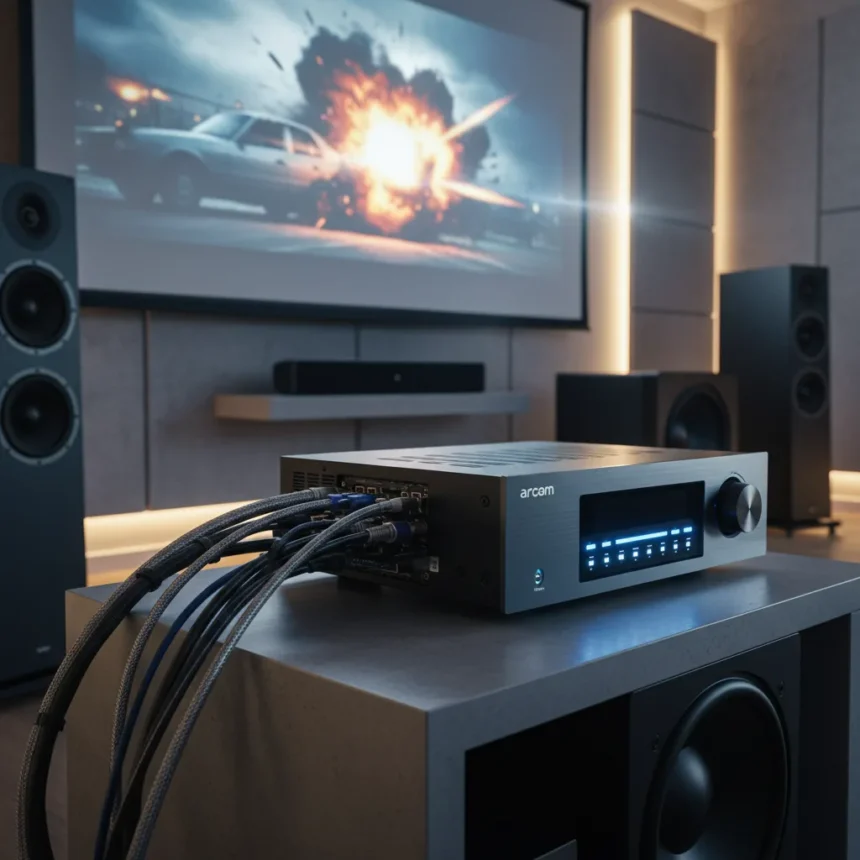
Arcam AVR immersive audio systems represent a fundamental departure from the flat, tinny compromises that plague budget soundbars. These high-end audio receivers restore dimensionality to movie soundtracks, delivering the spatial precision and dynamic range that cinema mixes demand. If your films currently sound like dialogue compressed through a phone speaker, an Arcam AVR addresses that problem at its root—not with clever DSP tricks, but with genuine amplification, proper speaker integration, and room-aware calibration.
Key Takeaways
- Arcam AVR receivers deliver immersive surround sound with proper amplification and spatial precision that soundbars cannot replicate.
- High-end audio receivers integrate multiple speaker channels for genuine three-dimensional soundscapes, not simulated surround effects.
- Cheap soundbars sacrifice dynamic range and frequency response to fit a single enclosure; Arcam AVR systems distribute sound across dedicated speakers.
- Proper room calibration and amplifier headroom transform movie audio from background noise into an engaging cinematic experience.
- Arcam AVR receivers eliminate the need for separate amplifiers by providing built-in power stages rated for real-world speaker loads.
Why Soundbars Fail at Immersive Audio
Budget soundbars compress an entire surround mix into a handful of tiny drivers. The result is predictable: dialogue gets lost in a muddy midrange, explosions sound like distant rumbles, and spatial cues that directors embedded in the mix simply vanish. A soundbar cannot create genuine surround channels because it has no physical space to place rear speakers. It cannot deliver the bass extension a subwoofer provides because a compact enclosure cannot move enough air. Most critically, it cannot amplify a complex soundtrack with the headroom needed for dynamic peaks—when a scene demands sudden volume, a soundbar compresses the signal instead of rising to meet it.
Arcam AVR immersive audio solves this by abandoning the soundbar’s false economy. Instead of forcing surround sound into one box, an Arcam receiver becomes the command center for a proper multichannel system. Front left, center, and right speakers handle dialogue and on-screen action with precision. Surround speakers placed at ear level in the side or rear walls create genuine ambient effects and panning cues. A dedicated subwoofer handles low frequencies with the excursion and control a compact soundbar cannot achieve. The receiver itself amplifies each channel independently, with power reserves that allow dynamic swings without compression or distortion.
Arcam AVR vs. Entry-Level Soundbars: Architectural Differences
The comparison between an Arcam AVR system and a budget soundbar is not about marketing claims—it is about physics. A soundbar driver is typically 1 to 2 inches wide. An Arcam-partnered speaker system uses dedicated drivers ranging from 4 to 8 inches or larger, optimized for specific frequency ranges. A soundbar amplifier powers all channels from a single power supply, often rated at 20 to 40 watts total. An Arcam AVR receiver dedicates separate amplification stages to each channel, typically delivering 50 to 100+ watts per channel depending on the model. A soundbar uses DSP upmixing to fake surround information from a stereo mix. An Arcam system plays true discrete surround channels encoded in Dolby Atmos, DTS:X, or traditional 5.1 and 7.1 formats.



These are not incremental differences. They are categorical. A soundbar is a convenience device—it prioritizes compact form factor and simplicity over audio fidelity. An Arcam AVR system prioritizes sound quality, assuming the listener has space for proper speaker placement and is willing to route cables. For anyone serious about movie audio, the Arcam approach is not a luxury upgrade. It is the only way to actually hear what the filmmaker mixed.
Room Calibration and Headroom Transform the Experience
One underrated advantage of an Arcam AVR receiver is its ability to adapt to your room. Most receivers include automated calibration systems that measure distances to each speaker, adjust levels, and apply equalization to compensate for room acoustics. A soundbar cannot do this effectively because it assumes all surround information comes from a single point source. An Arcam system knows that your left speaker is 8 feet away, your surround is at ear level 10 feet to the side, and your subwoofer is in the corner. It adjusts timing and frequency response accordingly, ensuring that sound reaches your ears as the mix intended.



Equally important is amplifier headroom. When a movie soundtrack includes a sudden explosion or orchestral swell, the audio signal spikes. A soundbar, limited by its compact power supply, compresses that peak to avoid distortion. An Arcam receiver has enough reserve power to amplify the peak cleanly. You hear the full dynamic range—the difference between quiet dialogue and loud action becomes genuinely dramatic instead of flattened into a narrow range. This headroom is why cinema mixes sound flat on a soundbar but revelatory on a proper system.
Is an Arcam AVR Worth the Investment Over a Soundbar?
The honest answer depends on what you watch and how much you value audio quality. If you stream casual content and rarely notice sound, a soundbar is adequate. If you watch films, play games with immersive soundtracks, or care about hearing dialogue clearly, an Arcam AVR system is not an indulgence—it is a correction. The initial setup requires more effort: speaker placement, cable routing, and calibration. But once installed, it transforms every film into an immersive experience that a soundbar simply cannot replicate. You are not paying for a brand name. You are paying for the physics of proper amplification, speaker separation, and room adaptation.
What Does an Arcam AVR Receiver Include?
An Arcam AVR receiver is a single component that amplifies multiple audio channels, decodes surround formats, and manages connections to your TV, streaming devices, and speakers. It handles HDMI input from your television, optical or coaxial input from legacy devices, and analog RCA connections. The receiver decodes Dolby Atmos, DTS:X, and traditional surround formats, then sends amplified signals to your speakers. Most Arcam receivers include built-in room calibration microphones and setup wizards that guide you through measuring distances and adjusting levels.
Can You Use an Arcam AVR with Existing Speakers?
Yes. An Arcam AVR receiver works with any speakers that match its amplifier output impedance and power handling. You do not need to buy speakers from Arcam—you can pair the receiver with speakers from other manufacturers. Many people upgrade their receiver first, then gradually replace or add speakers over time. This modularity is a key advantage over a soundbar, which forces you into a single ecosystem.



How Does Room Size Affect Arcam AVR Performance?
Larger rooms benefit from more powerful amplification and larger speakers, but an Arcam AVR system scales to any space. A smaller bedroom can use a compact Arcam receiver with bookshelf speakers and a modest subwoofer. A large living room can use a more powerful model with floor-standing speakers. The calibration system adjusts for room size and acoustics, so the receiver optimizes itself to your specific space rather than assuming a generic environment.
Arcam AVR immersive audio is not a gimmick or a luxury for audiophiles alone. It is the practical solution to a real problem: soundbars cannot deliver the dimensional, dynamic soundtracks that films deserve. If you have ever watched a movie and felt that something was missing from the audio—that dialogue was hard to follow, or action scenes lacked impact—an Arcam receiver and proper speaker system will show you what you have been missing. The investment is real, but so is the transformation.
Edited by the All Things Geek team.
Source: What Hi-Fi?