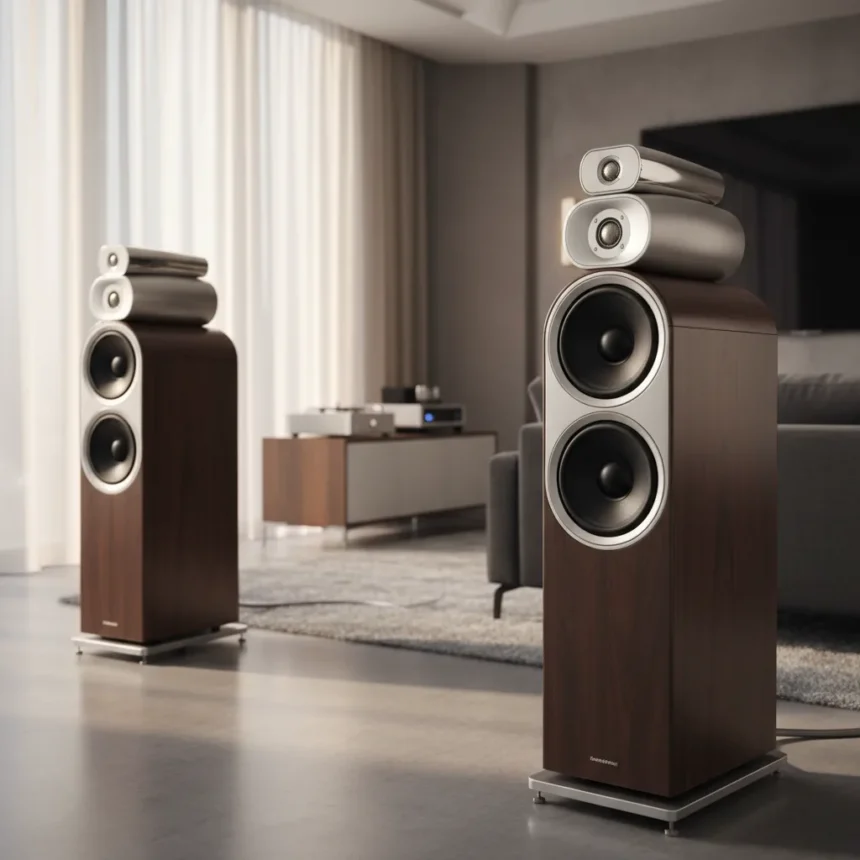
The Bowers & Wilkins 800 Series Diamond D5 is a seven-strong loudspeaker range representing the company’s most advanced high-end platform yet. Bowers & Wilkins positions this generation as the culmination of decades spent perfecting premium audio engineering, combining signature technologies like diamond tweeters and Continuum cones with evolved motor systems, refined crossover networks, and striking new finishes. The D5 generation signals that the company is committed to incremental mastery rather than wholesale reinvention—a philosophy that has defined the 800 Series through multiple generations.
Key Takeaways
- The 800 Series Diamond D5 is a seven-strong range with new finishes and evolved technology across the lineup.
- Diamond tweeters are engineered to maintain pistonic motion in the audible range while pushing breakup beyond 70 kHz.
- The 801 D4 Signature uses 16 bypass capacitors in its crossover, doubled compared to the standard 801 D4.
- Motor systems feature upgraded steel components designed to lower current distortion and improve bass accuracy.
- Bowers & Wilkins has evolved from Kevlar toward Continuum cones in its premium speaker designs.
Diamond Tweeter Technology Defines the D5 Range
The Bowers & Wilkins 800 Series Diamond D5 relies on the company’s signature diamond tweeter as its sonic foundation. The tweeter uses synthetic diamond and is engineered to keep pistonic motion in the audible range while pushing breakup beyond audibility. In related flagship models like the 801 D4 Signature, the tweeter breakup is stated to occur above 70 kHz, a frequency far beyond human hearing where distortion would be inaudible. The diamond element itself is housed in a longer enclosure designed to absorb more back wave energy, reducing unwanted reflections and coloration. This architectural approach has become a hallmark of Bowers & Wilkins’ premium designs, distinguishing them from competitors that rely on conventional dome or beryllium tweeters.
The tweeter integrates into a tweeter-on-top module that has been refined across multiple 800 Series generations. This configuration prioritizes vertical imaging and allows listeners to experience a more cohesive soundstage regardless of seating position—a practical advantage in real listening rooms where listeners rarely sit at the perfect equilateral triangle distance from speakers.
Crossover and Motor Refinements Improve Accuracy
The Bowers & Wilkins 800 Series Diamond D5 benefits from evolved crossover networks and upgraded motor systems that reduce distortion and improve bass precision. In the 801 D4 Signature, the crossover uses 16 bypass capacitors, doubled across the board relative to the standard 801 D4. These components are tasked with delivering more resolution and a welcome refinement to overall tonality. The increased capacitor count allows the crossover to handle complex musical passages with greater clarity, particularly in the critical midrange where vocals and instruments converge.



The motor system itself represents a meaningful step forward. The 801 D4 Signature incorporates a new top plate and midplate constructed from upgraded steel, specifically engineered to lower current distortion and improve bass accuracy. This approach reflects Bowers & Wilkins’ understanding that bass reproduction demands not just driver size but precision in the electromagnetic system driving that driver. The woofers fire forward and vent downward, a configuration that integrates more naturally into typical room acoustics than rear-ported designs.
The midrange employs a Turbine Head housing a 6-inch driver with improved spider material designed to reduce secondary output and unwanted noise. This combination of refined components across the frequency spectrum demonstrates Bowers & Wilkins’ commitment to coherent sonic presentation rather than isolated excellence in any single band.



Generational Progress in Cabinet and Material Design
The 800 Series has evolved significantly across generations, with Bowers & Wilkins continuously refining cone materials, cabinet bracing, and finish options. The company has transitioned from Kevlar toward Continuum cones in its premium speaker designs, reflecting a broader industry shift toward composite materials that offer superior damping and reduced breakup compared to traditional woven fabrics. The cabinet itself employs Matrix-style bracing, an architectural approach that controls internal resonance and prevents cabinet coloration from muddying the signal.
The D5 generation introduces new finishes including options like Midnight Blue Metallic and California Burl Gloss, allowing audiophiles to integrate these statement pieces into diverse interior aesthetics. This attention to finish quality underscores that premium speakers are not merely transducers but furniture-grade components that must satisfy both ears and eyes. The cabinet construction uses heavier bracing compared to standard models, further reducing unwanted vibration and resonance.
How Does the Bowers & Wilkins 800 Series Diamond D5 Compare to Earlier Generations?
The D5 generation builds on the architectural foundation established by the D4 and earlier iterations, preserving proven technologies like diamond tweeters and Continuum cones while upgrading motor systems, crossover components, and finishes. Compared with the standard 801 D4, the 801 D4 Signature adds upgraded bracing, motor components with improved steel, and crossover parts with doubled bypass capacitors. This incremental approach allows Bowers & Wilkins to preserve the sonic character listeners expect from the 800 Series while delivering measurable improvements in distortion reduction and tonal refinement.
What Makes the Diamond Tweeter Different from Conventional Designs?
The synthetic diamond tweeter in the Bowers & Wilkins 800 Series Diamond D5 is engineered to maintain pistonic motion—uniform movement across the diaphragm—throughout the audible frequency range, typically up to 20 kHz for human hearing. By pushing the tweeter’s breakup point above 70 kHz, Bowers & Wilkins ensures that any distortion occurs at frequencies inaudible to listeners. This contrasts with conventional dome tweeters, which may exhibit breakup coloration within the audible range, introducing harshness or sibilance into vocals and cymbals. The longer housing absorbs back wave energy, a passive design choice that reduces the need for active damping materials and simplifies the tweeter’s internal acoustic environment.



Should You Invest in the Bowers & Wilkins 800 Series Diamond D5?
The Bowers & Wilkins 800 Series Diamond D5 targets serious audiophiles and collectors who view speakers as long-term investments in listening pleasure. The seven-model range offers entry points at different price tiers, though the full lineup’s pricing remains unconfirmed in current sources. These speakers demand proper amplification, careful room treatment, and high-quality source material to justify their engineering refinement. If you listen to complex classical recordings, jazz ensembles, or acoustic music where tonal purity and imaging precision matter deeply, the D5 range represents genuine sonic advancement. Casual listeners or those in untreated rooms may not perceive the improvements that justify premium pricing. The D5 generation confirms that Bowers & Wilkins remains committed to evolutionary refinement—preserving what works while methodically improving what can be better.
Edited by the All Things Geek team.
Source: What Hi-Fi?