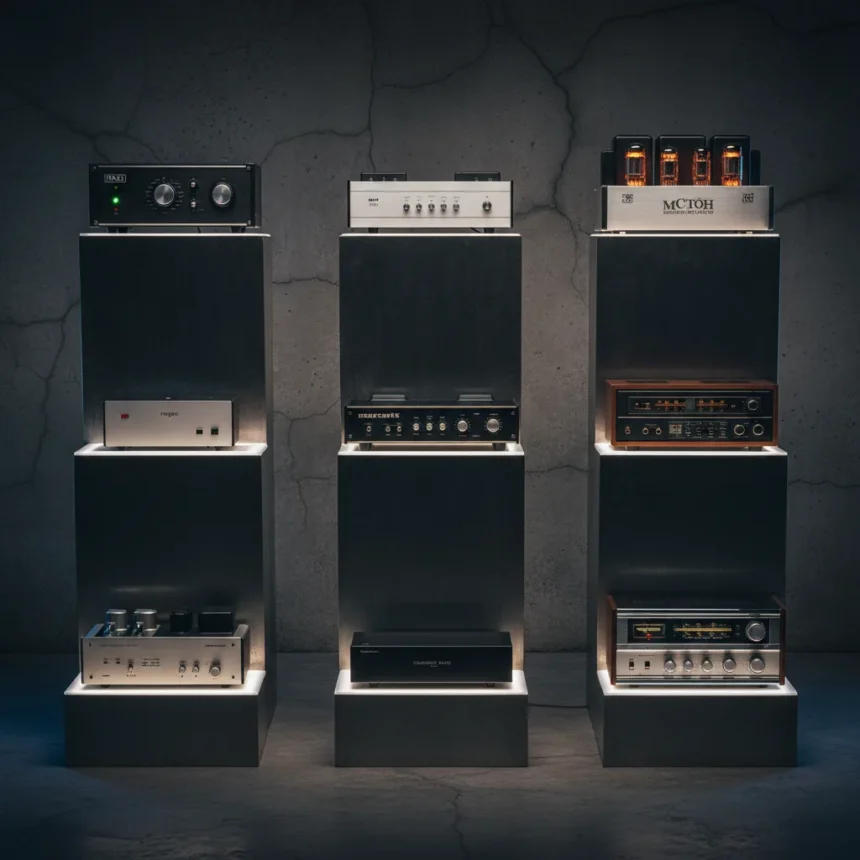
Debut stereo amplifiers matter more than most people realize. When a legendary hi-fi brand launches its first power amp, that product often defines the company’s sonic identity for decades to come. Nine standout models—from Naim’s NAP 200 to McIntosh’s MC275—proved that a debut amplifier could become a timeless reference point, shaping not just their makers’ futures but the entire trajectory of high-fidelity audio.
Key Takeaways
- NAD’s 3020 amplifier (1978) delivered 20W per channel but outperformed higher-wattage rivals in speaker-driving capability.
- The Naim NAP 200 (1973) established a design philosophy centered on pace, rhythm, and timing that the brand still pursues.
- Audiolab’s 8000A (1983) won multiple awards for its stylish appearance and detailed, clear sound presentation.
- McIntosh’s MC275 tube amplifier produces 75W in stereo and 150W in mono, delivering what reviewers call an enchanting velvety sound.
- These debut models became bestsellers and remain respected by audiophiles more than 40 years after their original release.
The NAD 3020: Modest Watts, Massive Impact
The NAD 3020, launched in 1978 at £85, put NAD on the map with a deceptively simple formula: 20 watts per channel and the ability to drive speakers better than pretty much any of its rivals. That claim sounds absurd on paper—20W was never enough power to shake a room—but the 3020’s engineering proved that wattage alone misses the point. The amplifier became a bestseller, and it remains a reference point for what a truly efficient, well-designed compact amplifier should accomplish. Decades later, the 3020 still appears on lists of the best stereo amplifiers ever made, a testament to how a smart debut can outrun the competition.
Naim’s NAP 200 and the Philosophy of Pace
Naim founder Julien Vereker completed the design of the NAP 200 in 1971, and the amplifier hit the market in 1973 with a singular focus: pace, rhythm, and timing. That philosophy was not about raw power or frequency response measurements—it was about how music actually sounds when it flows through a system. The NAP 200 established Naim’s sonic signature so thoroughly that the brand still chases the same performance goals today. The company’s modern NAP 100 continues that lineage, proving that a debut amplifier’s design philosophy can endure for half a century without becoming obsolete. Naim did not invent the idea of rhythmic coherence in amplifier design, but the NAP 200 crystallized it in a way that influenced an entire generation of amp designers.
Audiolab and McIntosh: Opposing Philosophies, Lasting Legacies
Audiolab’s 8000A arrived in 1983 with a retail price of £200 and 60 watts per channel. The amplifier won numerous awards for its stylish appearance, but the real achievement was sonic: a detailed and clear presentation that retained its appeal among serious hi-fi enthusiasts long after its competitors faded. The design philosophy prioritized transparency and refinement, qualities that made the 8000A a reference point for what a mid-powered amplifier could achieve. McIntosh took the opposite path with the MC275, a tube-based design that produces 75 watts in stereo and 150 watts in mono. The MC275 delivers what reviewers describe as an enchanting velvety sound that flows like a continuous river—a warmth and musicality that contrasts sharply with Audiolab’s analytical precision. Both approaches proved correct. Both became bestsellers. Both remain iconic.



Other Debuts That Defined the Era
The Cambridge Audio P40 (1968) arrived early enough to help establish what a stereo amplifier could be. The A&R A60 (1976) became so respected that What Hi-Fi? later named it one of the best stereo amplifiers in the publication’s entire history. Cyrus launched the Cyrus One in 1984, entering a market already crowded with excellent debut amplifiers but carving out its own space through distinctive design and engineering choices. Mark Levinson’s ML-2 (produced from 1977 to 1986) represented the company’s debut power amplifier—not its first product overall, but the amp that established Levinson’s reputation for uncompromising sound quality. The Naim 32/Snaps/250 combination, introduced in 1984, took a different approach: three separate boxes with an external power supply and proprietary circuitry, designed specifically to deliver the reference rhythm performance that Naim valued above all else. These amplifiers were little power houses that left indelible marks in hi-fi history, paving the way for agile, transparent, and joyous music systems.
Why Debut Amplifiers Matter More Than You Think
A brand’s first amplifier is not just a product—it is a declaration of sonic values. When Naim chose pace and rhythm over raw specs, when McIntosh chose tubes over solid-state, when Audiolab chose transparency, each company was making a bet about what music lovers actually wanted. Those bets paid off. Fifty years later, these debut amplifiers still influence how hi-fi companies approach amplifier design. They proved that a thoughtful, coherent design philosophy could outlast trendy features and raw power claims. The amplifiers that shaped hi-fi history were not the ones with the most watts or the flashiest marketing—they were the ones built by companies that understood what they stood for and committed to that vision from day one.



Is the NAD 3020 still worth buying today?
Yes, if you can find one in good condition on the secondary market. The 3020 remains a capable amplifier that drives speakers efficiently and delivers balanced, engaging sound. However, modern budget amplifiers offer better reliability and warranty support. The 3020’s value today is primarily historical and sonic nostalgia rather than practical superiority over contemporary designs.
Can you still buy the Audiolab 8000A?
The original 8000A is no longer in production, but it appears regularly on vintage audio markets and auction sites. Audiolab continues to make amplifiers, but under different model numbers. If you want the specific 8000A experience, you will need to hunt the used market or accept a modern Audiolab alternative with updated circuitry and features.
What makes the McIntosh MC275 special compared to solid-state amplifiers?
The MC275 uses vacuum tubes instead of transistors, which produces the warmth and harmonic richness that reviewers describe as velvety. Solid-state amplifiers typically sound more neutral and analytical. The MC275’s tube design also means it requires more maintenance and generates more heat, trade-offs that tube enthusiasts accept gladly in exchange for the sonic character they prefer.
These nine debut stereo amplifiers succeeded because they were built by companies that knew exactly what they believed in. They did not chase every trend or copy competitors—they established a sonic philosophy and executed it with precision. That is why they still matter. In an era when specs dominate marketing and hype drowns out substance, these amplifiers remind us that the best products come from clarity of vision, not complexity of features.



Edited by the All Things Geek team.
Source: What Hi-Fi?