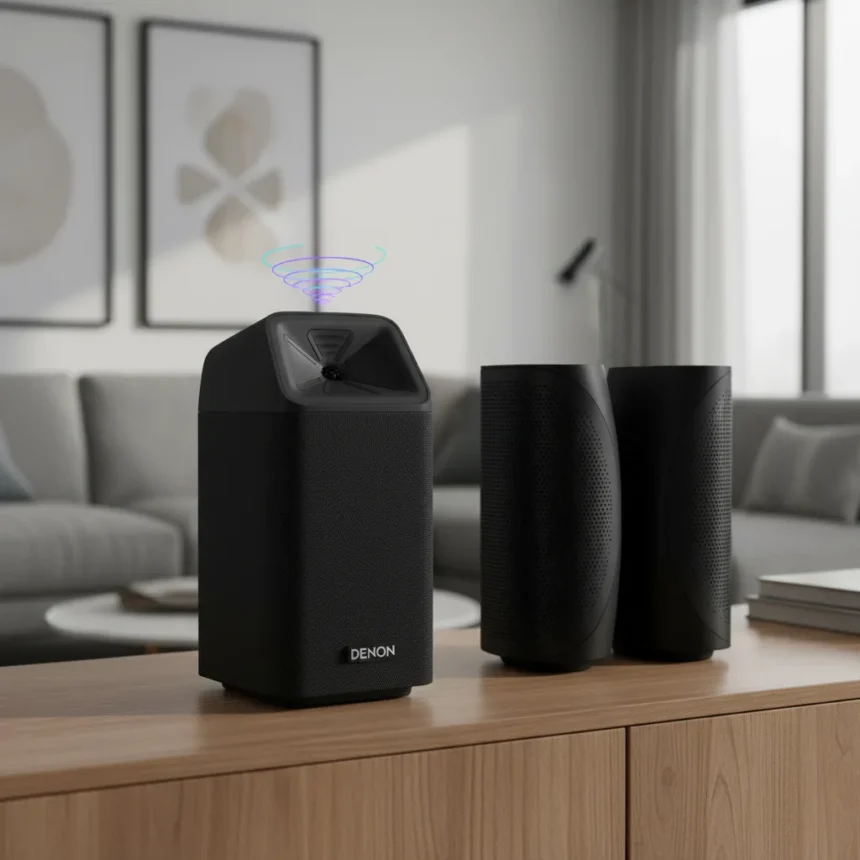
The Denon Home 400 is a mid-size wireless speaker made by Denon, positioned as a rival to Sonos’ Era 300 and designed to deliver spatial audio in living rooms and open-plan spaces. It sits squarely in the middle of Denon’s refreshed Home lineup—larger than the Home 200, smaller than the Home 600—and represents the company’s push into Dolby Atmos-enabled multi-room audio at a price point that does not require a second mortgage.
Key Takeaways
- The Denon Home 400 uses a 2.0.2 channel layout with six drivers including dedicated upfiring speakers for spatial audio
- Priced at £449 / $599 / AU$999, it directly competes with Sonos Era 300 in the mid-range wireless speaker category
- Supports Dolby Atmos virtual processing and hi-res audio via Tidal, Amazon Music Unlimited, and Qobuz
- Available in Stone and Charcoal finishes with USB-C and 3.5mm AUX connectivity
- Scales across the HEOS ecosystem to support up to 64 devices across 32 zones for multi-room audio
What Makes the Denon Home 400 Stand Out
The Denon Home 400 breaks from the typical stereo wireless speaker formula by adding a pair of upfiring drivers to its channel layout. This 2.0.2 architecture—left and right stereo channels plus two dedicated upfiring speakers—gives the Home 400 what reviewers describe as a greater sense of dimensionality compared to flat stereo designs. The speaker packs six drivers total: two 0.75-inch tweeters, two 1.25-inch mid-range drivers, and two 4.5-inch woofers. That driver count matters because it distributes sound across the frequency spectrum rather than forcing everything through a single point source.
The upfiring architecture is paired with Dolby Atmos virtual processing, which means the Home 400 can simulate spatial audio effects without requiring a full surround system. This is not true object-based Atmos—that would demand a multi-speaker setup—but virtual Atmos can create a sense of height and space that standard stereo cannot match. For people who want spatial audio without rewiring their living room, this is a pragmatic middle ground.
Ecosystem and Connectivity Options
Where the Denon Home 400 gains real leverage is through the HEOS platform that underpins the entire refreshed Home range. HEOS supports multi-room audio, room grouping, and hi-res playback across up to 64 devices spanning 32 zones. That scalability matters if you plan to expand beyond a single speaker—you can group rooms, adjust volume independently, or create whole-home audio without hitting a ceiling.


The Home 400 includes both USB-C and 3.5mm AUX inputs, giving you flexibility to connect devices beyond wireless streaming. It also supports Siri voice control, which appeals to Apple ecosystem users. On the streaming side, the speaker supports hi-res audio from Tidal, Amazon Music Unlimited, and Qobuz, so if you subscribe to lossless services, the Home 400 can actually deliver that quality rather than downsampling it.
The speaker integrates with Denon’s Home 550 soundbar and compatible subwoofers for those who want to expand their setup. This ecosystem approach mirrors what Sonos has built—the idea that your first speaker is just the beginning.



How It Compares to Sonos Era 300
The Home 400 is explicitly positioned against the Sonos Era 300, and the comparison is apt in terms of scale and market positioning. Both are mid-size wireless speakers aimed at people who want more than stereo but not a full home theater. The key architectural difference is that Sonos Era 300 uses a different driver layout, while the Denon Home 400’s 2.0.2 design with dedicated upfiring speakers creates what reviewers call a greater sense of dimensionality.
Pricing puts them in the same ballpark—the Home 400 at £449 / $599 / AU$999 versus Sonos’ comparable models. The real divergence comes down to ecosystem lock-in. Sonos users live in the Sonos app and device network. Denon Home 400 users tap into HEOS, which scales differently and integrates with a broader range of Denon audio equipment. If you already own Denon gear, the Home 400 becomes more attractive. If you are married to the Sonos ecosystem, switching costs are real.
Design and Practical Considerations
The Home 400 comes in Stone and Charcoal finishes, offering some aesthetic choice without overwhelming options. Reviewers have noted that the Home 400 occupies the sweet spot in the range when it comes to price, design, and performance—not too small to feel underpowered, not so large it dominates a room. It is suited to larger living rooms, open-plan entertaining spaces, and media dens where you want serious sound without installing a dedicated theater.
One practical note: the Home 400 is Dolby Atmos virtual enabled, not a full surround system. This means it creates the illusion of spatial audio through processing and upfiring drivers, not through actual surround speakers. For apartment dwellers and people who cannot install ceiling speakers, this is the right approach.



Is the Denon Home 400 Worth Buying?
The Denon Home 400 makes sense if you want spatial audio in a single mid-size speaker, value hi-res streaming support, and plan to expand your multi-room setup over time. It is not a Sonos killer—that framing overstates the case—but it is a credible alternative with a different ecosystem philosophy and upfiring drivers that genuinely add dimensional quality. The price sits in the premium range, but you are paying for HEOS scalability and Atmos processing, not just speaker drivers.
Can you add a subwoofer to the Denon Home 400?
Yes, the Home 400 is compatible with Denon subwoofers, allowing you to add deeper bass if your room supports it. This modular approach lets you start with the speaker alone and expand later.
Does the Denon Home 400 support all streaming services?
The Home 400 supports hi-res audio from Tidal, Amazon Music Unlimited, and Qobuz. It works with other services too, but hi-res support is limited to those three platforms.
How many zones can the HEOS system support?
The HEOS ecosystem can scale to 64 devices across 32 zones, making it suitable for large homes or commercial spaces that need distributed audio.
The Denon Home 400 represents a genuine attempt to compete in the mid-range wireless speaker space by focusing on spatial audio and ecosystem scalability rather than trying to undercut Sonos on price. Whether it is the right choice depends on your existing gear, your streaming preferences, and whether you value upfiring drivers enough to justify the premium. For people already in the Denon ecosystem or committed to hi-res audio, it is a logical step up.
Where to Buy
Check Amazon | Sonos Era 300 Wireless Speaker | JBL Authentics 500
Edited by the All Things Geek team.
Source: T3