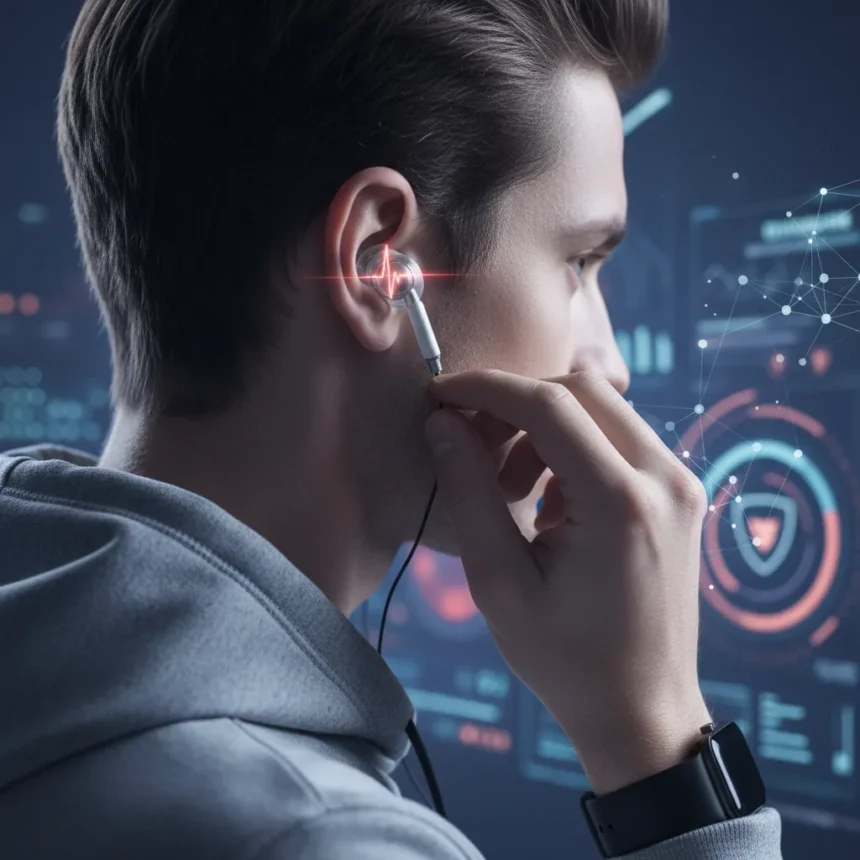
Ear ID authentication represents a new frontier in biometric security, using heartbeat signals detected through earbuds or ear-worn devices to verify user identity. Researchers have demonstrated that ear ID authentication can unlock personal gadgets with the same convenience as Touch ID or Face ID, but without requiring facial scans or fingerprint contact. The underlying technology captures unique heartbeat patterns—each person’s cardiac rhythm is as distinctive as their fingerprint—and uses machine learning to authenticate users based on these physiological signatures.
Key Takeaways
- Ear ID authentication detects individual heartbeat patterns through earbuds to verify identity.
- A recent study validated the method on 13 subjects with 97.3% average balanced accuracy.
- The technology uses 60 GHz microwave Doppler sensors to capture cardiac signals without direct contact.
- Ear ID offers privacy advantages over facial recognition, which requires visible scanning.
- Real-world scalability still requires improvements in handling posture variation and larger test populations.
How Ear ID Authentication Works
Ear ID authentication operates through a non-contact sensing approach fundamentally different from Touch ID or Face ID. Instead of scanning a face or fingerprint, the system uses a 60 GHz microwave Doppler sensor to detect subtle vibrations caused by blood flow through arteries near the ear. These heartbeat signals are processed through a conformer network that identifies individual heartbeats and segments them into distinct waveforms. The system then selects high signal-to-noise ratio waveforms and performs time-frequency analysis to extract subject-specific features.
The extracted features are fed into a conditional variational autoencoder (CVAE)—a machine learning model that encodes the unique characteristics of each person’s heartbeat into latent space. This encoding allows the authentication system to compare a new heartbeat sample against stored biometric templates. The CVAE approach is particularly effective because it captures the distinctive patterns in individual cardiac rhythms while filtering out noise and environmental interference that would otherwise confuse traditional authentication systems.
Performance and Accuracy in Early Trials
Early research validation demonstrates promising results for ear ID authentication, though on a limited scale. A study published in Frontiers in Digital Health tested the method on 13 subjects and reported an average balanced accuracy of 97.3% for authentication and 94.7% for identification. These figures suggest the technology can reliably distinguish one person’s heartbeat from another’s with minimal false positives or false negatives. The high accuracy is particularly notable given that heartbeat patterns, unlike passwords or PINs, cannot be forgotten, stolen, or shared.



The researchers noted that their approach outperformed conventional biometric methods by encoding subject-specific features while reducing noise-related issues that plague traditional heart-rate monitoring. However, the small sample size of 13 subjects means the technology has not yet been tested at scale. Real-world deployment would require validation across thousands or millions of users to account for demographic variation, age-related changes in cardiac patterns, and other factors that might affect authentication accuracy.
Ear ID vs. Touch ID and Face ID: Privacy and Practicality
Ear ID authentication offers distinct advantages over existing biometric systems, particularly regarding privacy and user convenience. Touch ID requires direct physical contact with a sensor, which can wear out over time and fail in certain environmental conditions. Face ID demands high-resolution imaging of facial features, raising privacy concerns for users who object to persistent facial scanning. Ear ID, by contrast, requires no visible scanning and no direct contact—a user simply wears earbuds or ear-worn devices that passively detect heartbeat signals during normal use.



The privacy case for ear ID is compelling. Heartbeat data collected through earbuds is not inherently tied to facial geometry, fingerprint patterns, or other physical identifiers that could be harvested or misused if a device is compromised. The technology also works in darkness, through clothing, and in conditions where Face ID or fingerprint sensors might fail. However, ear ID authentication still faces challenges before it can replace or supplement existing methods. The research indicates that further work is needed on handling posture variation—heartbeat signals change slightly depending on how a user is positioned relative to the earbud sensor—and on scaling the method to real-world populations.
Remaining Challenges for Real-World Deployment
Despite promising laboratory results, ear ID authentication still confronts significant hurdles before it becomes a practical consumer feature. The current research validates the concept on a small, controlled group of subjects, but real-world earbuds would need to work reliably across diverse ear shapes, wearing positions, and user behaviors. Posture variation is a particular concern: a user’s heartbeat signal detected while standing differs slightly from the signal captured while sitting or lying down, which could introduce authentication errors if not properly compensated.
Scalability represents another open question. The CVAE model used in the research was trained on data from 13 subjects; deploying this method across millions of users would require much larger training datasets and careful validation to ensure the system does not exhibit bias across age groups, health conditions, or ethnic backgrounds. Additionally, the technology would need to integrate smoothly into existing earbud designs without requiring specialized hardware or significant power consumption that would drain battery life. The researchers themselves acknowledge these limitations, suggesting that ear ID authentication remains in the research phase rather than ready for immediate consumer implementation.
Frequently Asked Questions
Could ear ID authentication replace Face ID or Touch ID?
Ear ID authentication could eventually complement or supplement existing biometric methods, but it is unlikely to fully replace them in the near term. Each method has distinct strengths: Face ID is fast and requires no device contact, Touch ID is familiar and widely deployed, and ear ID offers privacy and non-contact convenience. A multi-factor biometric approach—combining ear ID with one existing method—may prove more secure than any single approach alone.



Is heartbeat-based authentication already available in AirPods?
No. Ear ID authentication remains a research concept. The technology has been validated in laboratory settings but has not been integrated into commercial earbud products. Apple, Samsung, and other manufacturers would need to add specialized sensors to their devices and conduct extensive testing before deploying heartbeat-based authentication to consumers.
What makes heartbeat patterns unique enough for authentication?
Each person’s heartbeat exhibits subtle variations in rhythm, amplitude, and timing that are as distinctive as a fingerprint. These variations stem from differences in heart size, arterial structure, and autonomic nervous system behavior. Machine learning models can extract these distinguishing features and use them to authenticate users with high accuracy, even though two people’s resting heart rates might appear similar at first glance.
Ear ID authentication represents a genuinely novel direction for biometric security, moving beyond the face and fingerprint paradigm that has dominated consumer devices for the past decade. The technology is not yet ready for mainstream deployment, but the underlying research demonstrates that heartbeat-based authentication is technically feasible and potentially more privacy-respecting than facial recognition. Whether earbuds become the next frontier of device authentication depends on whether manufacturers can solve the scalability and real-world robustness challenges that currently limit the technology to laboratory validation. For now, ear ID remains a promising research direction rather than an imminent consumer feature.
Edited by the All Things Geek team.
Source: TechRadar