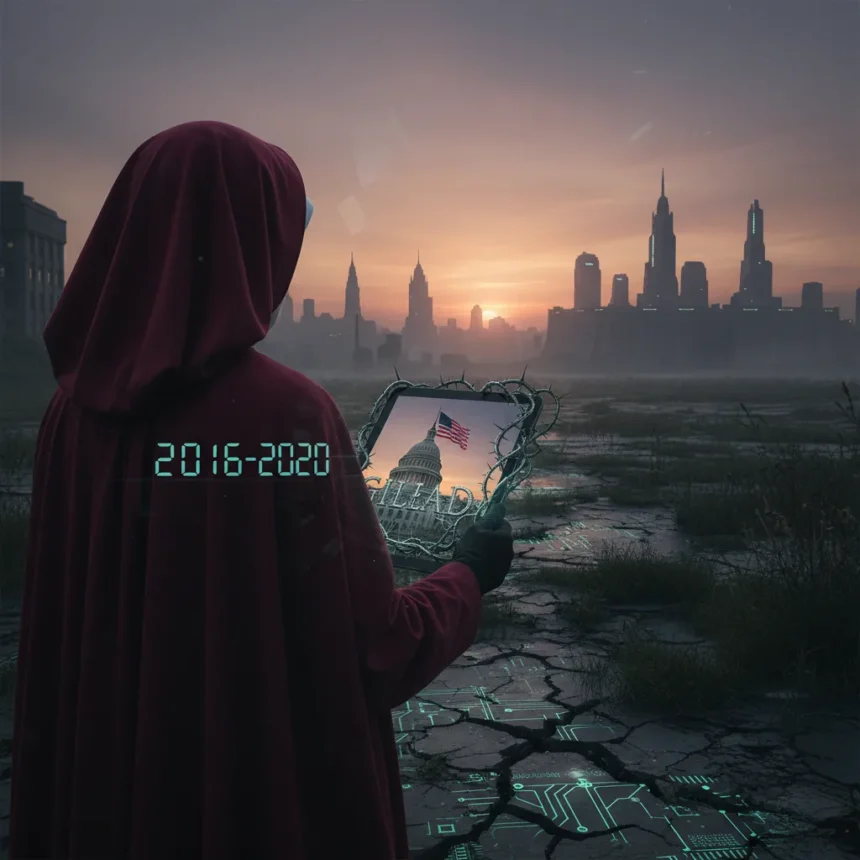
The Handmaid’s Tale Trump connection has become impossible to ignore. Margaret Atwood’s dystopian world premiered on Hulu in 2017, weeks after Trump’s first inauguration, and The Testaments arrived as he took office for his second term. Yet the show’s creators insist the real world hasn’t changed—only how audiences see it.
Key Takeaways
- The Handmaid’s Tale premiered shortly after Trump’s 2016 election, but the script was already written before November 9, 2016.
- Margaret Atwood stated the election did not instigate or alter the show’s production; audiences simply perceived it with greater urgency.
- The Testaments depicts a stabilized Gilead where Handmaids are rarer, focusing on teen daughters finding escape routes.
- Season 3 drew parallels to Trump-era America, including reproductive rights restrictions and voter suppression comparisons.
- The show’s crypto-working Commander joke reflects real-world anxieties about unqualified leadership.
Why The Handmaid’s Tale Feels Prophetic Now
The timing is uncanny. The Handmaid’s Tale premiered on Hulu shortly after Donald Trump’s first inauguration in 2017. The Testaments, set roughly 15 years after the original story, arrived as Trump began his second term. This synchronicity has fueled speculation that the show somehow predicted or responded to his presidency. But that’s not quite right. Margaret Atwood explicitly rejected the idea that Trump’s 2016 election instigated or changed the show’s script. The production was already underway. What changed was the audience’s perception. “They woke up on November 9th and realized they were in a different frame but the frame was now different,” Atwood explained, “so you can’t say that this election sort of instigated anything nor did they change the script they were already doing what they were doing but people saw it differently and they saw it with much more belief than they would have seen it otherwise”.
That distinction matters. The Handmaid’s Tale didn’t become prophetic because Trump won. It became prophetic because audiences suddenly viewed a fictional totalitarian state through the lens of real political anxiety. The show’s exploration of reproductive control, religious extremism, and the erosion of women’s rights felt less like speculative fiction and more like a warning that had already begun.
The Testaments Doubles Down on Gilead’s Stability—and Creepiness
The sequel takes a different approach. Rather than showing Gilead’s collapse, The Testaments depicts a society that has consolidated power. Environmental disasters have ended. Wives can now carry pregnancies to term, making Handmaids rarer and less central to the regime’s survival. This shift might seem like progress, but it’s actually more sinister. The show emphasizes how injustice becomes normalized when it stops being acute. “Girls in Gilead have spent their lives being vigilant in a way you never have,” one character tells Daisy, a teen protagonist. The Testaments focuses on these daughters finding ways out, but the real horror lies in how they’ve internalized oppression as routine.



The show even includes pointed digs at contemporary leadership. A Commander is revealed to have previously worked in crypto—a joke that lands harder when you consider real-world anxieties about unqualified people wielding power. The Testaments doesn’t need to explicitly reference Trump to feel relevant. It simply shows what happens when authoritarianism calcifies into normalcy.
How The Handmaid’s Tale Mirrors Trump-Era America
The parallels are not subtle. Season 3 of The Handmaid’s Tale drew direct comparisons to Trump’s America, particularly around reproductive rights. States like Alabama and Missouri passed restrictive abortion laws that felt ripped from Gilead’s playbook. The show’s exploration of biological justifications for gender inequality—referencing Charles Darwin’s 1871 text The Descent of Man and Selection in Relation to Sex—echoed real debates about women’s bodies and rights. Religious zealotry, voter suppression, and the concentration of power in unaccountable hands all mirrored anxieties many Americans felt during Trump’s first term.



The Handmaid’s Tale showrunner acknowledged the uncomfortable truth: “It’s always astonishing to me that as a woman, I have fewer rights” in Trump’s America than she might have expected. That statement alone captures why the show resonates so powerfully. It’s not that the show predicted Trump. It’s that Trump’s America made the show feel less like fiction and more like documentary.
The Real World Hasn’t Changed, But Our Eyes Have
Here’s the uncomfortable paradox: Atwood and the show’s creators maintain that the real world hasn’t fundamentally changed since The Handmaid’s Tale first aired. The threats were always there. Women’s rights were always fragile. Authoritarianism was always a possibility. What changed was visibility and urgency. Audiences who might have dismissed Gilead as pure fantasy in 2015 suddenly recognized its blueprints in 2017, and again in 2025.
This raises a darker question: Has Trump assisted audience fascination with Gilead, or has he simply exposed what was always lurking? The show’s creators seem to suggest both are true. The script didn’t change. The world did—or rather, our perception of it did. And that shift in perception is precisely what makes The Handmaid’s Tale and The Testaments feel so urgent right now.
Will The Testaments address Trump directly?
The Testaments doesn’t explicitly name Trump or contemporary politics. Instead, it builds a world where oppression has become invisible through normalization. The show trusts viewers to draw their own parallels to the real world without spelling them out.



Did Margaret Atwood write The Testaments in response to Trump?
No. Atwood has stated that Trump’s 2016 election did not instigate or change the show’s script. The production was already underway, but audiences perceived it with greater relevance after the election.
Why does The Handmaid’s Tale feel so relevant to Trump’s America?
The show explores reproductive control, religious extremism, voter suppression, and the concentration of power—themes that resonated deeply during Trump’s first term and continue to do so. The parallels are interpretive, but they’re undeniable.
The Handmaid’s Tale Trump connection reveals something unsettling about modern politics: dystopian fiction doesn’t need to predict the future to feel prophetic. It just needs to hold up a mirror to the present. Atwood and her collaborators created a world that was always possible. Trump’s presidency didn’t make Gilead real. It just made audiences believe in it.
Edited by the All Things Geek team.
Source: TechRadar