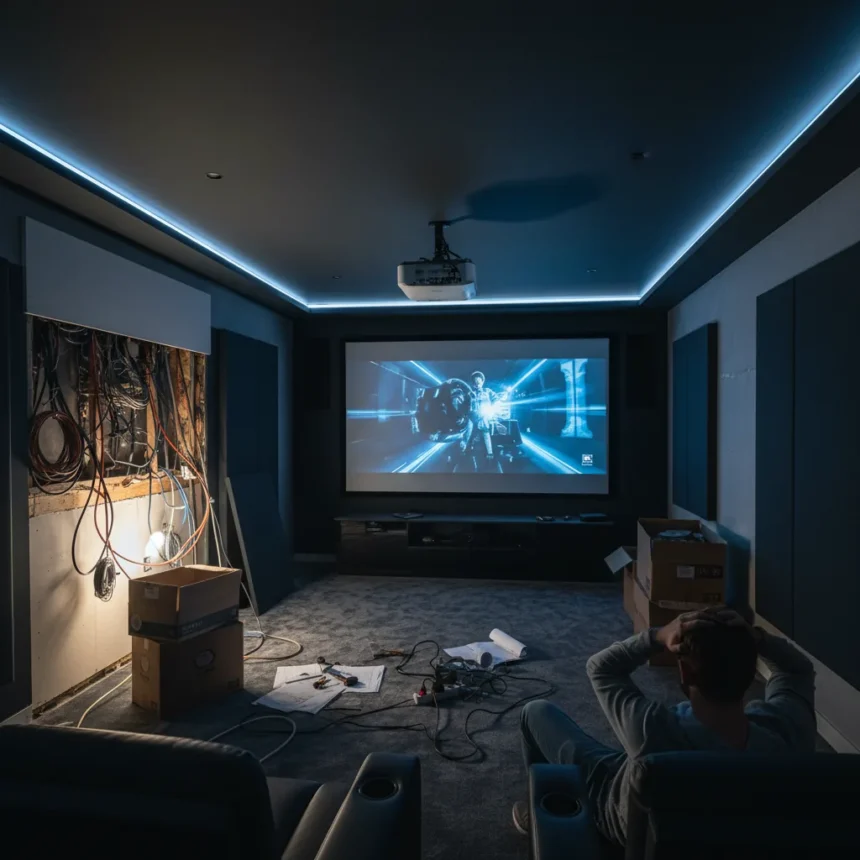
Building a dedicated home cinema demands precision, patience, and a willingness to learn from setbacks. Home cinema mistakes are expensive — they cost money, time, and frustration when discovered mid-project. One builder’s journey through eight critical errors offers a roadmap for avoiding the same pitfalls.
Key Takeaways
- Planning and room acoustics must come before equipment selection to avoid costly rewiring.
- Electrical infrastructure should be sized for future expansion, not just current needs.
- Seating layout and sightlines determine viewing quality more than display size alone.
- Cable management and conduit installation save thousands in rework costs later.
- Acoustic treatment is often delayed but delivers the biggest impact on sound quality.
Why Home Cinema Mistakes Cost More Than You Think
Home cinema mistakes compound. A miscalculation in room dimensions leads to wrong equipment sizing. Poor electrical planning forces expensive rewiring. Inadequate acoustic treatment ruins audio quality and demands costly retrofits. Each error multiplies the next, turning a weekend project into a months-long renovation. The real cost is not just money — it is the opportunity lost to actually enjoy the space while corrections drag on.
Most builders underestimate how much their initial decisions lock in downstream choices. A room layout chosen without considering sightlines cannot be easily adjusted after seating arrives. Electrical circuits sized for current equipment cannot support future upgrades without substantial rework. Acoustic panels installed after construction look like afterthoughts rather than integrated design. Planning avoids all of this. Rushing through the early stages guarantees expensive mistakes later.
Planning and Acoustics Must Come First
The biggest home cinema mistakes happen when builders choose equipment before understanding their room. Acoustic properties, dimensions, and sightlines should drive every other decision — not the other way around. A room’s natural resonance, reflection points, and ambient noise determine what speakers will work, where they should sit, and how much treatment the space needs. Picking a projector or receiver first, then trying to fit it into an unprepared room, is backwards thinking that leads to compromises and regret.



Acoustic treatment is often treated as optional or delayed. It is neither. A room with poor acoustics defeats even premium equipment. Bass frequencies build up in corners, dialogue gets muddied by reflections, and the space sounds hollow or boomy depending on layout. These problems cannot be fixed with a better receiver or more expensive speakers — they require physical treatment: absorption panels, bass traps, and diffusion. Installing these during construction is cheap. Adding them after drywall is up costs far more and looks worse.
Electrical Infrastructure and Future-Proofing
Undersizing electrical circuits is a home cinema mistake that becomes obvious only when expansion plans hit a wall. A room designed for one receiver and three speakers cannot easily add a second subwoofer, powered acoustic panels, or future amplification without circuit overload. Conduit runs should be installed during construction to handle future cable runs without tearing into walls. Power outlets should be placed based on anticipated future layout, not just current needs.



Cable management seems minor until you realize you have run speaker wire, power cables, and HDMI lines through walls without proper conduit. Future upgrades require ripping out existing cables or running new ones on the surface — both ugly and inefficient. Builders who install empty conduit during framing spend a few dollars extra upfront but save hundreds in labor later. This is the kind of forward-thinking that separates a well-built cinema from a perpetually half-finished one.
Seating Layout Determines Viewing Quality
Sightline planning is where many home cinema mistakes reveal themselves. A seating arrangement that looks good on paper may place viewers too close to the screen, creating neck strain and limiting the sweet spot for surround sound. Distance from the screen, angle to the display, and acoustic distance from speakers all interact. A row of seats positioned without considering these factors locks in a suboptimal experience that cannot be easily changed.
The viewing distance from screen to seating should match the display size and resolution. Too close and the image breaks into pixels or causes eye fatigue. Too far and the resolution advantage disappears. Surround speaker placement depends on where the audience sits. If seating is placed without this in mind, surrounds end up too far away or at awkward angles. These constraints should be modeled before construction begins, not discovered after furniture arrives.
Common Questions About Home Cinema Setup
What is the most expensive home cinema mistake to fix?
Acoustic treatment installed after construction costs three to five times more than building it in during framing. Electrical rewiring to add circuits or outlets is similarly expensive. Both are easily prevented with upfront planning.



How much should I budget for acoustic treatment in a dedicated cinema?
Acoustic treatment varies by room size and existing conditions. A small room might need a few hundred dollars in panels. A larger space could require several thousand. The cost is justified because poor acoustics cannot be compensated with better equipment.
Should I hire a professional designer for a home cinema build?
Professional design catches home cinema mistakes before they become expensive problems. A designer models sightlines, acoustic behavior, and electrical needs, then creates a plan that avoids costly revisions. For most dedicated builds, the design fee pays for itself in avoided errors.
Building a dedicated home cinema teaches hard lessons about planning, patience, and the interconnected nature of audio and video systems. The builders who avoid home cinema mistakes are not those with the biggest budgets — they are the ones who plan first, choose equipment second, and think about future expansion before picking up a drill. That discipline turns a room into a genuine cinema rather than an expensive experiment in trial and error.
Where to Buy
Edited by the All Things Geek team.
Source: What Hi-Fi?