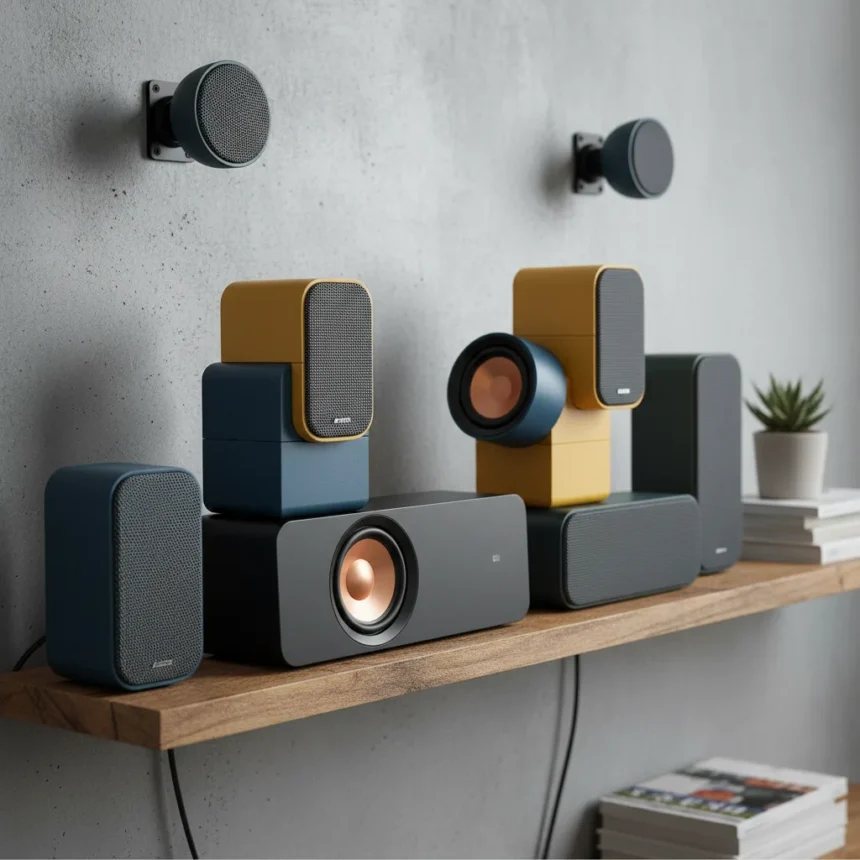
Jamo, the Danish audio brand, has returned to the market with seven new speaker products designed to solve a problem most audio enthusiasts face: fitting quality sound into compact spaces. The collection includes compact speakers bookshelf models that challenge the assumption that small rooms demand compromises on sound quality or aesthetics.
Key Takeaways
- Jamo unveiled two new speaker families with a total of seven products.
- The range includes a shallow speaker option specifically designed for narrow bookshelves.
- Compact designs resemble Lego bricks, combining form and function.
- Danish brand returns to market with focus on space-constrained audio solutions.
- Products address the growing demand for small-form-factor speakers in modern living spaces.
Compact Speakers Bookshelf: A New Approach to Space
The standout feature of Jamo’s new lineup is its focus on solving real-world placement challenges. The shallow bookshelf speaker is engineered specifically for narrow shelving, a constraint that has plagued consumers shopping for traditional bookshelf speakers. Rather than forcing customers to choose between sound quality and spatial practicality, Jamo engineered a speaker that fits both criteria. This design philosophy reflects a shift in how audio brands approach the compact speaker market, moving away from one-size-fits-all solutions toward purpose-built options.
The compact speakers bookshelf collection also draws inspiration from minimalist industrial design. One model is described as resembling a Lego brick that plays music, suggesting a playful yet functional aesthetic that appeals to consumers who refuse to hide their audio gear. This approach differentiates Jamo from competitors who often rely on conventional speaker enclosures that dominate living rooms visually.
Two New Families: Expanding the Compact Speaker Ecosystem
Jamo’s strategy centers on two distinct product families within the seven-product launch. Rather than spreading resources thin across unrelated designs, the brand has focused on cohesive families that share design language and engineering principles. This approach mirrors how successful audio brands like KEF and Sonos structure their portfolios, allowing customers to mix and match within a unified ecosystem while maintaining sonic consistency.



The dual-family structure suggests Jamo is targeting different use cases and customer preferences. One family likely emphasizes aesthetic minimalism, while the other may prioritize acoustic performance or connectivity features. Without detailed specifications available, the distinction between the two families remains unclear, but the existence of two separate lineups indicates thoughtful market segmentation rather than arbitrary product proliferation.
The Scandinavian Audio Market’s Return
Jamo’s reentry into the loudspeaker market carries significance beyond its own product line. Scandinavian audio brands have historically set standards for combining minimalist design with acoustic engineering, and Jamo’s return signals renewed confidence in this market segment. The brand competes implicitly with other compact speaker manufacturers, though none are explicitly named in available information. What distinguishes Jamo’s approach is its emphasis on solving specific spatial problems—narrow bookshelves, tight living rooms, modern apartments—rather than offering generic compact alternatives.



The timing of this launch reflects broader trends in consumer audio. As living spaces shrink and open-plan layouts dominate residential design, the demand for speakers that disappear aesthetically while performing acoustically has grown. Jamo’s new compact speakers bookshelf models position the brand at the intersection of these trends, offering solutions for consumers who previously had to choose between style, sound, and space efficiency.
Design Philosophy: Form Meets Function
The Lego brick comparison is more than marketing whimsy. It suggests a modular, stackable, or interlocking design approach that appeals to consumers who value flexibility and visual coherence. If the speakers can be arranged in multiple configurations, this opens possibilities for custom installations in unconventional spaces. The shallow bookshelf option reinforces this philosophy—it acknowledges that not every room has standard-depth shelving, and forcing customers to adapt their furniture to their speakers is poor design.
Scandinavian design principles typically prioritize clarity, functionality, and restraint. Jamo’s new lineup appears to follow this tradition, avoiding unnecessary ornamentation while maximizing practical usability. This approach has proven successful for brands like Bang & Olufsen and Linn, which command loyalty by respecting both aesthetics and performance.
What Remains Unknown
The absence of pricing, technical specifications, and exact availability details leaves critical questions unanswered. Without knowing frequency response, power output, or driver configurations, assessing whether these compact speakers bookshelf models represent genuine innovation or incremental design tweaks remains impossible. Similarly, the lack of a specific launch timeline creates uncertainty for consumers ready to purchase.



The research brief provides no information about connectivity options, whether these are active or passive speakers, or what amplification solutions Jamo recommends. These details significantly affect how the compact speakers bookshelf line fits into existing audio setups and what price point consumers should expect.
Will Jamo’s new speakers fit in my existing bookshelf?
The shallow speaker design is specifically engineered for narrow bookshelves, but dimensions are not publicly available. If your shelves are standard depth (eight to ten inches), traditional bookshelf speakers should fit. Jamo’s new shallow option targets narrower installations, but contacting the brand directly for exact measurements is necessary before purchasing.
How do Jamo’s compact speakers compare to other brands?
Jamo positions itself as a returning Scandinavian audio brand, competing with established players in the compact speaker market. However, specific performance comparisons are unavailable without technical specifications. The brand’s emphasis on design and space-conscious engineering suggests it targets aesthetically-minded consumers willing to prioritize form alongside function.
Are these speakers active or passive?
The research brief does not specify whether Jamo’s new compact speakers bookshelf models are active (self-powered) or passive (requiring external amplification). This distinction is critical for buyers planning their audio setup, and clarification from Jamo is necessary before making a purchase decision.
Jamo’s return with seven new products, particularly its compact speakers bookshelf line, signals that the market for thoughtfully designed small-form-factor audio is thriving. The shallow bookshelf option and Lego brick-like aesthetics suggest a brand unafraid to challenge conventions. Whether these speakers deliver on their design promise depends on specifications and performance data that remain to be released. For now, Jamo has succeeded in capturing attention by solving a real problem: how to fit quality sound into spaces where conventional speakers simply do not fit.
Edited by the All Things Geek team.
Source: TechRadar