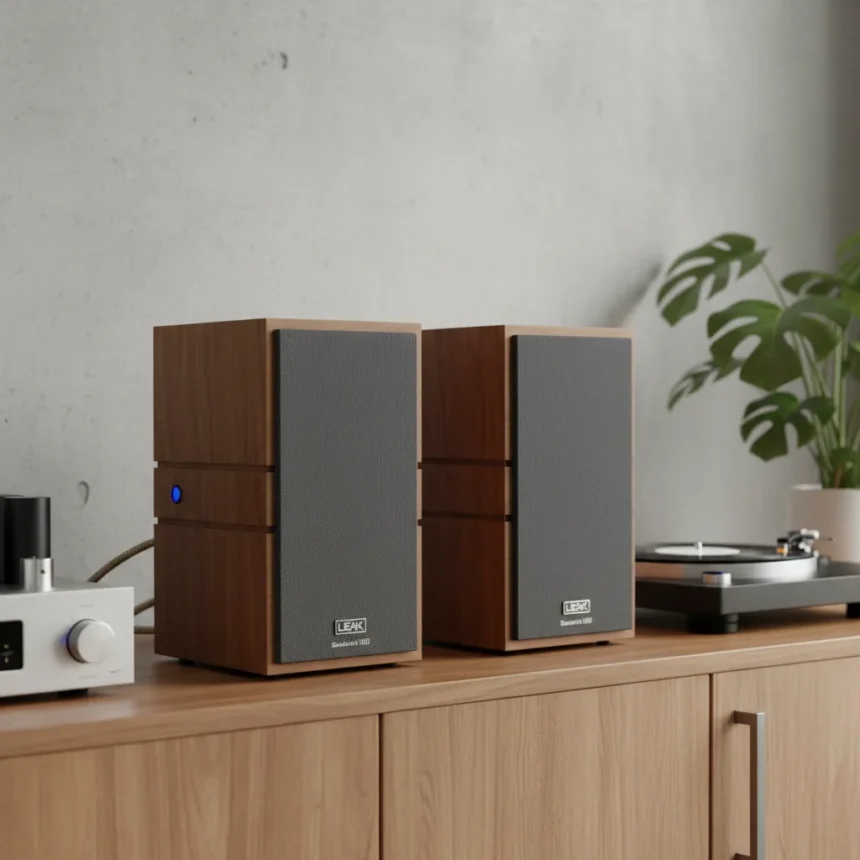
The Leak Sandwich 100 speakers are a compact bookshelf revival of Leak’s iconic 1961 Sandwich design, engineered for smaller spaces and priced under $65. They represent something rare in modern audio: a product that respects its heritage while refusing to live in the past. The question isn’t whether these speakers look or sound British—it’s whether anything else in the category even tries.
Key Takeaways
- Compact 2-way design inspired by Leak’s 1961 Sandwich with modern driver technology and crossover engineering.
- Features 150mm mid/bass driver with long-throw motor and 30mm textile dome tweeter for detailed, balanced sound.
- Sophisticated crossover uses audiophile-grade polypropylene capacitors and air-core inductors for phase coherence and stable imaging.
- Delivers uncompromising sound across jazz, rock, pop, and electronica with natural tone and transparency.
- Walnut veneer cabinet with aluminium trims and baffle insert creates distinctly British aesthetic.
Design That Whispers Heritage
Leak’s original Mini Sandwich from the 1960s became a cult object among collectors and audiophiles. The new Sandwich 100 doesn’t copy that design—it evolves it. The cabinet uses walnut veneer paired with aluminium driver trims and a baffle insert, creating visual restraint that feels intentional rather than budget-conscious. In an era when speaker design has become either aggressively modern or awkwardly retro, the Sandwich 100 simply looks right. It belongs on a shelf next to vinyl records and vintage amplifiers without apology.
The modest footprint matters more than aesthetics suggest. Leak engineered the Sandwich 100 specifically for smaller rooms and apartments where full-size floorstanders create acoustic chaos. This isn’t a compromise—it’s a philosophy. The speaker accepts its physical constraints and works within them, rather than pretending to be something it isn’t.
Engineering That Justifies the Price
The Leak Sandwich 100 speakers deliver performance that contradicts their sub-$65 price tag through deliberate engineering choices. The 150mm mid/bass driver uses a long-throw motor system with high-gauss magnet and low-loss suspension, allowing linear excursion at high volumes without distortion. The cone shape itself is engineered for stiffness and to suppress breakup modes, ensuring vocal purity and upper bass clarity. This level of specification usually appears in speakers costing three times the price.



The 30mm coated textile dome tweeter is larger than typical in this price class, allowing a lower crossover point and superior power handling. That crossover—the network separating bass and treble signals—uses audiophile-grade polypropylene capacitors, air-core inductors, and low-loss resistors with precision layout for minimal phase shift and accurate time alignment. The result is phase coherence and stable 3D stereo imaging that rewards careful placement but doesn’t punish casual listening.
Smooth off-axis response ensures consistent imaging and tonal balance even when listeners sit slightly to the side, a feature absent from many budget speakers. This is the difference between a speaker that sounds good only in one seat and one that performs across a real room.



Sound Character Across Genres
The Sandwich 100 was developed to offer uncompromising sound across jazz, strings, rock, pop, and electronica, delivering rich detail, rhythmic confidence, emotional involvement, natural tone, scale, and transparency. That claim matters because most affordable speakers specialize—they’re good with vocals or good with drums, rarely both. The Sandwich 100 aspires to balance.
Jazz trios should reveal the space between instruments. String quartets should convey bow texture. Rock should maintain rhythmic drive without bloat. Pop should feel present without fatigue. Electronica should resolve layered synths without harshness. These aren’t revolutionary demands, but they require careful engineering to achieve at any price, let alone under $65.
How Sandwich 100 Compares to Alternatives
Leak’s own Sandwich 150 is the larger sibling, priced at £999 and measuring 16.3 x 9.8 x 12.4 inches with 27.1 lbs weight. The 150 uses a 170mm aluminium-foamcore mid/bass driver and achieves 86.5dB sensitivity with 44Hz-26kHz response and 38Hz bass extension. It’s bass-forward for small rooms and praised for precise, detailed sound, but requires more space than the compact 100. The Sandwich 250 is a three-way standmount reaching 65.5cm tall with separate midrange driver, suitable for larger rooms but at significantly higher cost.
If you need deeper bass or larger soundstage, the 150 justifies its price premium. If your space is genuinely small or your budget is tight, the 100 delivers surprising maturity without requiring a subwoofer for most genres. The choice depends on room size and listening priorities, not on which speaker is objectively superior.



Is the Leak Sandwich 100 Worth Buying?
Yes, if you have a small to medium room, listen across multiple genres, and value tonal balance over bass extension. The engineering is legitimate, not marketing fiction. The aesthetic is confident without being pretentious. The price is genuinely remarkable for the component quality inside. British audio culture built its reputation on speakers that prioritize musicality over specifications, and the Sandwich 100 inherits that DNA.
Can the Sandwich 100 work without a subwoofer?
Yes. The 150mm driver provides adequate bass for most music genres without a sub. If you listen primarily to electronic music or film soundtracks demanding deep bass extension below 40Hz, a subwoofer adds capability. For jazz, rock, pop, and classical, the Sandwich 100 stands alone.
How do the Sandwich 100 speakers compare to the original 1961 design?
The original 1961 Leak Mini Sandwich used different driver technology and a simpler crossover around 900Hz. The modern Sandwich 100 uses evolved aluminium-foamcore cone construction, sophisticated crossover engineering with audiophile-grade components, and cabinet advances for better resonance control. Sound quality is substantially improved while maintaining the design philosophy of compact, detailed performance.
What amplifier power do the Sandwich 100 speakers need?
The research brief does not specify amplifier requirements for the Sandwich 100. The larger Sandwich 150 accepts 25-150W of amplification, suggesting the 100 operates across a similar range, but exact specifications should be verified with the manufacturer before purchase.
The Leak Sandwich 100 speakers represent something increasingly rare: a product that respects its past without being imprisoned by it. They look distinctly British without parody. They sound detailed and balanced without pretension. They cost less than most people spend on a single dinner out. In a market obsessed with specifications and features, they remind us that thoughtful engineering and honest aesthetics still matter.
Edited by the All Things Geek team.
Source: Creativebloq