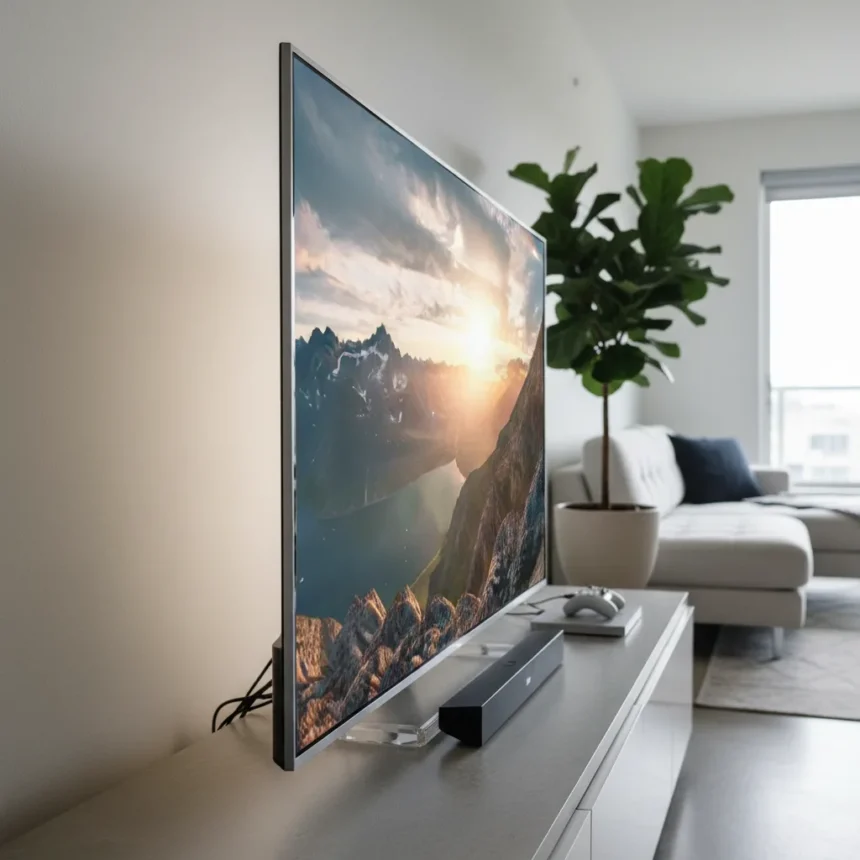
The LG B6 OLED TV represents a meaningful step forward for budget OLED buyers, delivering the much-needed brightness boost that plagued LG’s B-series for years. But as with most display compromises, that gain comes with a cost—and not just in your wallet.
Key Takeaways
- LG B6 peaks at 895 nits HDR brightness in Cinema Home, a major jump from the B5’s 668 nits
- Supports 4K gaming at up to 120Hz with VRR, plus 144Hz with FreeSync or G-Sync enabled
- Color gamut coverage dropped slightly compared to the B5, hitting 97.4% DCI-P3 instead of 99.5%
- Likely uses LG Display’s newer OLED SE panel, though this is not officially confirmed
- Four HDMI 2.1 ports, Dolby Vision support, and webOS 26 round out the feature set
Where the LG B6 OLED TV Finally Delivers
LG’s B-series has always been the entry point for OLED shoppers—affordable, capable, but underpowered in one critical area: brightness. The LG B6 OLED TV finally addresses that weakness head-on. The measured peak HDR brightness of 895 nits in Cinema Home represents a healthy jump from the previous B5’s 668 nits. That is not just a spec sheet victory; it translates to visibly punchier HDR content, richer blacks in bright rooms, and less washed-out color in high-brightness scenes.
The fullscreen brightness improvement is more modest but consistent—roughly 20 nits brighter than the B5 in both SDR and HDR modes. For streaming and gaming, this means less eye strain in daylit rooms and better visibility of shadow detail without cranking up the backlight artificially. The LG B6 OLED TV also shines for PC gamers, supporting 4K at 120Hz with variable refresh rate (VRR) enabled, and reaching 144Hz with AMD FreeSync or Nvidia G-Sync. That combination is rare in budget OLED TVs.
Dolby Vision support rounds out the HDR feature set, ensuring compatibility with the growing library of Dolby Vision content across streaming platforms and physical media. The TV packs four HDMI 2.1 ports, so you are not forced to choose between your gaming console, set-top box, and streaming device.



The Color Accuracy Tradeoff Nobody Wants to Discuss
Here is where the LG B6 OLED TV stumbles. To achieve that brightness bump, something had to give—and that something was color accuracy. Measured color gamut coverage dropped to 72.5% of BT.2020 and 97.4% of DCI-P3, compared with the B5’s 74.85% BT.2020 and 99.5% DCI-P3. The DCI-P3 result still clears the 95% threshold that reviewers want to see, but the decline is real and visible in side-by-side comparisons.
TechRadar’s testing revealed occasional color inconsistencies, including a greener tint in some scenes. This is not catastrophic—most viewers will not notice it during normal viewing. But if you are sensitive to color accuracy or plan to use this TV for photo editing or color-critical work, the LG B6 OLED TV is not the right choice. The C6 remains brighter and more colorful overall, making it the better pick if budget allows.



The brightness gains likely come from LG Display’s newer OLED SE panel, which removes the polarizer layer that reduces reflections. That architectural change boosts peak brightness but introduces a new problem: the TV may be more reflective in bright rooms. This is the classic display engineering tradeoff—you cannot have it all.
Gaming and Processor Performance
Gaming is where the LG B6 OLED TV makes its strongest case against step-up models. The Alpha 8 Gen 3 AI processor handles scaling and upsampling without introducing obvious artifacts, and the full suite of gaming features—4K 120Hz, VRR, FreeSync, G-Sync—means console and PC gamers are equally well served. The 144Hz refresh rate with VRR is a genuine differentiator for PC gamers running high-end graphics cards.
Response times are excellent, as is typical for OLED displays, and the low input lag means competitive gaming feels responsive. For a budget OLED, the LG B6 OLED TV punches well above its weight in the gaming category—potentially outperforming more expensive LCD TVs in this specific use case.
Should You Buy the LG B6 OLED TV?
The LG B6 OLED TV is the best budget OLED option if brightness and gaming matter more to you than perfect color accuracy. If you watch mostly streaming content in well-lit rooms and play games regularly, the brightness boost and gaming features justify the upgrade from older B-series models. But if color accuracy is non-negotiable, or if you want the absolute best OLED performance, the C6 is worth the extra cost.



Does the LG B6 OLED TV have better brightness than the C6?
No. The C6 is brighter overall. However, the B6 actually outperforms the C6 in HD/SDR brightness in some modes, hitting 342 nits versus the C6’s 253 nits. For HDR, the C6 remains superior.
What panel does the LG B6 OLED TV use?
The LG B6 OLED TV likely uses LG Display’s newer OLED SE panel, which is claimed to reach up to 1,000 nits peak brightness. However, this has not been officially confirmed by LG, and the measured result of 895 nits reflects real-world performance.
Is the LG B6 OLED TV good for gaming?
Yes. It supports 4K at 120Hz with VRR, plus 144Hz with FreeSync or G-Sync, making it competitive with much more expensive gaming TVs. Response times are excellent, and input lag is minimal.
The LG B6 OLED TV succeeds where it matters most for budget shoppers—brightness and gaming—but the color accuracy compromise reminds us that no TV is perfect. It is a smart choice for the right buyer, and a frustrating near-miss for everyone else.
Where to Buy
Edited by the All Things Geek team.
Source: TechRadar