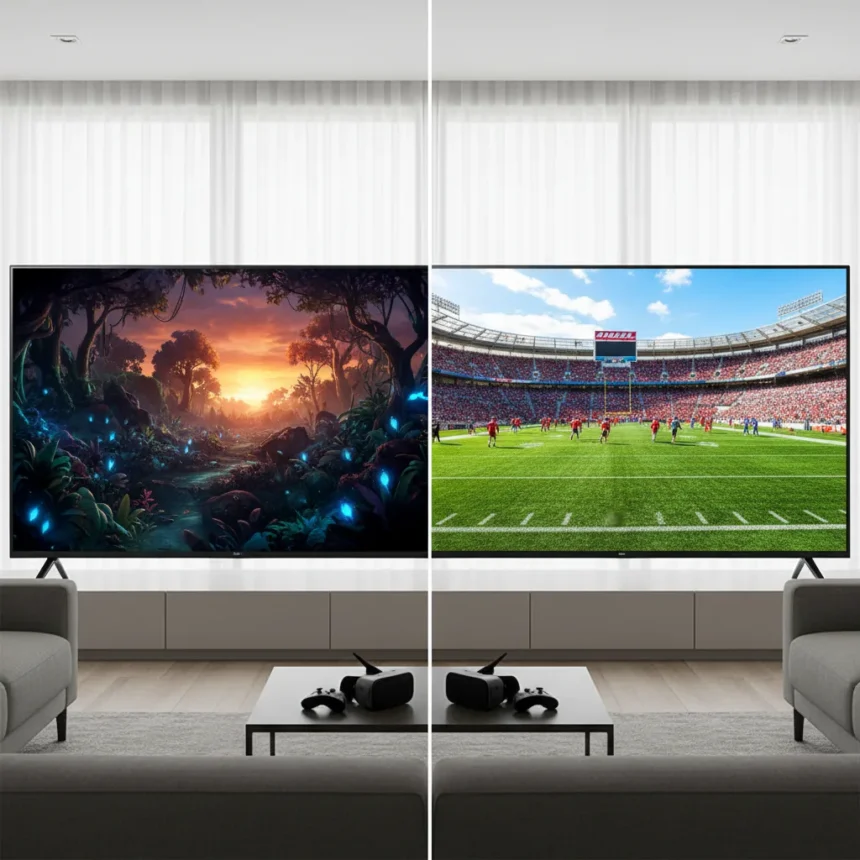
LG C6 vs Hisense UR9 pits OLED against an aggressive new challenger that refuses to cede the brightness crown. LG’s C6 is the company’s mid-range OLED for 2026, available in 42- to 65-inch sizes with standard WOLED display technology, while the Hisense UR9 is Hisense’s 2026 flagship using RGB Mini-LED—red-, green-, and blue-colored LEDs instead of quantum dots. Both are premium performers, but they chase different priorities, and the choice hinges on what matters most in your living room.
Key Takeaways
- LG C6 delivers superior color accuracy with Delta-E of 1.62 versus Hisense UR9’s 2.72, making it the more precise choice for critical viewing.
- Hisense UR9 crushes brightness: 3,327 nits HDR and 2,486 nits SDR, ideal for bright rooms but with color balance trade-offs.
- LG C6 excels at gaming and color consistency; UR9 lacks gaming features and inconsistent performance across content types.
- UR9’s Rec.2020 gamut coverage reaches 93.1%, beating most competitors, but LG C6 wins overall picture quality and reliability.
- For most buyers, LG C6 offers the better value-to-performance ratio; UR9 suits extreme brightness seekers willing to accept compromises.
Brightness and Color: Where RGB LED Makes Its Stand
The Hisense UR9 arrives with a singular mission: obliterate every brightness record in the room. It hits 3,327 nits in HDR and 2,486 nits in SDR, numbers that make traditional OLED look dim by comparison. For daytime viewing in sunlit rooms, this is genuinely useful—the UR9 remains visible and vibrant where OLED panels fade to gray. The RGB Mini-LED architecture pushes color saturation to 93.1% coverage in the Rec.2020 color space, outperforming most 2026 competitors including QD-OLED and SQD Mini-LED TVs. On paper, it is a color powerhouse.
But brightness alone does not equal picture quality. The LG C6 achieves a Delta-E of 1.62, meaning its color accuracy is nearly imperceptible to the human eye. The Hisense UR9’s Delta-E of 2.72 is respectable but noticeably softer in color precision. This gap widens in mixed-content viewing: the UR9 struggles with color balance consistency across SDR films, streaming content, and gaming, while the C6 maintains rock-solid accuracy regardless of input. For anyone who watches calibrated content or cares about faithful color reproduction, the LG wins decisively.
Gaming and Performance: OLED’s Unshakeable Advantage
Gaming is where the LG C6’s OLED architecture shines brightest. The panel’s instant pixel response, lack of blooming, and zero input lag create a gaming experience that RGB Mini-LED cannot match. The Hisense UR9 lacks dedicated gaming features, and its inconsistent performance across different content types means you cannot rely on it for competitive gaming or fast-paced action scenes. The UR9 simply was not built for gaming; it is a brightness-first display.



The LG C6 scored 94 overall in comparative testing versus the TCL QM8L (91 total), demonstrating that OLED’s architectural strengths—perfect blacks, instant response, no blooming—translate into measurable performance gains. For PS5, Xbox Series X, or PC gaming, the C6 is the obvious choice. The UR9 is better suited to sports bars and outdoor spaces where raw brightness matters more than pixel-perfect response times.
Practical Trade-Offs: Brightness vs. Consistency
The fundamental trade-off is simple: do you want peak brightness or peak consistency? The Hisense UR9 excels in bright rooms and daytime viewing but falters when the lights dim or the content demands color balance. Its 99.93% Rec.709 coverage (standard definition) is impressive, yet this does not translate to the nuanced color rendering that OLED achieves with fewer zones and smarter backlight control.



The LG C6 occupies the sweet spot between value and performance. It does not match the UR9’s raw nits, but its 1,251 nits HDR brightness is sufficient for most living rooms, and it maintains that brightness consistently across all content types. The C6’s Rec.709 coverage of 97.8% is excellent, and its 75.92% Rec.2020 gamut, while lower than the UR9, is still competitive and more accurately rendered. For the average viewer, the C6’s reliability outweighs the UR9’s brightness peaks.
Is the LG C6 Worth Buying Over the Hisense UR9?
Yes, for most buyers. The LG C6 offers superior color accuracy, gaming performance, and consistency at a mid-range price point. The Hisense UR9 is exceptional if your primary use case is daytime viewing in a bright room or if you value extreme color saturation above all else. But for balanced performance across movies, gaming, and streaming content, the C6 is the more reliable choice.
What Makes RGB Mini-LED Different From WOLED?
RGB Mini-LED uses separate red, green, and blue LEDs for backlighting, allowing for precise color mixing and higher peak brightness. WOLED uses a white OLED panel with color filters, prioritizing color accuracy and response time over raw brightness. The UR9’s RGB approach excels at saturation; the C6’s WOLED approach excels at precision and consistency.
Should You Wait for Larger LG C6 Models With RGB Tandem OLED?
LG’s larger C6 variants use RGB Tandem OLED technology, but lab testing is still pending, so full performance data is not yet available. If you need a larger screen and can wait for reviews, this may be worth considering. For now, the 42- to 65-inch WOLED models are the proven choice.



The LG C6 vs Hisense UR9 comparison ultimately reflects two competing philosophies for 2026 flagship TVs. The UR9 chases brightness and color volume; the C6 chases accuracy and consistency. For gaming, streaming, and mixed-content viewing, OLED still holds the crown. The Hisense UR9 is a formidable challenger in specific use cases—bright rooms, sports bars, outdoor installations—but it cannot dethrone OLED as the all-around winner. Choose the C6 unless daytime brightness is your primary concern.
Where to Buy
$1,599.99 at Amazon | Check Amazon | 65-inch C6 for $2,699 on Amazon | 55-inch LG C6 can be had for $1,999
Edited by the All Things Geek team.
Source: Tom's Guide