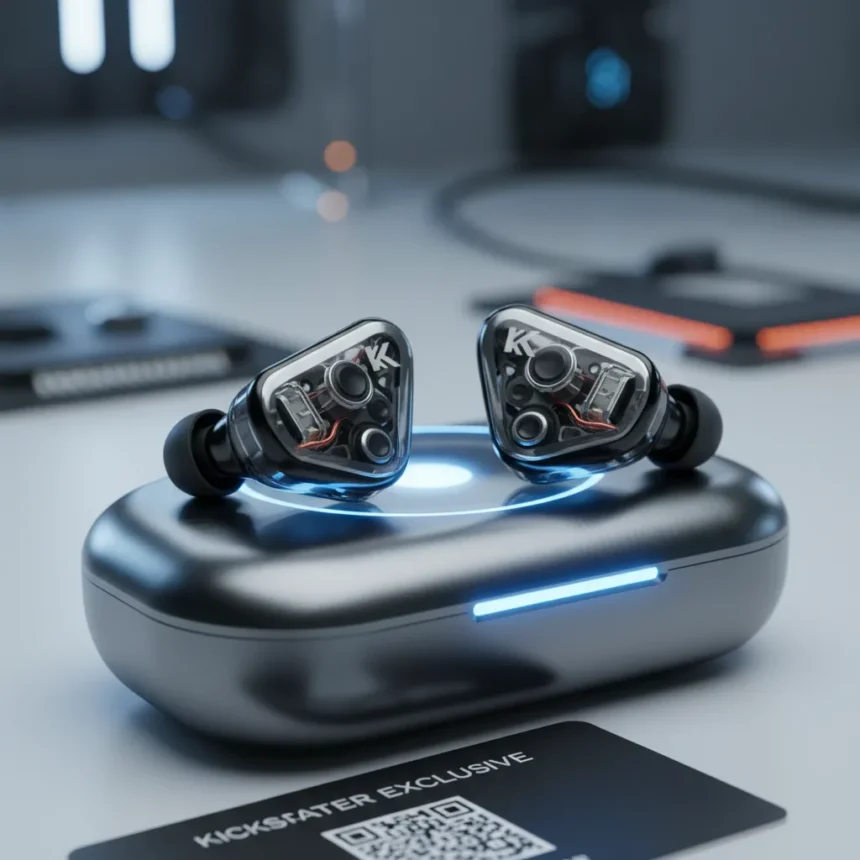
A Kickstarter earphone world first has landed with a bold claim: revolutionary design that changes how you listen. Yet after hearing it, the sensation is one of déjà vu. The campaign is live with early bird pricing at $209, climbing to $259 once that tier sells out. The paradox is worth examining, because it reveals something uncomfortable about innovation claims in audio hardware.
Key Takeaways
- Kickstarter earphone world first claims novelty but delivers familiar acoustic character
- Early bird price of $209 USD offers reasonable value; full price of $259 is harder to justify
- Campaign is active on Kickstarter with limited early bird inventory
- Sound signature feels derivative despite purported breakthrough technology
- Crowdfunded audio gear requires skepticism toward marketing claims
The World First Problem in Audio
Every earphone launch now carries the weight of a world first claim. This Kickstarter earphone world first is no exception—the campaign promises technology never before combined in this form. Yet the actual listening experience contradicts that narrative. The sound is competent, balanced, and forgettable in precisely the ways we’ve heard a hundred times before. There is nothing wrong with competent audio, but there is something wrong with selling competence as revolution.
The disconnect between marketing and reality is the real story here. Crowdfunding thrives on bold claims because bold claims drive backing. A Kickstarter earphone that simply sounds good does not move the needle. A Kickstarter earphone world first that sounds good—that moves units. The problem is that most earphones, regardless of claimed innovation, converge on similar tuning philosophies because human ears prefer similar things. Bass clarity, midrange presence, treble extension. These are not revolutionary concepts, and no amount of engineering can make them sound genuinely novel.
Pricing: Where the Contradiction Becomes Clear
The reviewer’s assessment cuts directly to the heart of the value proposition: at $209 early bird pricing, this Kickstarter earphone world first is a fair deal. At $259 full price, it becomes a harder sell. This $50 gap is not arbitrary—it reflects the difference between a crowdfunding discount and a retail price that must justify the world first positioning without the novelty factor to back it up.


Early bird tiers exist precisely because campaigns know that full retail pricing is fragile. Once the hype settles and early backers receive their units, the narrative shifts from innovation to reality. At that point, a $259 earphone competes against established alternatives with proven track records, better warranty support, and no crowdfunding risk. The world first claim loses its persuasive power when you can buy something similar from a company with a decade of audio expertise.
Why Familiar Sound Matters More Than You Think
Hearing a familiar sound signature is not inherently bad—it means the tuning is likely competent and listenable. The problem arises when familiarity contradicts the marketing narrative. A Kickstarter earphone world first should sound different, at least in some meaningful way. Instead, this one sounds like the product of competent engineering without distinctive character. It is the audio equivalent of a well-designed but unremarkable smartphone: it does the job, but it does not excite.



This matters because audio is one of the few hardware categories where subjective preference still dominates purchasing decisions. You cannot benchmark sound the way you benchmark processor speed. That subjectivity is precisely why marketing claims matter so much—they shape expectations. When those expectations are not met, the product feels like a disappointment even if its technical performance is solid. A Kickstarter earphone positioned as revolutionary but sounding conventional will frustrate backers who took the risk on the promise of something genuinely new.
The Crowdfunding Gamble
Backing a Kickstarter earphone world first is always a gamble. You are paying for a product that does not yet exist, from a company with limited track record, based on marketing claims and prototype demos. The $209 early bird price softens that gamble—it gives you a discount for taking the risk. But the discount only makes sense if you understand what you are actually backing: a competent earphone with a familiar sound, not a category-defining innovation.
This is not an argument against crowdfunding audio gear. Some of the most interesting earphones in recent years have come through Kickstarter. But it is an argument for skepticism. When a campaign claims a world first, ask what specifically is new. Ask whether that newness translates to audible differences. Ask whether you would buy the product at full retail price if it were sold by Sony or Sennheiser instead. If the answer is no, then the early bird discount is not a deal—it is a trap.
Should I back this Kickstarter earphone world first?
At $209, the early bird tier offers reasonable value for a competent earphone. If you are comfortable with crowdfunding risk and the familiar sound signature appeals to you, it is worth considering. At $259 full retail, the value proposition weakens significantly unless you have specific reasons to prefer this product over established alternatives.


What makes this Kickstarter earphone world first different from other earbuds?
The campaign claims breakthrough technology that has never before been combined in this form. However, the actual listening experience does not reveal obvious distinctions from existing earphones, suggesting that the novelty may be technical rather than audibly apparent.
Is the early bird price of $209 worth it compared to the full price of $259?
The $50 difference between early bird and full retail pricing reflects the crowdfunding discount. At $209, backers are getting a fair deal for a competent earphone. At $259, the same product must compete against established brands with proven reliability, making the premium harder to justify.
The Kickstarter earphone world first campaign succeeds as marketing but falters as innovation. That gap between promise and delivery is what matters most. If you are drawn to the novelty claim, manage your expectations—you are buying a well-engineered earphone, not a revolution. At the early bird price, that is a reasonable trade-off. At full retail, it is not.
Where to Buy
Chord Mojo 2 | Fosi DS2 | Kiwi Ears Allegro Mini IEM | Binary EP321 regularly for $279 over at Amazon | Binary EP321
Edited by the All Things Geek team.
Source: Creativebloq