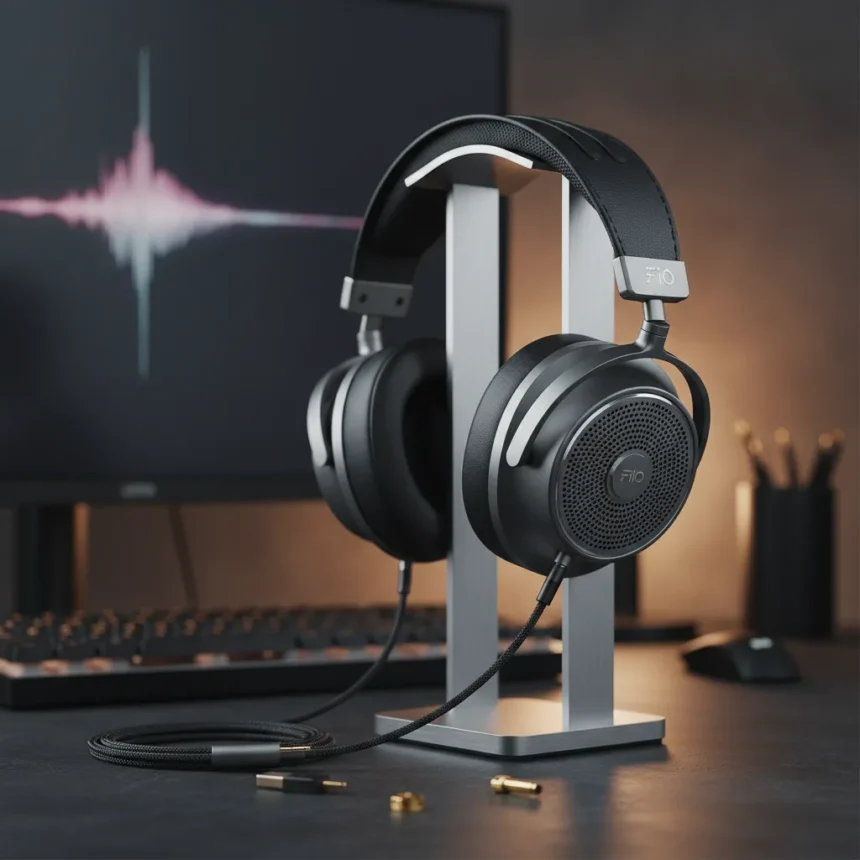
The FiiO JT7 are planar magnetic open-back headphones designed for audiophiles and newcomers alike, launched in early 2025 at $109.99 USD. These 90mm planar magnetic drivers challenge the assumption that serious audio requires a $300+ investment. After testing dozens of budget-friendly options, one Tom’s Guide headphones expert declared them his favorite planar magnetic open-back headphones under $120.
Key Takeaways
- FiiO JT7 feature 90mm planar magnetic drivers with neutral tuning and sub-bass emphasis at $109.99.
- Frequency response spans 7Hz–40kHz with 94dB/mW sensitivity and 16Ω impedance for easy amplification.
- Aluminum earcups and glass fiber suspension headband weigh just 374g without cable.
- Open-back design delivers wide soundstage and excellent imaging across rock, electronic, classical, and jazz.
- Compete favorably with HiFiMan Sundara ($299) and Audeze LCD-1 ($399) for value and comfort.
Why Planar Magnetic Open-Back Headphones Matter Now
Planar magnetic open-back headphones have historically demanded deep pockets. The HiFiMan Sundara costs $299. The Audeze LCD-1 runs $399. Both deliver exceptional sound, but that price wall locks out serious listeners on tight budgets. The FiiO JT7 shatter that barrier. They prove that planar magnetic technology—the driver design favored by audiophiles for its speed, detail, and low distortion—no longer requires choosing between quality and affordability. Alex Bracetti, Tom’s Guide’s headphones expert who tests over 100 pairs annually, notes that the JT7 deliver premium sound quality that punches way above their price point. This matters in 2025, when budget-conscious listeners are re-entering the audiophile hobby post-pandemic and want entry points that do not sacrifice performance.
Build Quality and Comfort on the FiiO JT7
The FiiO JT7 weigh 374 grams without the cable—light enough for extended listening but substantial enough to feel durable. CNC-machined aluminum earcups pair with a fourth-generation glass fiber arm beam suspension headband, a design that distributes weight evenly across your head without pinching. The 70mm inner diameter protein leather earpads seal comfortably without clamping, and FiiO includes a spare set of suede earpads in the box for listeners who prefer a different texture or acoustic signature. The silver-plated monocrystalline copper cable (1.5 meters, 3.5mm termination) arrives with both a 4.4mm balanced adapter and a 3.5mm to 6.35mm adapter, covering most amplifier and DAC configurations. The carrying case protects the headphones during transport—essential for a product this affordable, since replacement cost is low but inconvenience is real.
Sound Profile and Performance of Planar Magnetic Open-Back Headphones
The FiiO JT7 employ neutral tuning with a deliberate sub-bass emphasis, a tuning choice that respects the source material while adding impact to electronic and hip-hop tracks. The 90mm planar magnetic drivers with 12N + 8N N52 silver-plated flat-wire voice coils deliver excellent imaging—you hear precisely where instruments sit in the stereo field—and a wide soundstage that rivals closed-back designs costing twice as much. Mids remain detailed without harshness. Treble stays smooth, avoiding the brittleness that plagues cheaper planars. Rock, electronic, classical, and jazz all sound composed and engaging. Compared to the HiFiMan Sundara, the JT7 emphasize bass more aggressively, making them more fun for casual listening while the Sundara pursues a flatter reference curve. Compared to the Audeze LCD-1, the JT7 match soundstage width and imaging precision at a fraction of the cost, though the LCD-1 retrieves marginally more fine detail in the midrange—a difference that matters mainly to engineers and mastering professionals. The Sennheiser HD 560S, a dynamic driver open-back at $199, sounds less resolving overall because dynamic drivers inherently trade some clarity for warmth. The FiiO JT7 hit a sweeter balance.



Who Should Buy the FiiO JT7 and Who Should Skip
Buy these if you are dipping your toes into high-end audio and want an ideal entry point without risk. Buy them if you listen to rock, electronic, classical, or jazz and value soundstage width and imaging precision. Skip them if you need portability—open-back design means sound leaks, unsuitable for commutes or shared spaces. Skip them if you demand bass-heavy tuning; the sub-bass emphasis is tasteful, not aggressive. Skip them if you own a high-impedance amplifier; at 16Ω, these are easy to drive from any source, but they do not require premium amplification to shine. The Philips Fidelio X3, a closed-back alternative at $179, offers more bass and isolation but sacrifices the open soundstage that makes the JT7 special. The FiiO FT3, FiiO’s own step-up model at $299, improves build quality and adds refinement, but the returns diminish—you pay nearly three times as much for incremental gains.
Frequency Response and Technical Specs Explained
The FiiO JT7 span 7Hz to 40kHz—a range that covers all audible frequencies and extends into ultrasonic territory where some claim to hear subtle artifacts (though this remains debated among audiophiles). Sensitivity of 94dB/mW means the headphones play loud from modest sources; you do not need an expensive amplifier to drive them. The 16Ω impedance is exceptionally low for planar magnetic headphones, which typically demand 32Ω or higher. This low impedance makes the JT7 compatible with smartphones, laptops, portable DACs, and entry-level amplifiers—removing a barrier that stops many newcomers from exploring planar magnetic audio. The silver-plated voice coil and monocrystalline copper cable prioritize signal purity, though the audibility of these upgrades versus standard copper remains subjective.



Should I buy the FiiO JT7 if I already own budget headphones?
If your current headphones cost under $80, the FiiO JT7 represent a meaningful upgrade in soundstage, imaging, and detail retrieval. If you own headphones in the $80–$150 range, the upgrade depends on whether you value open-back soundstage over closed-back isolation and bass. If you already own planar magnetic headphones above $200, the JT7 offer little advantage beyond portability and cost savings.
How do the FiiO JT7 compare to closed-back alternatives?
Closed-back headphones like the Philips Fidelio X3 deliver more bass and isolation, making them better for commuting and shared spaces. Open-back designs like the JT7 sacrifice isolation but deliver wider soundstage and more spacious imaging. Choose based on your listening environment, not on which is objectively better—they serve different purposes.
Can I use the FiiO JT7 with a smartphone or portable DAC?
Yes. The 16Ω impedance and 94dB/mW sensitivity mean the JT7 play adequately loud from any smartphone, laptop, or portable DAC without requiring a dedicated amplifier. A quality DAC improves the experience but is not mandatory for enjoyable listening.
The FiiO JT7 prove that planar magnetic audio no longer belongs exclusively to the wealthy. At $109.99, they deliver soundstage, imaging, and neutrality that challenge headphones costing two and three times as much. For anyone entering the audiophile hobby or upgrading from budget models, they represent the smartest entry point available in early 2025. Open-back design means they are not for everyone—isolation matters for commuters, and bass-hungry listeners might prefer closed alternatives—but for stationary listening in a quiet space, the JT7 are hard to beat.



Where to Buy
$119.99 at Amazon | $119.99 at Amazon | $119 | $119 on Amazon U.S. | Philips SHP9500
Edited by the All Things Geek team.
Source: Tom's Guide