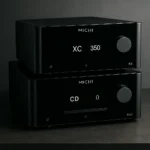
The Rotel Michi Prestige Series marks a significant expansion for the Japanese manufacturer into the premium hi-fi market segment. The new product line launches with two core components: a stereo amplifier and a dedicated CD player, signaling Rotel’s commitment to serving audiophiles who demand both analog warmth and digital precision in their playback chains.
Key Takeaways
- Rotel Michi Prestige Series debuts with X430 stereo amplifier and Q430 CD player models
- Premium positioning targets serious audiophiles seeking high-end audio performance
- New product line expands Rotel’s reach beyond integrated amplifier designs
- Stereo amplifier and dedicated CD player offer separation-based architecture
- Launch reflects growing demand for discrete, component-based hi-fi systems
What Is the Rotel Michi Prestige Series?
The Rotel Michi Prestige Series represents a new tier within Rotel’s Michi lineup, distinct from the existing integrated amplifier models. Rather than combining preamplifier and power amplifier functions into a single chassis, the Prestige Series adopts a separation philosophy—pairing a dedicated stereo power amplifier with a standalone CD transport and digital-to-analog converter. This architectural approach appeals to purists who believe component separation reduces electromagnetic interference and allows each stage of the signal chain to operate optimally. The X430 amplifier and Q430 CD player form the foundation of what Rotel positions as a gateway into serious hi-fi for discerning listeners.
Design Philosophy Behind the Prestige Launch
Rotel’s decision to introduce the Prestige Series reflects a calculated bet on the resilience of CD playback and the enduring appeal of discrete component design. While streaming dominates consumer listening, a segment of audiophiles continues to value the tactile ritual of disc playback and the sonic characteristics of well-engineered CD players. By separating the amplification stage from the source component, Rotel allows users to upgrade either element independently—a flexibility that integrated designs cannot offer. The Prestige Series thus positions itself as a counterpoint to all-in-one solutions, appealing to listeners who view their audio system as an evolving collection rather than a fixed purchase.
How Rotel Michi Prestige Series Compares to Integrated Amplifiers
Rotel’s existing Michi integrated amplifiers—such as the X3 and X5 models—combine preamp and power amp functions in a single enclosure, prioritizing simplicity and space efficiency. The Prestige Series reverses this logic. By splitting the stereo amplifier from the CD player, the new line demands more rack space but offers sonic and upgrade advantages. Users of integrated designs benefit from fewer connections and simpler setup; Prestige Series adopters gain the ability to swap the CD player for an alternative source or upgrade the amplifier later without replacing the entire system. This modularity is a hallmark of traditional hi-fi architecture and signals Rotel’s willingness to serve both convenience-focused and component-obsessed audiences.



Market Positioning and Audience
The Prestige Series targets a specific demographic: audiophiles with established listening rooms, disposable income, and a preference for physical media or those seeking a long-term investment in audio infrastructure. This is not an entry-level product line. By introducing dedicated amplification and CD playback in a premium package, Rotel acknowledges that a meaningful audience still values CD fidelity and the sonic benefits of component-based design. The launch also reflects broader industry trends: even as streaming grows, CD sales among committed audiophiles remain stable, and manufacturers continue to invest in digital transport technology. Rotel’s move suggests confidence that this niche will sustain demand for the foreseeable future.
What Does the X430 Stereo Amplifier Offer?
The X430 stereo amplifier serves as the power delivery engine of the Prestige Series. As a dedicated power amplifier, it eliminates the preamplification stage, allowing the Q430 CD player to connect directly or through an external preamp. This topology reduces signal path complexity and, in theory, minimizes noise and distortion. The amplifier’s specifications and measured performance remain undisclosed in available materials, but the Prestige positioning suggests it targets listeners seeking high power output, stable impedance handling across demanding speaker loads, and the sonic signature Rotel has cultivated in the Michi line. The separation of amplification from source material handling is central to the appeal—users can later introduce a preamp, tuner, or other components without replacing the amplifier itself.



Understanding the Q430 CD Player
The Q430 CD player brings dedicated digital playback to the Prestige ecosystem. In an era dominated by streaming, Rotel’s investment in a standalone CD transport and DAC signals that the format retains appeal among its target audience. CD playback offers bit-perfect reproduction of the original recording, free from the lossy compression and variable quality of streaming services. The Q430 presumably incorporates quality digital circuitry and analog output stages to deliver the sonic performance expected at the Prestige tier. For listeners with existing CD collections or those who prize the sound quality and ownership model of physical media, the Q430 removes the need to integrate playback through a universal player or streaming device.
Does Rotel Michi Prestige Series justify the component separation approach?
Component separation makes sense for listeners who plan to upgrade or modify their system over time. If you own a CD collection and prioritize fidelity, the dedicated Q430 player eliminates compromises inherent in universal or streaming-focused devices. The X430 amplifier’s standalone design allows future additions—a preamp for source switching, a phono stage for vinyl, or a tuner for radio—without requiring a complete system replacement. However, if you prioritize convenience, value simplicity, or rely primarily on streaming, an integrated amplifier like Rotel’s X3 or X5 may deliver better value and require fewer cables and rack spaces.
Is the Rotel Michi Prestige Series worth buying if I already own a CD player?
If your existing CD player delivers satisfactory sound, upgrading to the Q430 alone may not justify the investment unless you seek measurable improvements in clarity, dynamics, or timing. However, if you are building a system from scratch or your current player is aging, the Q430 paired with the X430 amplifier creates a cohesive, component-based foundation. The real value lies in the modularity: you invest in quality amplification and playback now, then evolve the system as your needs and preferences change.
Can I use the X430 amplifier with other CD players or sources?
Yes. The X430 stereo amplifier is a standalone power amp, meaning it accepts line-level input from any source—CD player, preamp, tuner, or streaming device with a DAC. This flexibility is a core advantage of the Prestige Series architecture. You are not locked into Rotel’s ecosystem; you can pair the X430 with a preferred CD transport, add a separate preamp for source management, or integrate streaming through an external DAC. This modularity appeals to listeners who have invested in other quality components or who want to preserve the option to change sources without replacing the amplifier.



The Rotel Michi Prestige Series represents a deliberate choice: quality over convenience, modularity over integration, and long-term investment over immediate simplicity. For audiophiles with the space, budget, and commitment to building a system piece by piece, it offers a credible entry point into premium hi-fi. For casual listeners or those committed to streaming, it is likely overkill. The real question is not whether the Prestige Series is good—Rotel’s reputation suggests it is—but whether component-based design aligns with your listening habits and your willingness to manage multiple devices rather than rely on a single, elegant integrated solution.
Edited by the All Things Geek team.
Source: What Hi-Fi?