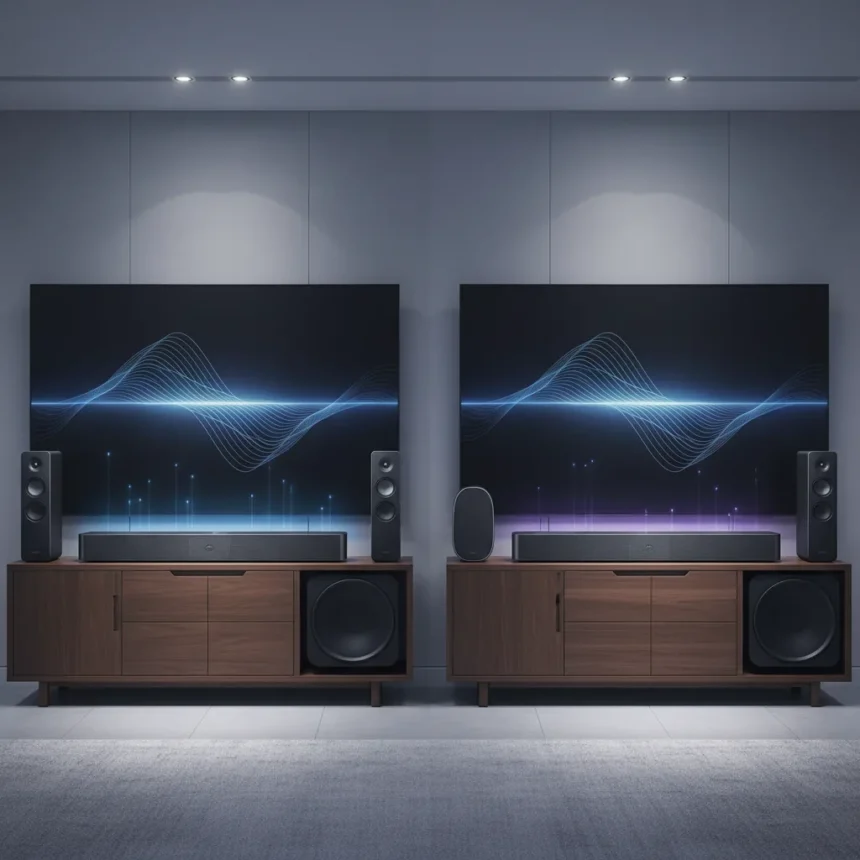
The Samsung HW-Q990F and HW-Q990H represent the pinnacle of the Dolby Atmos soundbar system category, yet the comparison reveals crucial differences for buyers seeking premium home cinema audio. Both models share the same 11.1.4-channel architecture with 23 drivers and support for Dolby Atmos and DTS:X, but positioning them side by side exposes where each excels and where compromises emerge.
Key Takeaways
- Both models feature identical 11.1.4-channel configuration with 23 drivers and Dolby Atmos support
- HW-Q990F represents a step up from the earlier HW-Q990D model
- DTS:X support available on both Dolby Atmos soundbar system variants
- Five-star ratings confirm both systems deliver premium home cinema performance
- Specification parity suggests the choice hinges on availability, pricing, and generation differences
Architecture and Channel Configuration
Both the HW-Q990F and HW-Q990H employ the same 11.1.4-channel architecture, a configuration that places them among the most ambitious soundbar systems on the market. The 11.1.4 designation means 11 horizontal channels, one subwoofer channel, and four height channels for overhead sound. This layout, combined with 23 individual drivers across the system, creates a Dolby Atmos soundbar system capable of rendering immersive three-dimensional audio landscapes. The symmetry in channel count between these models suggests Samsung prioritized maintaining architectural consistency across its flagship lineup.
The presence of 23 drivers distributed across the soundbar, subwoofer, and satellite speakers gives both systems the physical foundation to deliver genuine height channel separation. This is not a simulated or phantom height effect—actual drivers fire sound upward and sideways, creating convincing overhead effects during compatible content. Compared to entry-level Atmos soundbars that simulate height channels through psychoacoustic tricks, a true 11.1.4 Dolby Atmos soundbar system represents a fundamentally different listening experience.
Codec Support and Format Compatibility
Both models support Dolby Atmos and DTS:X, the two leading immersive audio formats in home cinema. This dual-codec approach is crucial for future-proofing. Dolby Atmos dominates streaming platforms and disc media, while DTS:X remains prevalent in premium home theater installations and select streaming titles. A Dolby Atmos soundbar system that omits DTS:X support leaves performance on the table for content encoded in that format. The fact that both the HW-Q990F and HW-Q990H include both codecs eliminates this as a differentiator.



Generational Positioning and Market Placement
The HW-Q990F is explicitly positioned as a step up from the HW-Q990D, Samsung’s previous flagship. However, the research brief provides no detailed specifications for the HW-Q990H, leaving its exact positioning within Samsung’s roadmap unclear. This ambiguity is significant for buyers. If the HW-Q990H is a newer generation, it may incorporate refinements in processing, connectivity, or calibration that don’t appear in raw specifications. If it is a regional variant or parallel model, the differences may be minimal. Without access to the complete feature set and performance characteristics of the HW-Q990H, determining which Dolby Atmos soundbar system represents the better long-term investment requires additional research beyond specification sheets.
Should You Buy the HW-Q990F or HW-Q990H?
If both models are available at similar pricing, the choice becomes a matter of availability and future support. The HW-Q990F’s explicit positioning as an upgrade from the Q990D suggests it incorporates lessons learned from that model’s performance in the field. Buyers should verify which model carries longer warranty coverage and better service support in their region. For a Dolby Atmos soundbar system purchase at this price point, post-sale support and parts availability matter as much as raw specifications.



How does the 11.1.4 configuration compare to 7.1.4 soundbars?
The 11.1.4 setup in both Samsung models adds four extra horizontal channels compared to 7.1.4 systems. This translates to more precise panning across the front soundstage and better side-wall envelopment. A 7.1.4 Dolby Atmos soundbar system can deliver convincing overhead effects, but the 11.1.4 architecture creates a wider, more immersive spatial bubble around the listener.
Do both models require a separate subwoofer?
Yes. Both the HW-Q990F and HW-Q990H ship as complete systems with dedicated subwoofers. The subwoofer handles the .1 channel in the 11.1.4 configuration and provides low-frequency support. The soundbar itself cannot deliver the full system experience without the subwoofer connected.
What’s the difference between Dolby Atmos and DTS:X?
Dolby Atmos uses object-based audio metadata to position sounds anywhere in three-dimensional space, while DTS:X employs a similar approach with different processing. Both create height channel effects, but content creators choose one or the other based on production preference and licensing. A Dolby Atmos soundbar system that supports both codecs can handle any immersive content thrown at it.
The Samsung HW-Q990F and HW-Q990H occupy nearly identical technical territory, making this a closer matchup than the headline suggests. Both deliver the same channel count, driver complement, and codec support. The real differentiator lies in generation, regional availability, and pricing—factors the specification sheet alone cannot reveal. For buyers committed to a premium Dolby Atmos soundbar system, either model represents a serious investment in home cinema audio, but verifying which one carries better long-term value in your market is essential before committing.



Where to Buy
Edited by the All Things Geek team.
Source: What Hi-Fi?