





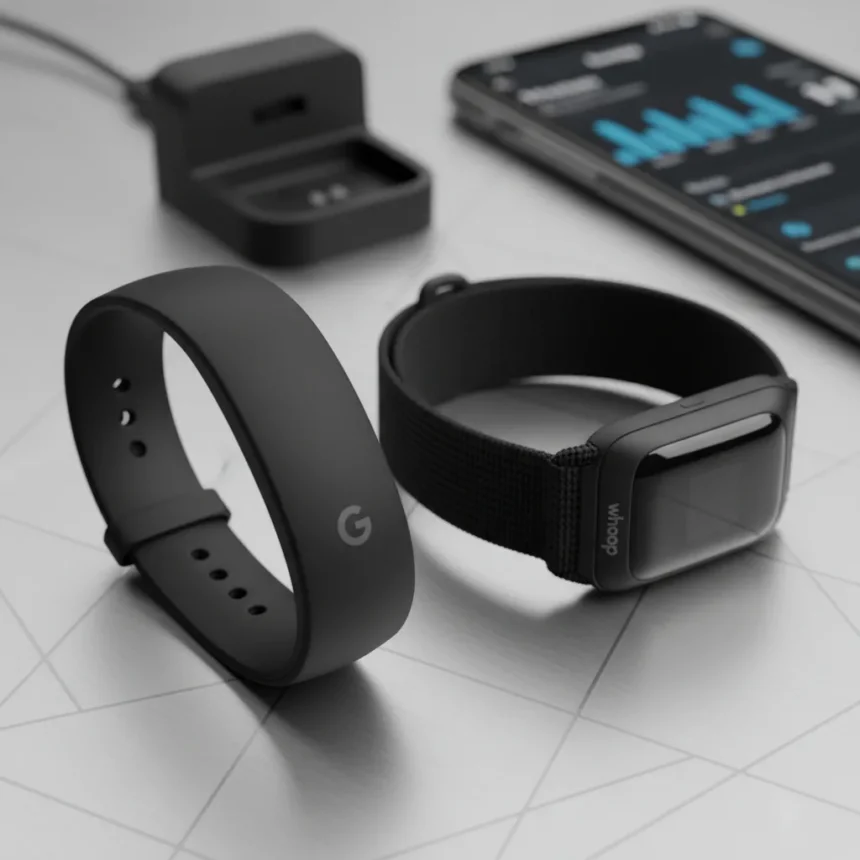
Google Fitbit Air is a screenless fitness tracker made by Google, designed as a lightweight wearable that syncs to the new Google Health app. Weighing just 12g with the fabric band, the device signals Google’s renewed commitment to ‘set and forget’ tracking—a deliberate return to the simplicity that defined the original Fitbit, not the smartwatch-heavy direction competitors have pursued.
Key Takeaways
- Google Fitbit Air weighs 12g and requires no screen, positioning it as a direct Whoop competitor.
- Stores seven days of detailed motion data and one day of workout data on the device.
- Syncs exclusively to Google Health, which replaces the Fitbit app in a mandatory rebrand.
- Free tier provides readouts and graphs; AI-powered coaching requires a subscription.
- Revealed via NBA player Stephen Curry’s Instagram after weeks of leaks.
Google Fitbit Air vs the Subscription Trap
The core tension in the screenless fitness tracker market is simple: Whoop dominates the category but demands a subscription. Google Fitbit Air breaks that model by offering a free tier that delivers basic data readouts, scores, and graphs without forcing users into paid access. Full AI-powered coaching advice still requires subscription, but casual trackers who want motion insights without constant upselling have an actual alternative.
Whoop 5.0 and WHOOP MG shifted toward clinical-grade longevity insights in May 2025, positioning themselves as premium offerings for serious biohackers. Google’s approach feels more democratic. The device stores seven days of detailed minute-by-minute motion data plus one day of workout information, enough for most users to spot patterns without drowning in granularity. This is deliberate restraint—a feature, not a limitation.
The Return of the Invisible Wearable
The Google Fitbit Air heralds a genuine shift in how wearables should work. The original Fitbit of 2008 was almost invisible—clip it on, forget it existed, check results later. Smartwatches inverted that philosophy, demanding constant interaction and battery anxiety. Google Fitbit Air reclaims the original vision. At 12g, it is lighter than most smartwatches and designed to vanish into your routine rather than dominate it.


This positioning directly challenges Garmin’s fitness-focused ecosystem, which layers complexity atop complexity. Garmin trackers offer more features, deeper analytics, and superior sports modes—but they also demand engagement. Google Fitbit Air asks: what if most users just want to move, sleep, and know whether they are recovering? That simplicity is the product, not a limitation.
Google Health: The Ecosystem Play
The Google Fitbit Air does not exist in isolation. It arrives alongside a sweeping redesign of Fitbit itself, with the Fitbit app and Fitbit Premium subscription rebranded as ‘Google Health’ in a mandatory rollout. This is Google consolidating its health ambitions under a single brand. The device is explicitly designed for Google Health Coach, tying it to a broader ecosystem rather than a standalone tracker.



Users can sync the Google Fitbit Air to the free version of Google Health, which provides readouts, scores, and graphs based on the motion data the band captures. AI-powered coaching advice requires a subscription, but the free tier is genuinely functional—not a crippled trial designed to frustrate you into paying. That distinction matters when competing against Whoop, which locks everything behind its subscription wall.
Why Google Revealed It Through Stephen Curry
Google did not announce the Google Fitbit Air through a press release. Instead, it teased the device for weeks via NBA all-star Stephen Curry’s Instagram account before finally breaking cover. This unconventional reveal strategy signals how seriously Google takes the consumer fitness market—and how much it wants to distance the device from corporate tech announcements. Fitness trackers live in the culture of sports and wellness, not quarterly earnings calls. The reveal strategy matched the message: this is a tool for real people, not a specification sheet.
Does Google Fitbit Air actually replace Whoop?
Not entirely. Whoop users who pay for the service get clinical-grade metrics and AI coaching tailored to their training load. Google Fitbit Air offers solid foundational tracking with optional AI features, but it is not a direct feature-for-feature replacement. However, for users who want screenless tracking without the mandatory subscription, Google Fitbit Air is the first credible alternative.
How much data does Google Fitbit Air store?
The device saves seven days of detailed motion data recorded minute by minute, plus one day of workout data. This is sufficient for trend spotting and weekly pattern analysis without overwhelming storage or requiring constant syncing.



Will Google Fitbit Air work with the old Fitbit app?
No. Google is rebranding the Fitbit app and Fitbit Premium as ‘Google Health’ in a mandatory rollout, so Google Fitbit Air syncs exclusively to the new Google Health app and ecosystem. Existing Fitbit users will be migrated to Google Health as part of the transition.
Google Fitbit Air represents a rare moment of clarity in wearable design: a company stepping back from feature bloat to ask what users actually need. At 12g with a seven-day data window, it is not trying to be everything. It is trying to be invisible, and that simplicity is precisely why it threatens Whoop’s subscription dominance.
Edited by the All Things Geek team.
Source: TechRadar




