





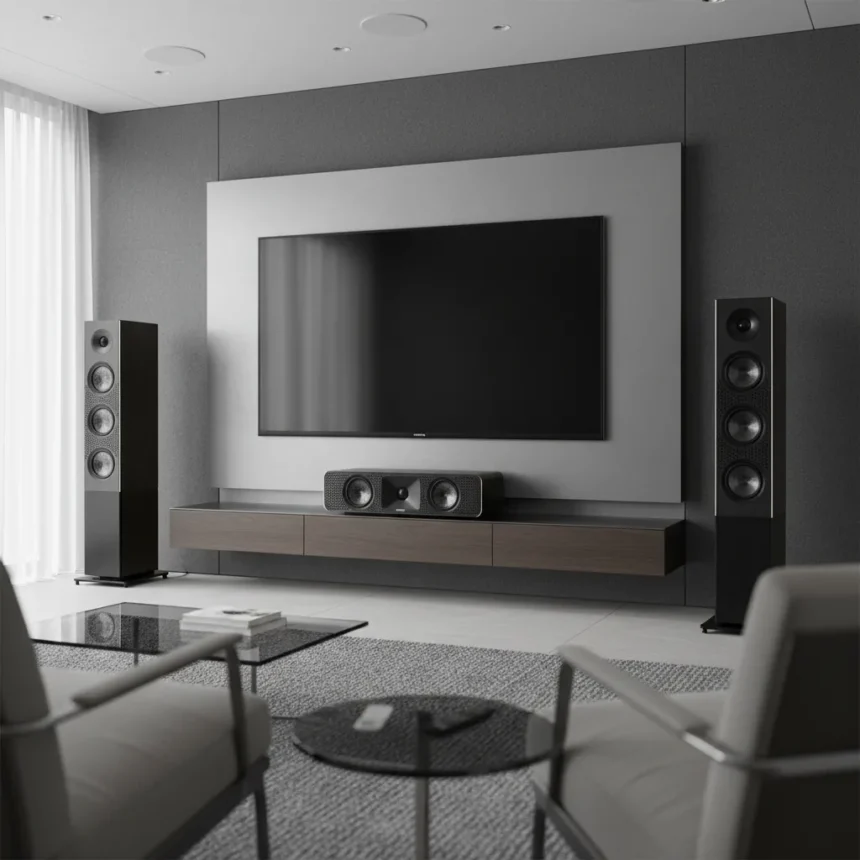
Sony’s new wireless LCR Dolby Atmos system represents a shift in how premium TV owners approach home theater sound. Rather than mounting a single soundbar beneath a giant television, Sony is betting that buyers want the immersive staging of separate left, center, and right speakers—but without the complexity of a full receiver setup. The system is designed specifically for large-screen TV owners who find conventional soundbars inadequate for their viewing environments.
Key Takeaways
- Sony’s wireless LCR system separates left, center, and right speakers for wider soundstage than a single soundbar
- The system supports Dolby Atmos for height and immersion without a traditional AV receiver
- Wireless connectivity eliminates the cable runs required by traditional home theater setups
- The architecture directly challenges Sonos’ soundbar-centric approach to TV audio
- The system targets buyers of large TVs seeking theater-quality sound with modern convenience
Why Separate Speakers Beat Soundbars for Large TVs
A wireless LCR Dolby Atmos system fundamentally changes how sound spreads across your room. Where a soundbar concentrates all audio output from a single point below the screen, an LCR configuration places the left and right channels at the edges of your viewing area and the center channel—where dialogue lives—directly beneath the display. This separation creates a wider, more convincing soundstage that scales naturally with larger screens. For a 75-inch or 85-inch TV, a single soundbar often feels cramped by comparison.
The Dolby Atmos component adds height information to the sound mix, creating the impression of audio moving above and around you. Without a receiver and ceiling-mounted speakers, a wireless system achieves this through upfiring drivers or post-processing techniques built into the individual speakers themselves. This approach avoids the installation nightmare of running cables through walls and mounting speakers to ceilings—a major friction point that keeps many home theater enthusiasts stuck with soundbars.
How Sony’s System Compares to Sonos and Traditional Soundbars
Sonos has built its home theater reputation almost entirely on soundbars, particularly the Arc and Arc Ultra, which dominate the premium wireless TV audio category. These single-unit speakers integrate deeply with Sonos’ broader ecosystem and offer genuine Dolby Atmos support through upfiring drivers. However, a soundbar—no matter how expensive—still outputs all its audio from a single location. It cannot replicate the left-right separation that dedicated left and right speakers provide, especially across a large viewing distance.



Sony’s wireless LCR approach occupies a middle ground between a soundbar and a full home theater receiver setup. It delivers the spatial imaging and immersion of separate speakers while maintaining the wireless simplicity that modern TV owners expect. Unlike a traditional receiver-based system, there are no HDMI cables, no setup menus buried in receiver interfaces, and no need to learn a new remote. The trade-off is that it abandons the all-in-one convenience of a soundbar in favor of three separate units that must be powered and networked. For buyers with large TVs and adequate space, that trade-off is worth making.
The Wireless Home Theater Shift
The rise of wireless LCR systems reflects a broader movement away from receiver-based home theater. Younger buyers and cord-cutters view traditional setups as unnecessarily complex. They want Dolby Atmos and surround sound, but they do not want to learn HDMI switching, calibration menus, or amplifier settings. A wireless system that connects to your TV via a single connection and fills your room with immersive audio appeals directly to this audience. Sony is positioning itself to capture this middle market—buyers who have outgrown soundbars but are not ready to commit to a full receiver installation.



The wireless LCR format also sidesteps one of soundbars’ biggest limitations: they cannot easily expand. Add a wireless subwoofer and surround speakers to a Sonos Arc, and you have a multi-brand ecosystem relying on proprietary software. Add surrounds and a sub to an LCR system, and you are building a modular home theater where each speaker is independent. This flexibility appeals to buyers who want to upgrade incrementally rather than replace everything at once.
What This Means for Soundbar Buyers
If you own a large TV and have never heard a dedicated center channel speaker, the difference is immediate. Dialogue snaps to the center of the screen instead of seeming to float somewhere in the middle of the soundbar. Action sequences feel wider and more enveloping. Atmos content gains genuine height and space. A wireless LCR system delivers all of this without the installation burden that has historically kept home theater out of reach for casual buyers.
The catch is that Sony’s system requires more space, more power outlets, and more shelf or stand real estate than a soundbar. It is not a product for apartments, small rooms, or minimalist setups. It is explicitly designed for the living room with a giant TV and the space to support three separate speakers. If that describes your situation, the sonic benefits are substantial enough to justify the added complexity.
Is a wireless LCR system right for my TV setup?
A wireless LCR Dolby Atmos system makes sense if you have a TV larger than 65 inches, adequate space for three speakers, and you prioritize sound quality over simplicity. If you have a smaller TV, a limited budget, or you value the single-unit convenience of a soundbar, stick with that approach. The LCR format is purpose-built for large-screen home theater enthusiasts who are tired of soundbar compromises.



How does Sony’s wireless LCR system compare to a receiver-based setup?
A traditional receiver-based home theater offers more flexibility, more speaker options, and more processing power, but it requires professional installation or significant DIY effort. Sony’s wireless system sacrifices some flexibility for ease of setup and modern wireless convenience. You get Dolby Atmos and separate speakers without the complexity, but you lose the ability to add a second surround pair or connect legacy equipment through HDMI switching.
Can you add surround speakers to a wireless LCR system?
Yes, wireless LCR systems are designed to expand. You can add rear surrounds and a subwoofer to create a more complete home theater experience. The exact expansion options depend on Sony’s ecosystem and wireless protocol, but the modular approach is one of the key advantages over all-in-one soundbars.
Sony’s wireless LCR Dolby Atmos system signals a meaningful shift in home theater design. It acknowledges that soundbars have hit their ceiling in terms of immersion and that traditional receivers are too complex for modern buyers. By combining separate-speaker staging with wireless simplicity, Sony is offering a third way—one that could reshape how premium TV owners think about audio. For anyone with a large TV and the space to support three speakers, this approach is worth auditioning.
Edited by the All Things Geek team.
Source: TechRadar




