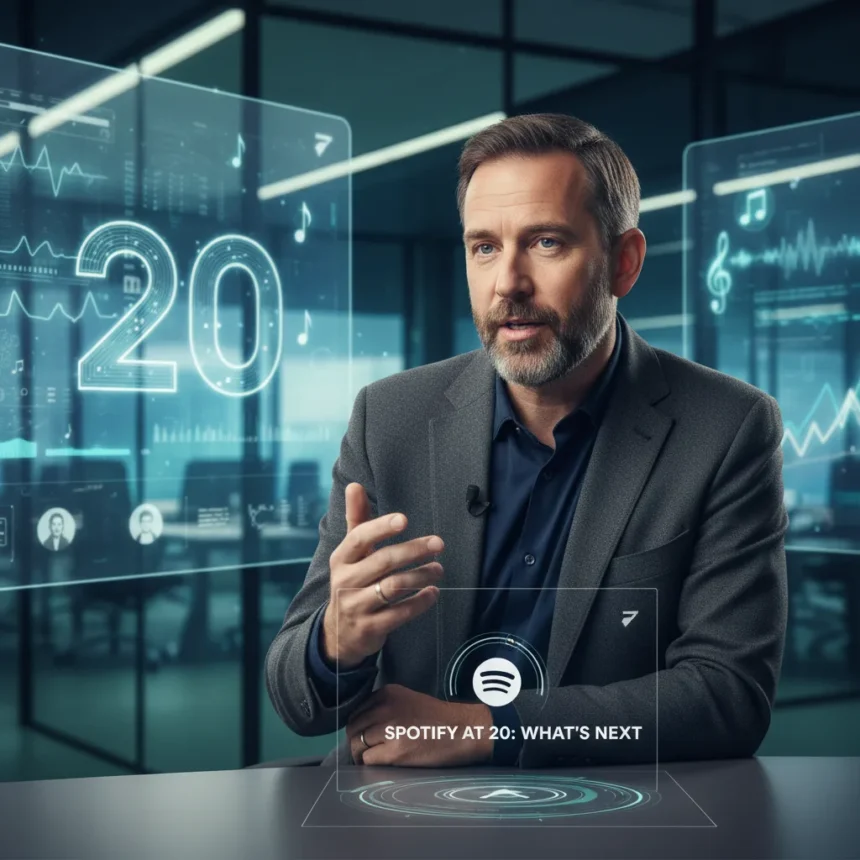
Music streaming innovation has reached a critical inflection point, and Spotify’s leadership is acutely aware of it. As the company marks its 20th anniversary in 2026, Head of Consumer Experience Sten Garmark argues that Spotify remains “by far the most ubiquitous experience for music”—a claim backed by the platform’s scale: 750 million global users, over 100 million tracks, 7 million podcast titles, and 500,000 audiobooks. But ubiquity alone no longer guarantees dominance in an era of AI-generated content, fragmenting formats, and rising artist pressure.
Key Takeaways
- Spotify paid out a record $11 billion in royalties in 2025, up sharply from prior years.
- In 2025, 13,800 artists earned at least $100,000 from Spotify alone, up 1,400 from the previous year.
- The 100,000th-highest-earning artist made over $7,300 in 2025 royalties versus ~$350 in 2015—a twentyfold increase.
- Daniel Ek stepped down as CEO in January 2026 to focus on strategy; day-to-day operations now run through Alex and Gustav.
- Spotify Lossless audio finally launched in September 2025 after a five-year wait since its 2021 promise.
Why Spotify’s Artist Economics Story Matters Now
Spotify’s claim to ubiquity rests partly on numbers that look impressive on a spreadsheet but tell a more nuanced story in practice. The platform paid out a record $11 billion in royalties to the music industry in 2025. For mid-tier and emerging artists, the shift has been dramatic. Over 13,800 artists generated at least $100,000 from Spotify in 2025, an increase of nearly 1,400 compared to 2024. More strikingly, the 100,000th-highest-earning artist on the platform earned over $7,300 in 2025 royalties—a twentyfold jump from approximately $350 in 2015.
This growth trajectory underscores a fundamental shift in how artists can sustain themselves through streaming. Yet the 2024 policy change that stopped paying artists with fewer than 1,000 streams remains controversial, signaling that Spotify’s generosity has limits. The company is essentially drawing a line: artists below a certain threshold do not register as economically viable on its platform, a move that triggered backlash from independent musicians and raised questions about whether Spotify’s ecosystem truly serves all creators or just those who already have momentum.
The Leadership Transition and Strategic Refocus
In January 2026, Daniel Ek—Spotify’s founder and long-time CEO—stepped down from day-to-day leadership to become executive chairman, handing operational control to Alex and Gustav, two executives who have shaped the company since its earliest days. Ek’s transition reflects a broader pattern in tech: founders stepping back to focus on long-term vision rather than quarterly execution. His statement was direct: “Over the last few years, I’ve turned over a large part of the day-to-day management and strategic direction of Spotify to Alex and Gustav—who have shaped the company from our earliest days and are now more than ready to guide our next phase”.



This shift matters because it signals where Spotify sees its challenges. The company became profitable in 2024, a milestone that took longer than rivals expected. Now, with profitability secured, the focus pivots to growth vectors beyond music—podcasts, audiobooks, and the unspecified “new formats” Garmark hints at in the interview title. The leadership change positions Ek to champion these expansions without the friction of quarterly earnings pressures, while his successors manage the core streaming business and artist relationships.
Lossless Audio: Late, but Finally Here
Spotify Lossless launched in September 2025—more than four years after the company first promised it in 2021. The delay is telling. Apple Music had already rolled out Hi-Fi lossless audio, giving Apple a narrative advantage in the premium audio space. Spotify’s tardiness meant ceding the “audiophile-friendly” positioning to a competitor, even though the company’s installed base dwarfs Apple’s music subscriber count.



The launch of Spotify Lossless, paired with a new feature called Listening Lounge, attempts to reclaim ground in high-fidelity audio. But the recovery strategy exposes a weakness: Spotify excels at algorithmic discovery, social features, and sheer scale, not at premium audio positioning. Competitors like Apple and Tidal have long positioned themselves as superior on sound quality. Spotify’s strength lies elsewhere—in Wrapped, its annual personalized listening recap that has become a cultural phenomenon, and in features like Daylists, Prompted Playlists, and Release Radar that other platforms have attempted to copy but failed to match.
The AI Music Threat and Spotify’s Response
The interview title mentions Spotify’s plans to “combat AI music,” yet the research available provides no specifics on what those plans entail. This gap is significant. The music industry is flooded with AI-generated tracks, and streaming platforms face a legitimacy crisis: if anyone can generate a song in seconds and upload it to Spotify, does the platform’s curation and discovery engine lose credibility? Does artist compensation become meaningless if the barrier to entry collapses?
Garmark’s framing—that Spotify is “by far the most ubiquitous experience for music”—suggests the company’s defense against AI music is not technical gatekeeping but ecosystem dominance. In other words, Spotify will compete not by blocking AI-generated music but by ensuring that human artists, curators, and playlists remain the primary discovery path. This is a bet that listeners still prefer human curation and artist narratives over algorithmic generation, even if both are technically possible.
What’s Next: Formats Beyond Music
The company’s expansion into podcasts and audiobooks signals a strategic pivot away from music-only positioning. With over 7 million podcast titles and 500,000 audiobooks now on the platform, Spotify is building a broader audio ecosystem. Garmark’s mention of plans to expand to “new formats” suggests the company is exploring spaces beyond music, podcasts, and audiobooks—though without specifics, it remains speculative.



This diversification is essential. Music streaming has matured; growth now comes from adjacent audio categories and international expansion. Spotify’s 20-year anniversary is not a victory lap—it is a reset point. The company is profitable, its artist economics have improved measurably, and its leadership has been restructured to pursue growth beyond the core business. Whether Spotify can execute on these ambitions while managing the twin pressures of artist relations and AI-generated content remains the central question.
How has artist earnings on Spotify changed since 2015?
Artist earnings on Spotify have increased dramatically over the past decade. The 100,000th-highest-earning artist earned over $7,300 in 2025 royalties compared to approximately $350 in 2015—a twentyfold increase. In 2025 alone, 13,800 artists earned at least $100,000 from the platform, up 1,400 from the prior year.
Why did Spotify delay Lossless audio for so long?
Spotify promised Lossless audio in 2021 but did not launch it until September 2025. The delay is not fully explained in available statements, but it reflects the company’s prioritization of algorithmic features and social discovery over premium audio quality—areas where Spotify leads competitors. Apple Music launched Hi-Fi lossless earlier, gaining a narrative advantage in that space.
What is Spotify’s strategy against AI-generated music?
The interview mentions Spotify’s plans to combat AI music, but specific strategies are not detailed in available sources. The company’s approach appears to rely on its ecosystem dominance—ensuring that human artists, curators, and playlists remain the primary discovery path rather than implementing technical gatekeeping against AI-generated tracks.
Spotify’s 20-year milestone marks a company in transition: from a pure-play music streamer to a diversified audio platform, from founder-led to professionally managed, and from growth-at-all-costs to profitable expansion. Whether Garmark and the leadership team can navigate AI disruption, format fragmentation, and artist pressure while maintaining ubiquity will define the next chapter.
Edited by the All Things Geek team.
Source: TechRadar