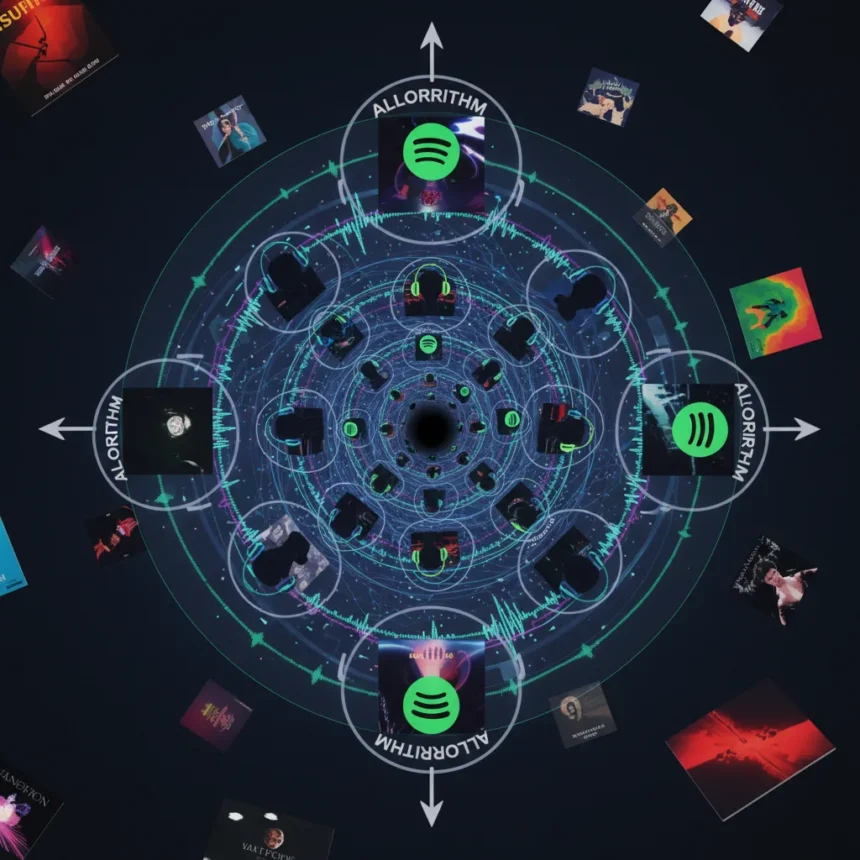
Spotify’s AI echo chamber problem represents one of the streaming era’s most pressing contradictions: the more personalized your recommendations become, the narrower your musical world grows. Spotify uses AI-powered recommendation systems that analyze listening habits, skips, saves, and user activity to curate personalized playlists like Discover Weekly and Wrapped, but this very personalization may be trapping listeners inside feedback loops that reinforce existing tastes rather than expanding them.
Key Takeaways
- Spotify’s AI uses content-based and collaborative filtering to match songs to user preferences and group similar listeners into taste clusters.
- Feedback loops reinforce existing preferences, narrowing suggestions into filter bubbles that limit exposure to diverse music.
- The Wrapped feature has faced backlash for highlighting familiar routines over genuine musical discovery.
- Spotify’s recommendation algorithm remains a “black box” with operations kept secret from the public.
- Apple Music emphasizes human curation as a potential alternative to AI-driven standardization.
How Spotify’s AI creates musical echo chambers
The mechanics of Spotify’s recommendation engine sound sophisticated but operate toward a counterintuitive outcome: the more data Spotify collects about what you listen to, the less likely you are to discover something genuinely new. Spotify’s algorithms analyze content characteristics, match song attributes to user preferences, and use collaborative filtering to group listeners with similar taste profiles into clusters. The system adapts to mood, activity, and environment—even tracking milliseconds of skip time to build psychological profiles and suggest music that fits those patterns.
This creates a self-reinforcing cycle. You listen to a recommendation, Spotify interprets that as confirmation of your preference, and the next batch of suggestions narrows further into the same lane. Over time, your Discover Weekly playlist stops discovering anything. Instead, it becomes a mirror reflecting your existing taste back at you, slightly remixed. The algorithmic feedback loop transforms what should be a discovery engine into a preference amplifier.
Why Spotify’s Wrapped reinforces the problem
Spotify’s annual Wrapped feature, celebrated by millions as a year-end ritual, actually exemplifies the echo chamber problem rather than solving it. Wrapped highlights your most-played artists, top genres, and familiar listening routines—essentially congratulating you for staying inside your own taste bubble. The feature has faced backlash for reinforcing echo chambers by celebrating consumption patterns rather than encouraging exploration beyond them.



The irony cuts deep. Wrapped is Spotify’s most engaging product, the moment when users feel most connected to the platform. Yet it simultaneously locks them further into algorithmic predictions based on what they already know they like. A genuinely discovery-focused feature would highlight the most unexpected artists you actually finished listening to, the genre-crossing moments that broke your patterns. Instead, Wrapped celebrates the patterns themselves.
The black box problem behind Spotify’s AI
Spotify’s recommendation algorithm remains deliberately opaque. The exact inputs, weighting mechanisms, and decision trees that determine what lands in your feed are kept secret, classified as proprietary business logic. This opacity creates a trust deficit. Users cannot understand why they are trapped in narrow recommendations, and Spotify has no incentive to explain the mechanics of its own lock-in.



This secrecy matters because it prevents independent scrutiny. If Spotify’s algorithm truly expanded musical horizons, the company would benefit from transparency. Instead, the black box design suggests the opposite: Spotify knows its recommendations narrow taste, and the company prioritizes engagement and retention over genuine discovery. A listener who explores widely might churn. A listener locked in an echo chamber stays subscribed.
Apple Music’s human-curation alternative
Not all streaming services embrace pure algorithmic personalization. Apple Music emphasizes human curation over AI-driven recommendations, potentially offering more diverse playlists and broader exposure to artists outside listener comfort zones. Human curators can make unexpected connections, champion emerging artists, and break patterns in ways algorithmic systems optimized for engagement cannot.
The contrast highlights a fundamental choice in streaming design: optimize for what users already like, or push them toward what they might discover? Spotify chose the former. The platform’s business model rewards engagement metrics—time spent, skips avoided, playlist completion rates. An algorithm that broadens taste risks lower engagement in the short term. Human curation accepts that trade-off as a feature, not a bug.
Can Spotify’s AI echo chamber be fixed?
Fixing Spotify’s echo chamber problem would require the platform to deliberately reduce engagement in service of discovery—a structural contradiction for a publicly traded company optimizing for subscriber growth and listening minutes. Spotify could inject more randomness into recommendations, prioritize unfamiliar artists, or surface music that contradicts listener profiles. None of these moves would improve engagement metrics.



The echo chamber is not a bug in Spotify’s algorithm. It is the algorithm working exactly as designed: keeping listeners satisfied with incremental variations on their existing taste, reducing churn, and maximizing time on platform. Until Spotify faces competitive or regulatory pressure to prioritize discovery over retention, the feedback loops will only tighten.
Does Spotify Wrapped actually help you discover new music?
No. Wrapped celebrates your listening habits rather than challenging them. It highlights artists you already know and genres you already favor, reinforcing the echo chamber rather than breaking it. A truly discovery-focused feature would surface unexpected artists you completed songs from or genres outside your typical rotation.
How does Spotify’s algorithm decide what to recommend?
Spotify uses content-based filtering to match song characteristics to your preferences and collaborative filtering to group you with listeners who have similar taste profiles. The system also tracks skip behavior, mood context, and activity type to refine suggestions. However, the exact weighting and decision logic remain proprietary and opaque.
Is Apple Music better than Spotify for music discovery?
Apple Music prioritizes human curation over pure algorithmic personalization, which can expose listeners to more diverse music and emerging artists. However, whether it is “better” depends on whether you value human editorial judgment or algorithmic precision. Both approaches have trade-offs in terms of discovery breadth versus personalization accuracy.
The Spotify AI echo chamber problem is not unsolvable—it reflects deliberate design choices optimized for engagement over exploration. Until listeners demand better, or competitors prove that discovery-first algorithms can sustain profitable streaming services, expect your Discover Weekly to keep sounding exactly like last week. The algorithm knows what you like. That is precisely the problem.
Edited by the All Things Geek team.
Source: What Hi-Fi?