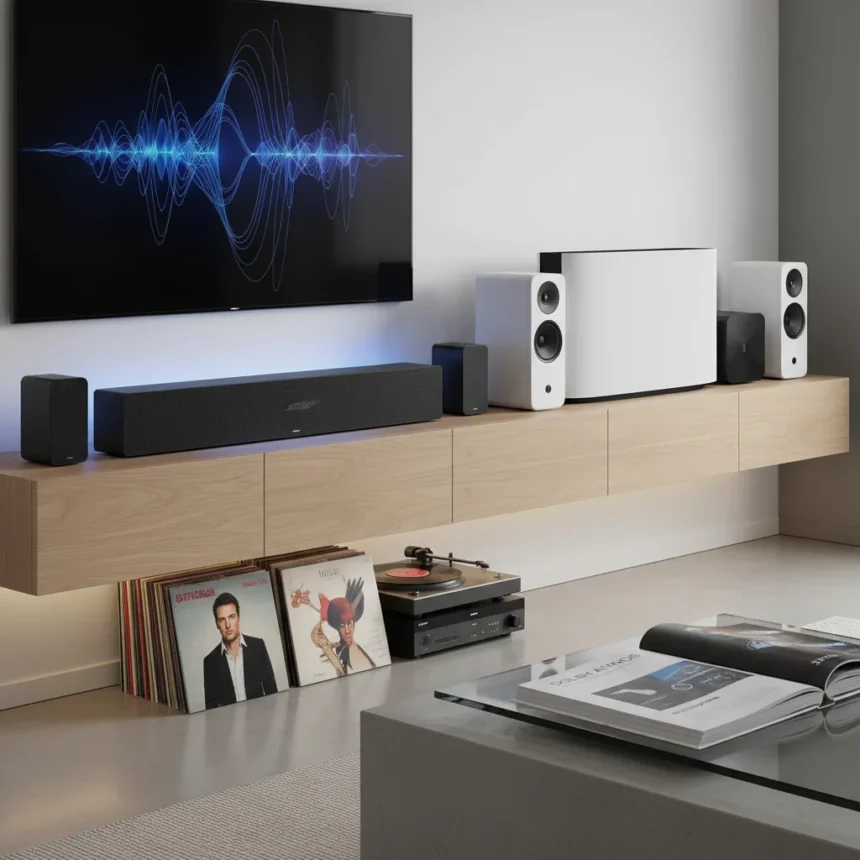
Wireless soundbar systems are experiencing a resurgence in 2025, with manufacturers treating them as the foundation for modern home cinema rather than a temporary trend. Bose has entered this competitive space with new offerings designed to challenge Sonos’s market dominance, signaling that wireless soundbar systems have moved beyond niche appeal into mainstream home entertainment.
Key Takeaways
- Wireless soundbar systems are no longer viewed as a passing trend but as a permanent shift in home audio architecture
- Bose launched new wireless soundbar products to compete directly with Sonos’s established lineup
- Dolby Atmos adoption in soundbars is expected to accelerate throughout 2025 and into 2026
- High-end vinyl experiences and immersive audio formats are driving consumer interest in premium home audio
- The market debate centers on whether Dolby Atmos implementation in soundbars delivers genuine immersive value
Why wireless soundbar systems are reshaping home cinema
Wireless soundbar systems represent a fundamental rethinking of how consumers approach home theater. Unlike traditional wired setups that demand complex installation and cable management, wireless soundbar systems offer flexibility, scalability, and ease of deployment. This shift has attracted both budget-conscious buyers and premium audio enthusiasts, creating a market segment that did not exist in its current form five years ago. The appeal lies not in novelty but in practical advantages: a soundbar can be installed in minutes, repositioned without rewiring, and expanded with additional speakers through wireless connectivity.
The question facing the industry is whether wireless soundbar systems represent genuine innovation or merely repackage older wireless speaker concepts under a new marketing umbrella. Skeptics note that wireless multi-speaker systems have existed for decades, but the current generation distinguishes itself through tighter integration with streaming services, smarter room calibration, and support for immersive audio formats. Bose’s entry into this space with dedicated wireless soundbar products validates the market’s maturity and signals that wireless soundbar systems are no longer experimental.
Bose takes on Sonos with new wireless soundbar competition
Bose has launched new wireless soundbar products designed to directly compete with Sonos, one of the market’s dominant players. This competitive pressure is reshaping how manufacturers approach wireless soundbar systems, forcing innovation in audio quality, ecosystem integration, and pricing strategy. Sonos, which pioneered consumer-friendly wireless audio through its Zone Players and later the Playbar, now faces competition from a brand with deep expertise in acoustic engineering and premium audio positioning.



The rivalry between Bose and Sonos extends beyond hardware specifications. Both companies are betting that wireless soundbar systems will become the centerpiece of home entertainment ecosystems, with expandable satellite speakers, subwoofers, and integration with voice assistants. However, user experiences vary significantly. Some consumers who switched from older Sonos hardware to newer models report dissatisfaction, suggesting that wireless soundbar systems still have adoption friction despite their theoretical advantages. This reality check matters: wireless soundbar systems only succeed if they deliver better sound and simpler operation than what they replace.
Dolby Atmos adoption accelerates in wireless soundbars
Dolby Atmos support is becoming standard in premium wireless soundbar systems, with industry expectations pointing toward significant adoption growth through 2026. This immersive audio format creates height channels that place sound above the listener, enhancing spatial realism in film and music. However, the implementation of Dolby Atmos in wireless soundbar systems remains contentious. Some audio professionals argue that true Atmos requires ceiling-mounted speakers or sophisticated upfiring techniques, making soundbar-only implementations a compromise.



The practical question facing consumers is whether Dolby Atmos in wireless soundbar systems justifies the premium pricing. Manufacturers claim that advanced processing and multiple drivers can simulate height channels convincingly, but critical listening reveals limitations compared to full surround setups. This debate will likely intensify as wireless soundbar systems become more sophisticated, forcing consumers to weigh marketing claims against real-world listening experiences.
Immersive experiences beyond traditional audio
Beyond soundbars, the audio industry is exploring immersive experiences that extend into visual and conceptual territory. A 360-degree David Bowie experience demonstrates how wireless soundbar systems and premium audio can anchor multisensory installations. High-end hi-fi launches continue to emphasize vinyl and analog playback, reflecting consumer appetite for tactile, ritualistic engagement with music. These trends suggest that wireless soundbar systems occupy one end of a spectrum that includes everything from convenience-focused wireless solutions to obsessive audiophile setups.
The vinyl resurgence is particularly instructive. While wireless soundbar systems prioritize convenience and connectivity, vinyl enthusiasts invest in turntables, preamps, and speakers specifically to recover analog warmth and detail. This polarity reveals a fundamental truth about audio: consumers do not all want the same thing. Wireless soundbar systems serve those prioritizing simplicity and integration, while high-end hi-fi serves those willing to trade convenience for perceived sonic superiority. Both markets are healthy and growing, suggesting that the audio industry has fragmented into distinct consumer tribes rather than converging on a single ideal.
What makes wireless soundbar systems different from traditional home theater?
Wireless soundbar systems eliminate the need for speaker wire runs, wall-mounted surrounds, and complex AV receivers, replacing them with Wi-Fi or Bluetooth connectivity and integrated amplification. This simplicity appeals to renters, apartment dwellers, and anyone unwilling to commit to permanent installation. Traditional home theater demands infrastructure investment and planning; wireless soundbar systems prioritize plug-and-play convenience.



Should you buy a Dolby Atmos soundbar or wait for better implementations?
If you value immersive audio and have ceiling height and space for proper speaker placement, a full surround setup with dedicated height channels remains superior to Atmos soundbars. However, if space, budget, or installation constraints are limiting factors, current Dolby Atmos soundbars deliver noticeable improvements over standard stereo soundbars, even if they fall short of true Atmos theater experiences.
Are wireless soundbar systems just a rehash of older wireless speaker trends?
While wireless multi-speaker systems have existed for years, modern wireless soundbar systems integrate more tightly with streaming services, offer superior room calibration, and support immersive formats that earlier wireless speakers could not deliver. The core innovation is not wireless connectivity itself but the sophistication of how that connectivity is implemented and managed.
Wireless soundbar systems have moved from novelty to necessity in the home audio market. Bose’s competitive entry, Dolby Atmos acceleration, and continued vinyl enthusiasm all point to an industry fragmenting into distinct consumer segments rather than consolidating around a single standard. For manufacturers, this means opportunity; for consumers, it means choice but also confusion. The next two years will determine whether wireless soundbar systems become the default home cinema solution or remain one option among many.
Edited by the All Things Geek team.
Source: What Hi-Fi?