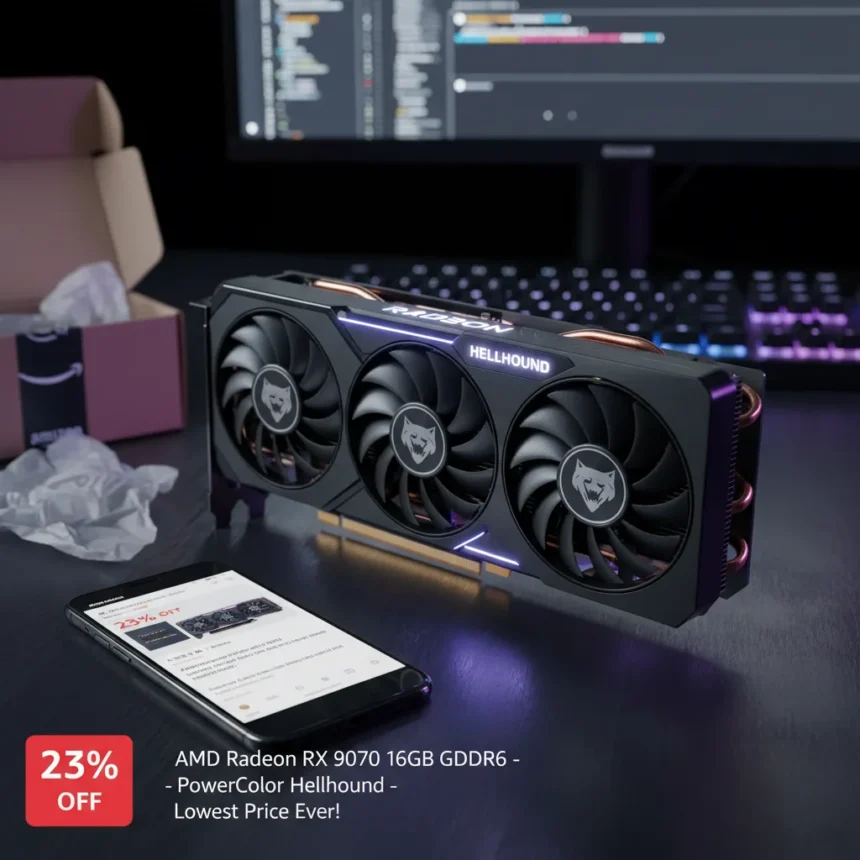
The AMD Radeon RX 9070 with 16GB of VRAM has reached an all-time low price on Amazon, making this RDNA 4 graphics card a compelling option for budget-conscious gamers and creators. The PowerColor Hellhound variant specifically is discounted 23% off its $549 MSRP, delivering genuine value in a competitive GPU market where performance-per-dollar matters.
Key Takeaways
- AMD Radeon RX 9070 standard model features 56 compute units, 3,584 shaders, and 16GB GDDR6 memory at $549 MSRP
- PowerColor Hellhound variant achieves all-time low pricing with 23% discount from list price
- Outperforms Nvidia RTX 5070 in rasterization by 8% while costing less than RTX 5070 Ti
- Second best-selling GPU on Amazon; top seller in Germany and UK markets
- Targets 1440p gaming with 4K upscaling capability using AMD FSR technology
Why the AMD Radeon RX 9070 Matters Right Now
The AMD Radeon RX 9070 represents a significant shift in GPU value. At its original $549 price point, it already undercut Nvidia’s premium positioning. This latest discount makes it an even harder choice to ignore for anyone building or upgrading a mid-range gaming PC. The standard RX 9070 (non-XT) delivers solid performance without the premium tag attached to higher-tier models, and the PowerColor variant’s aggressive pricing suggests retailers are confident in inventory and demand.
What makes this timing notable is the AMD Radeon RX 9070’s rapid adoption across major markets. The card is already tracking as the second best-selling GPU on Amazon globally, and has claimed the top spot in Amazon Germany and Amazon UK. That kind of market traction validates the hardware’s appeal while also suggesting competitive pressure from Nvidia may be driving these discounts deeper.
AMD Radeon RX 9070 vs. Nvidia’s Competing Cards
The AMD Radeon RX 9070 occupies an interesting position in Nvidia’s lineup. According to Tom’s Hardware testing, it outperforms the RTX 5070 in rasterization performance by approximately 8%, which matters for traditional gaming workloads. However, the RTX 5070 Ti pulls ahead in ray-traced scenarios and benefits from DLSS 4 integration, which Nvidia continues to optimize across its ecosystem.


For buyers prioritizing pure rasterization performance and willing to accept AMD’s FSR upscaling technology, the AMD Radeon RX 9070 delivers better frame rates at lower cost. The gap narrows when ray tracing enters the equation, but the price difference—roughly $50 cheaper than the RTX 5070 Ti—may offset that performance delta for budget-conscious shoppers. The real competition isn’t between these cards in isolation; it’s whether you value raw rasterization speed (AMD wins) or ray-tracing fidelity and AI integration (Nvidia’s domain).
What You Get with the AMD Radeon RX 9070
The AMD Radeon RX 9070 packs 16GB of GDDR6 memory across a 256-bit interface, with 56 compute units delivering 3,584 stream processors and a boost clock of 2.97 GHz. Built on TSMC’s N4P process, the chip achieves solid efficiency for its performance tier. The card handles 1440p gaming comfortably at high settings with ray tracing enabled, and scales to 4K with upscaling technology like AMD FSR.



The PowerColor Hellhound variant specifically adds custom cooling and power delivery on top of AMD’s reference design. This isn’t a stripped-down SKU—it’s a full-featured implementation with the same core specifications as other AIB partners’ models. At 23% off MSRP, you’re getting the same silicon with a partner’s thermal and acoustic tuning at a significant discount.
Competitive Alternatives Worth Considering
The AMD Radeon RX 9070 XT sits just $50 higher at $599 MSRP, adding 8 additional compute units (64 total) for those who want more headroom. For previous-generation shoppers, AMD’s own RX 7900 XT and XTX remain available at clearance pricing in some regions, though they lack the efficiency and architectural improvements of RDNA 4. If you’re open to Nvidia, the RTX 5070 offers competitive rasterization with stronger ray-tracing performance, while the RTX 5070 Ti commands a higher price for ray-traced dominance.
Is the AMD Radeon RX 9070 worth buying at this price?
Yes, if you’re targeting 1440p gaming or 4K with upscaling. The 23% discount on the PowerColor Hellhound variant brings the AMD Radeon RX 9070 into territory where it’s difficult to find better performance-per-dollar. You sacrifice ray-tracing leadership and DLSS 4 access compared to Nvidia, but gain rasterization performance and a lower entry price.
How does the AMD Radeon RX 9070 compare to last-gen AMD cards?
The AMD Radeon RX 9070 uses RDNA 4 architecture with significant efficiency improvements over the RX 7900 XT’s RDNA 3 design. You get more compute units, newer process technology (N4P), and better power efficiency—all of which translate to faster performance at lower power draw. The jump from RX 7900 XT to RX 9070 is meaningful for anyone running older hardware.



Should I wait for further price drops on the AMD Radeon RX 9070?
The AMD Radeon RX 9070 is already at all-time low pricing, which suggests we’re near the floor for this generation. Further meaningful discounts are unlikely unless market conditions shift dramatically. If you need a GPU now and plan to keep it for 3-4 years, the current price makes sense. If you can wait and don’t mind potential scarcity, holding out for seasonal sales might yield another 5-10% off, but that’s speculative.
The AMD Radeon RX 9070 at 23% off MSRP represents genuine value in today’s GPU market. It’s a card built for 1440p dominance and 4K ambition without the premium positioning of Nvidia’s Ti-series models. If rasterization performance and price matter more to you than ray-tracing perfection, this discount window is worth acting on.
Where to Buy
AMD's RX 9070 for just $554 on Amazon | PowerColor Hellhound RX 9070 :
Edited by the All Things Geek team.
Source: Tom's Hardware