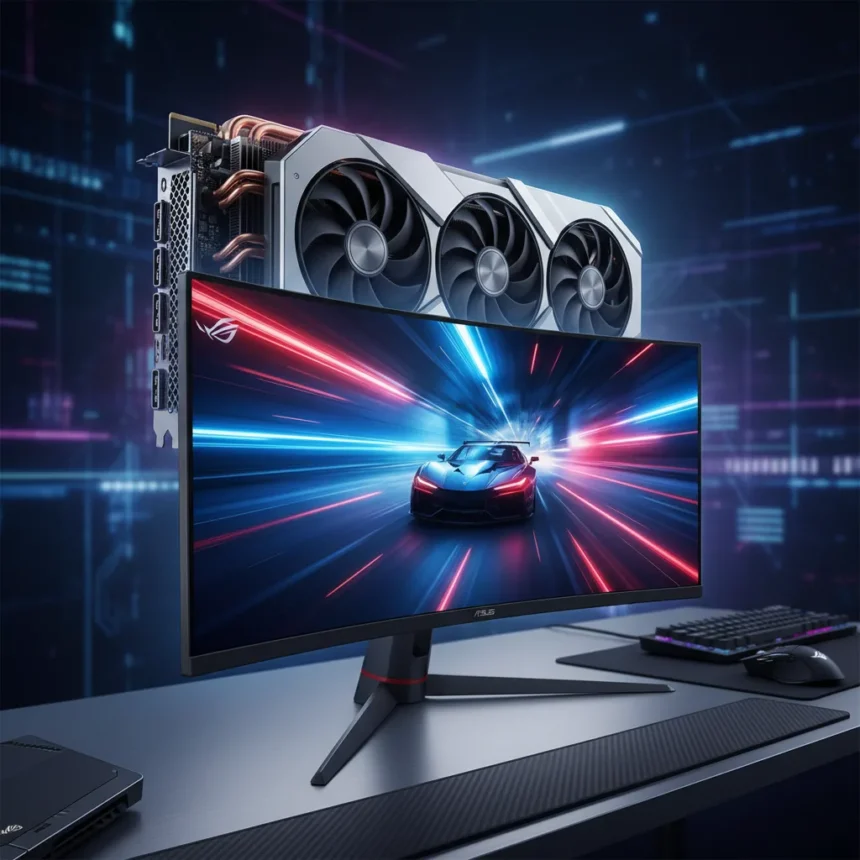
The Asus ROG Swift PG34WCDN is a 34-inch curved ultrawide QD-OLED gaming monitor with a 360 Hz refresh rate, representing Asus’s shift to Quantum Dot OLED technology in its flagship ROG Swift lineup. It delivers the fastest refresh rate available in the WQHD ultrawide segment, but the real question is whether your GPU can actually feed it frames fast enough to matter.
Key Takeaways
- First ROG Swift ultrawide to use 5th Gen QD-OLED with RGB-stripe pixel layout instead of WOLED
- 360 Hz refresh rate is the highest available for 34-inch WQHD ultrawides
- Requires high-end GPU to reach full frame rates in demanding titles
- New BlackShield Film and QD-OLED tech promise improved brightness over prior 240 Hz models
- Input lag remains extremely low, ideal for competitive fast-paced gaming
What Makes the Asus ROG Swift PG34WCDN Different
The Asus ROG Swift PG34WCDN abandons the WOLED panel technology of its predecessor, the PG34WCDM, in favor of 5th Gen QD-OLED with a true RGB-stripe pixel layout and a new BlackShield Film. This architectural shift allows Asus to push the refresh rate from 240 Hz to 360 Hz—a generational leap that sounds impressive until you realize what it demands from your system. The 34-inch curved screen maintains the familiar 21:9 aspect ratio and 800R curvature, with native resolution locked at 3440 x 1440 (WQHD). The panel supports AMD FreeSync Premium Pro, NVIDIA G-Sync Compatible, and Adaptive-Sync for variable refresh rate gaming.
The shift to QD-OLED technology is significant. Quantum Dot enhancement promises better brightness than traditional WOLED, addressing one of OLED’s historical weaknesses in gaming monitors. The PG34WCDM, its direct predecessor, peaked at 1300 nits in small windows, and the new QD-OLED generation should push that ceiling higher. The new BlackShield Film is designed to reduce reflections and improve contrast, a welcome addition for ultrawide screens that can struggle with ambient light across their expansive surface.
The 360 Hz Problem: GPU Reality Check
Here’s where the Asus ROG Swift PG34WCDN reveals its true nature: it’s a monitor built for systems that don’t exist yet. Hitting 360 Hz at 3440 x 1440 requires GPU horsepower that only the absolute flagship cards can deliver, and even then, only in less demanding titles. An RTX 4090 will struggle to maintain 360 fps in AAA games at native resolution with high settings. Competitive shooters and esports titles benefit most from the higher refresh rate, but casual gamers and those playing story-driven games will spend most of their time well below 360 fps, making the higher refresh rate feel more like a spec sheet than a practical feature.


This is not a flaw unique to Asus—it’s an industry problem. Ultrawide gaming at extreme frame rates is a niche pursuit. The monitor excels at variable refresh rate gaming, where Adaptive-Sync keeps the image smooth even when frame rates fluctuate. For esports players running competitive titles like Counter-Strike or Valorant, the 360 Hz ceiling provides headroom and ultra-low input lag. For everyone else, the practical benefit over a 240 Hz ultrawide is marginal.
Speed Meets Brightness in QD-OLED Form
The real achievement of the Asus ROG Swift PG34WCDN lies in combining two qualities that OLED panels historically struggle to balance: speed and brightness. OLED’s response times are near-instantaneous, eliminating ghosting and motion blur entirely. QD-OLED’s brightness advantage over traditional WOLED means the PG34WCDN can deliver those fast response times without sacrificing the luminosity needed for HDR gaming. The monitor carries an HDR500 certification, indicating VESA DisplayHDR support at that level.



Input lag remains extremely low, making the monitor well-suited to fast-paced competitive gaming where every millisecond counts. The benefits in frame rate support and overall end-to-end system latency from the higher refresh rate are real, but they’re only felt by players pushing toward 360 fps consistently. For the majority of gamers, the jump from a 240 Hz ultrawide to this 360 Hz panel is a luxury upgrade, not a necessity.
How It Compares to the PG34WCDM
The Asus ROG Swift PG34WCDM, the predecessor model, offered 240 Hz on a WOLED panel with a $1,299 USD price point. It remains an excellent monitor for ultrawide gaming, delivering smooth visuals and competitive input lag without demanding as much GPU power. The choice between the two comes down to budget and frame rate ambition. The PG34WCDM is the smarter buy for most gamers; the PG34WCDN is for those who already own flagship GPUs and want to squeeze every possible frame from their system.
The shift from WOLED to QD-OLED is meaningful for brightness and color vibrancy, but the practical gaming experience at typical frame rates feels incremental rather than transformative. The 360 Hz refresh rate is the headline feature, but it’s also the feature most gamers will rarely fully utilize.
Burn-In and OLED Trade-Offs Remain
The Asus ROG Swift PG34WCDN inherits the classic OLED risk: permanent burn-in with static UI elements. Gaming HUDs, taskbars, and static menu overlays can leave ghosted images on the screen after extended exposure. This is not unique to this monitor, but it’s a real consideration for always-on gaming setups. Asus’s BlackShield Film may help mitigate some risks, but it does not eliminate the fundamental vulnerability of OLED technology to static content.



VRR flicker is another potential issue when frame rates drop and fluctuate rapidly. In variable refresh rate scenarios, some users report visible flickering. With Adaptive-Sync enabled, this is less of a problem, but it’s worth testing in your specific setup before committing to the purchase.
Is the 360 Hz Worth It?
The Asus ROG Swift PG34WCDN is a technically impressive monitor that pushes the boundaries of what’s possible in ultrawide gaming displays. But impressive specs and practical value are not the same thing. If you own an RTX 4090 or equivalent, play competitive esports titles, and have the budget for a premium ultrawide, this monitor deserves consideration. If you’re playing AAA games, streaming, or using the monitor for productivity alongside gaming, a 240 Hz ultrawide delivers 95% of the experience at a lower cost and lower GPU demand.
Can the Asus ROG Swift PG34WCDN reach 360 fps in AAA games?
Not consistently. Even flagship GPUs struggle to maintain 360 fps at 3440 x 1440 with high settings in demanding titles. Competitive esports games with lower graphical complexity are where the 360 Hz refresh rate becomes practical.
What is QD-OLED and why does it matter?
QD-OLED combines Quantum Dot technology with OLED’s fast response times, delivering both brightness and speed. The Asus ROG Swift PG34WCDN uses 5th Gen QD-OLED with an RGB-stripe pixel layout, improving color accuracy and brightness compared to traditional WOLED panels.
Is the Asus ROG Swift PG34WCDN better than the PG34WCDM?
It depends on your needs. The PG34WCDN offers 360 Hz and QD-OLED brightness, while the PG34WCDM costs less and demands less from your GPU. For most gamers, the PG34WCDM remains the smarter choice unless you’re specifically chasing the highest possible frame rates.
The Asus ROG Swift PG34WCDN represents the cutting edge of ultrawide gaming monitors, but cutting edge does not always mean practical. It’s a monitor for the GPU-rich minority willing to pay for frame rate headroom they may never fully use. For everyone else, a 240 Hz ultrawide remains the sensible ultrawide gaming choice.
Where to Buy
Edited by the All Things Geek team.
Source: Tom's Hardware