





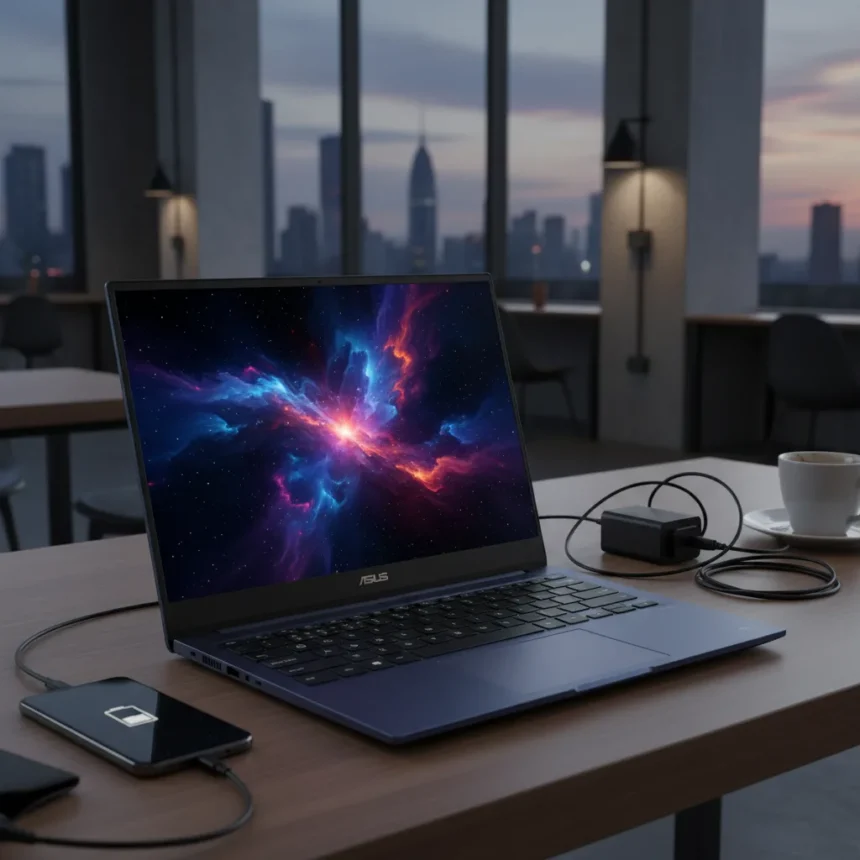
The ASUS ZenBook S14 2026 is a Windows ultrabook that pairs a stunning OLED display with 16GB of RAM and a 512GB SSD, launching in 2026 as part of ASUS’s refreshed ZenBook lineup. It is designed for creators and professionals who prioritize screen quality over all-day battery endurance. The trade-off is immediate: you get a display that genuinely impresses, but you sacrifice the kind of battery life that lets you work through an entire day without seeking a charger.
Key Takeaways
- ASUS ZenBook S14 2026 features a 14-inch FHD OLED touch screen with exceptional color accuracy and brightness
- 16GB RAM and 512GB SSD configuration handles multitasking and creative work smoothly
- Moderate battery life means regular charging required for all-day mobile work
- Intel Core Ultra processor delivers solid performance for everyday and creative tasks
- Premium build quality and display excellence justify the trade-off for screen-focused users
OLED Display Sets This Laptop Apart
The ASUS ZenBook S14 2026’s defining feature is its 14-inch FHD OLED touch screen. OLED technology delivers infinite contrast ratios, pixel-perfect blacks, and color reproduction that LCD panels cannot match. For photo editors, video creators, and designers, this screen alone justifies consideration. The touch functionality adds practical value for creative workflows, though it makes the display a fingerprint magnet.
ASUS’s 2026 refresh prioritizes display quality over battery capacity, a deliberate choice that separates this laptop from competitors like Dell’s XPS 13 or Lenovo‘s ThinkPad X1 Carbon, which lean toward longer battery life with traditional LCD screens. If your work lives on screen—color grading, image editing, design—the OLED advantage is real and measurable. If you spend half your day in spreadsheets and email, you are paying for performance you do not need.
Performance and Configuration: Solid But Not Exceptional
The ASUS ZenBook S14 2026 ships with an Intel Core Ultra processor, 16GB of RAM, and a 512GB SSD. This configuration handles multitasking, light video editing, and creative software without strain. The 16GB RAM ceiling is adequate for most workflows but feels modest compared to competitors offering 32GB as standard. The 512GB SSD is enough for an OS and working files, but creative professionals often need external storage or rapid upgrades.


The processor choice reflects ASUS’s positioning: this is not a gaming machine or a workstation replacement. It is a creator-focused ultrabook where the screen matters more than raw CPU performance. Benchmark comparisons with competing ultrabooks show the ZenBook S14 2026 performing competently within its class, but not dominantly. The real strength lies in the integrated package—display quality, build materials, and keyboard comfort—rather than any single performance metric.
Battery Life: The Real Compromise
Here is where ASUS made its trade-off explicit. The ASUS ZenBook S14 2026 has moderate battery life, not the 12-16 hour endurance you might expect from an ultrabook. OLED displays, while efficient compared to older LCD technology, still demand more power than LED-backlit alternatives. Add Intel’s Core Ultra processor and the touch layer, and you are looking at a laptop that needs charging every 6-8 hours of mixed use.



This is not a dealbreaker if your workflow includes regular desk time or access to power outlets. It is a significant limitation if you travel frequently or work from cafes and libraries. The battery trade-off is the price of admission for that OLED screen. Competitors with LCD displays and larger batteries will last longer on a charge, but their screens will not match the ASUS’s visual quality.
Build Quality and Design
ASUS has maintained its reputation for premium materials in the ZenBook S14 2026. The chassis uses aluminum construction, and the keyboard is responsive and travel-friendly. The overall design is understated—no RGB lighting, no aggressive angles, just functional elegance. Ports include USB-C Thunderbolt connectivity, which is standard for modern ultrabooks, and the trackpad is spacious enough for comfortable navigation.
The laptop weighs under 1.5kg and measures around 15mm thick, making it genuinely portable despite the battery limitation. If you are moving between locations multiple times per week, the lightweight design is a practical advantage. The trade-off is that ASUS did not add a larger battery to compensate—weight and thinness took priority.
Should You Buy the ASUS ZenBook S14 2026?
Buy this laptop if you are a creator, designer, or content professional who values screen quality above all else and has regular access to power. The OLED display is the standout feature, and it justifies the purchase for anyone doing color-critical work. The 16GB RAM and 512GB SSD are sufficient for most creative tasks, though you may want to budget for an external SSD for large project files.



Skip it if you need all-day battery life without compromise. The moderate battery endurance is not a minor inconvenience—it is a design choice that shapes your entire workflow. If you travel constantly or refuse to carry a charger, a traditional ultrabook with an LCD screen and larger battery will serve you better. The ASUS ZenBook S14 2026 is a specialist tool, not a generalist solution.
How does the ASUS ZenBook S14 2026 compare to older ZenBook models?
The 2026 refresh prioritizes OLED display technology and modern Intel processors over the LCD screens and older-generation chips in previous ZenBook generations. The newer model offers superior color accuracy and touch responsiveness, but the battery life remains moderate—ASUS did not solve the power consumption challenge with this update.
Can you upgrade the RAM or SSD on the ASUS ZenBook S14 2026?
Upgradeability varies by specific configuration and region. Some ASUS ZenBook models allow SSD replacement, but RAM is often soldered to the motherboard. Check the specific unit’s specifications before purchase if upgrades are important to your workflow.
Is the ASUS ZenBook S14 2026 good for gaming?
No. The integrated Intel graphics are adequate for light gaming or video playback, but this laptop is not designed for gaming workloads. If gaming is a priority, consider a dedicated gaming ultrabook or a more powerful mobile workstation instead.
The ASUS ZenBook S14 2026 is a polarizing laptop—brilliant for screen-focused creatives, frustrating for anyone who needs all-day battery life. ASUS made a clear choice about what matters, and if that choice aligns with your priorities, you will love this machine. If battery endurance is non-negotiable, look elsewhere.
Edited by the All Things Geek team.
Source: Windows Central




